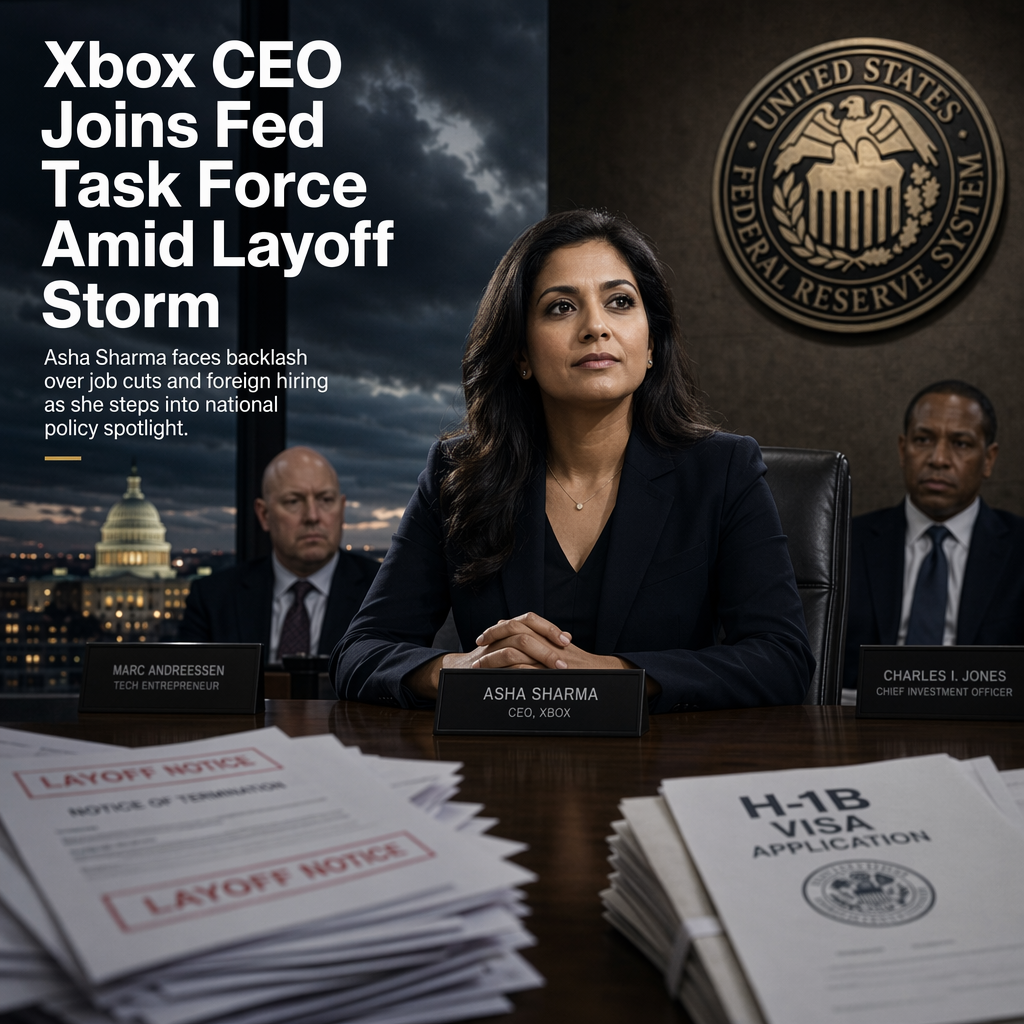
Asha Sharma, CEO of Microsoft's Xbox division, has been appointed to a newly created Federal Reserve task force on 'Productivity and Jobs,' despite facing significant criticism for her company's recent workforce decisions. Earlier this week, Sharma announced that Microsoft would lay off 4,800 employees, including 1,600 from the Xbox division, while the company had previously been approved to hire 2,273 foreign H-1B visa workers earlier this year, according to U.S. Citizen and Immigration Services data [1].
The Federal Reserve, under new Chairman Kevin Warsh, proceeded with Sharma's appointment at the height of the backlash. Sharma will serve alongside Marc Andreessen, co-founder of Andreessen Horowitz, and Stanford economics professor Charles I. Jones. Warsh emphasized the Fed's commitment to price stability and maximum employment, stating, 'Each task force will carefully consider whether policymakers' means and methods, analytical tools and policy approaches can be improved upon' [1].
The decision has sparked widespread criticism, with many accusing Sharma and Microsoft of replacing American workers with foreign labor. Critics have used strong language online, likening the appointment to 'asking El Chapo to lead the DEA' and suggesting the Federal Reserve is incentivizing mass layoffs of American workers in favor of foreign hires [1]. Some critics also questioned Sharma's qualifications, noting her lack of gaming, finance, or economic experience, and alleged a racial component to the hiring of H-1B workers, most of whom are from India [1].
In response to the controversy, Vice President JD Vance announced a large-scale investigation into H-1B visa fraud, stating that the Department of Labor has initiated dozens of subpoenas and investigations into alleged abuses of the visa program [1]. Xbox and the Federal Reserve did not respond to requests for comment [1].
CONCLUSION
The appointment of Asha Sharma to the Federal Reserve's task force has intensified scrutiny of Microsoft's labor practices and the broader use of H-1B visas. The controversy has triggered a federal investigation and raised questions about the Fed's approach to employment policy, signaling potential market and regulatory impacts for Microsoft and related sectors.