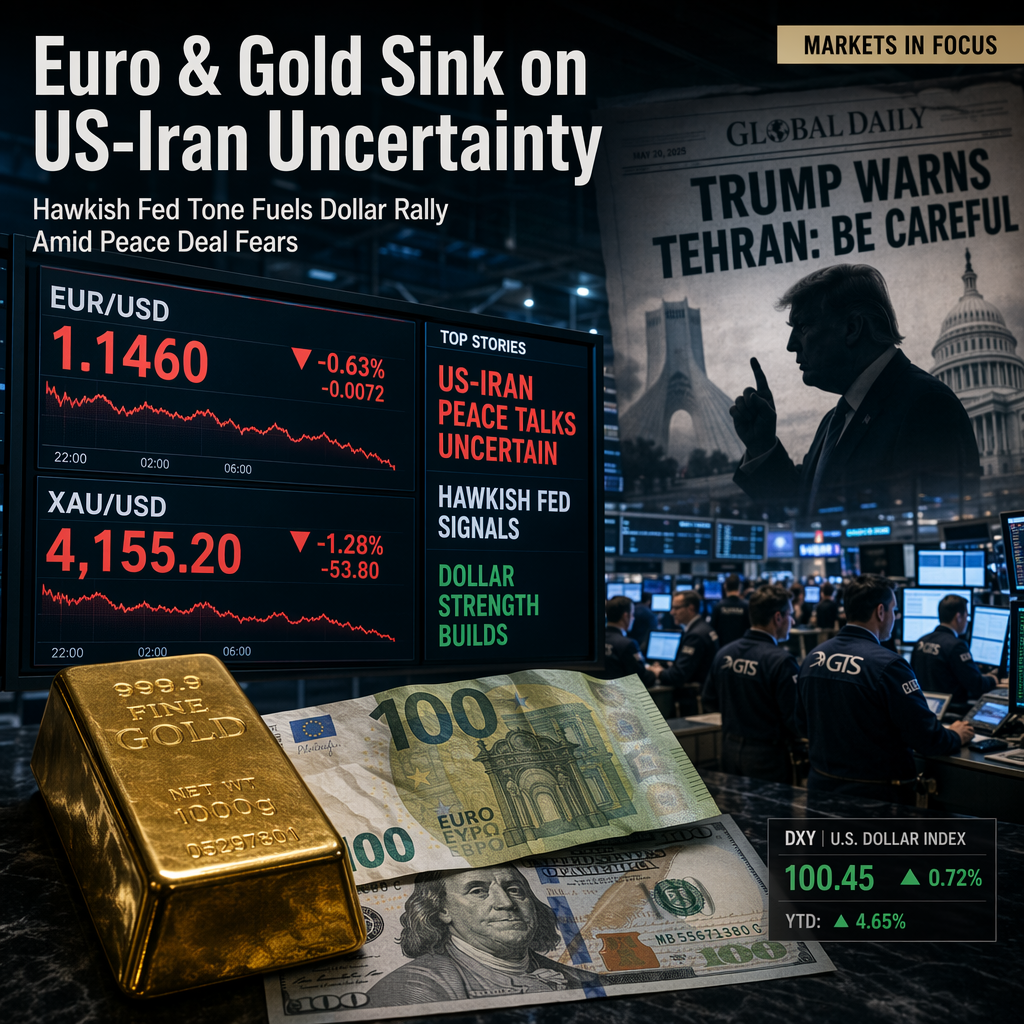
Both the Euro and Gold experienced declines during the early Asian session on Monday, as market participants reacted to uncertainty surrounding the US-Iran peace talks and expectations of higher US interest rates. The EUR/USD pair drifted lower to around 1.1460, with concerns about the progress of the US-Iran peace deal and the possibility of further US rate hikes supporting the US Dollar as a safe-haven currency against the Euro [1]. Similarly, Gold (XAU/USD) traded with mild losses around $4,155, as traders assessed developments in the US-Iran negotiations and responded to hawkish signals from the US Federal Reserve [2].
US President Donald Trump threatened to restart war with Iran, warning of strikes if Hezbollah continues attacks on Israel. This rhetoric led Iranian negotiators to suspend high-stakes talks with the US in Switzerland, although sources indicated discussions were ongoing despite the verbal threats [1][2]. Risk-off flows returned to the markets following these headlines, further boosting the US Dollar and weighing on Gold prices [1][2].
ECB President Christine Lagarde is scheduled to speak later on Monday, while ECB policymaker Pierre Wunsch stated on Friday that the central bank may raise interest rates one more time as soon as next month if evidence of Eurozone inflation spreading beyond energy emerges. The ECB’s deposit rate currently stands at 2.25%, and financial markets anticipate additional 25 basis point hikes in September or October, possibly followed by another in early next year [1].
On the Gold front, Tim Waterer, chief market analyst at KCM Trade, noted that "Gold’s rally on the back of the U.S.-Iran peace deal proved short-lived. The resurgent dollar, powered by the Fed’s newly hawkish tone under Kevin Warsh, has stolen the spotlight" [2]. Goldman Sachs projects gold prices to rise to $4,900 per ounce by December, revising its earlier forecast of $5,400, as the bank no longer expects a US rate cut this year [2].
CONCLUSION
Uncertainty over the US-Iran peace deal and hawkish US rate expectations have led to declines in both the Euro and Gold, with risk-off flows favoring the US Dollar. Forward-looking statements from the ECB and Goldman Sachs suggest continued volatility, as central banks weigh inflation risks and rate decisions. The market remains sensitive to geopolitical developments and monetary policy signals.