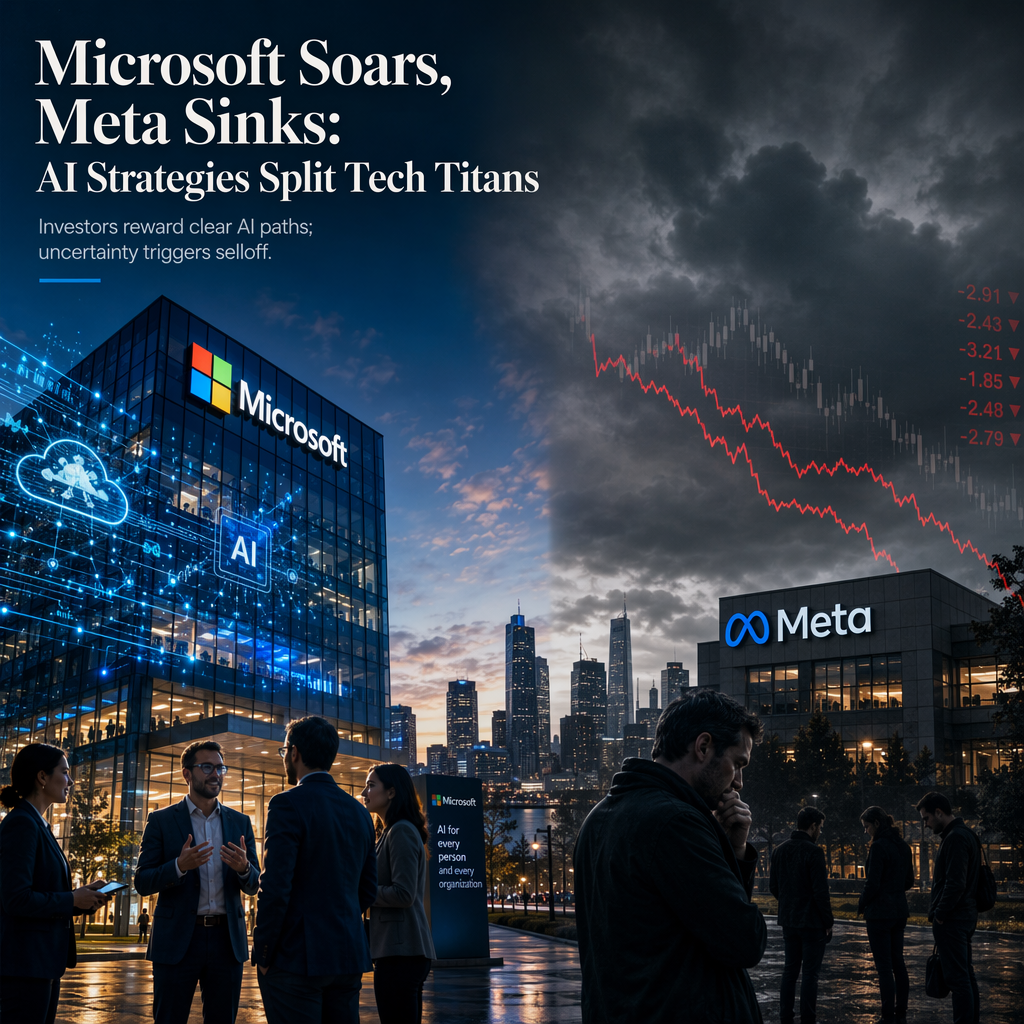
Microsoft and Meta Platforms reported sharply divergent quarterly results, leading to significant moves in their share prices. Microsoft shares jumped 8% in extended trading after the company posted fiscal fourth-quarter revenue that beat analyst estimates and reported 43% growth at its Azure cloud business, surpassing market expectations [1]. The company also announced that Microsoft 365 Copilot, its AI work assistant, now has over 30 million paid seats, up from more than 20 million in April, highlighting the accelerating adoption of its AI offerings [1]. Tracy Woo, principal analyst at Forrester, noted that Microsoft's strong revenue performance and Copilot adoption indicate that its $190 billion data-center buildout is starting to deliver returns [1]. Despite reiterating its 2026 capital expenditure forecast and signaling potential spending expansion in fiscal 2027, Microsoft's positive results reassured investors even amid concerns about AI-related costs [1].
In contrast, Meta's stock fell 8.5% in premarket trading after the company missed investor expectations on earnings and issued revenue guidance for the current quarter below analyst forecasts [1]. Meta expects revenue between $61 billion and $64 billion, with the midpoint at $62.5 billion, compared to analyst expectations of $63.15 billion according to LSEG [1]. The company's free cash flow plunged 91% year-on-year to $784 million as it continued to invest heavily in AI [1]. Meta CEO Mark Zuckerberg mentioned receiving offers to lease out excess computing capacity at a premium, but provided few details on this potential business shift, emphasizing the need to retain resources for internal product development [1]. Ben Barringer, head of technology research at Quilter Cheviot, commented that Meta's narrative is currently light on detail and that the company is still finding its way in the AI space, resulting in volatile costs and revenues [1].
Microsoft's stock is down around 24% year-to-date, while Meta's shares are down approximately 16% this year [1]. The market's reaction underscores the importance of clear AI monetization strategies and the impact of capital allocation decisions on investor sentiment [1].
CONCLUSION
Microsoft's strong AI-driven growth and positive revenue surprise fueled a sharp rally in its shares, while Meta's weak guidance and plunging free cash flow led to a significant selloff. The contrasting results highlight the market's focus on tangible AI returns and disciplined capital spending. Investors are rewarding companies with clear, successful AI strategies and punishing those with uncertain outlooks and volatile financials.