
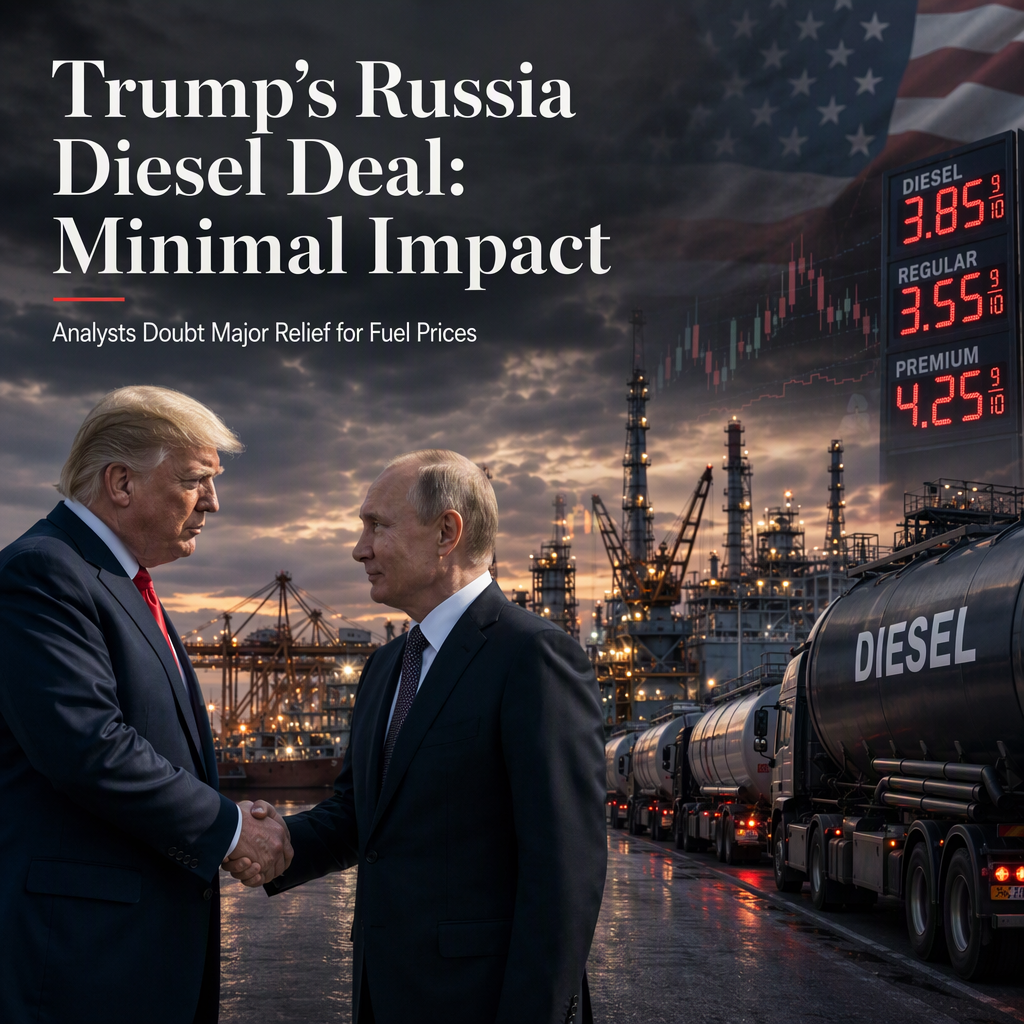
President Donald Trump announced a diesel deal with Russia that would supply the global market with 4.8 million metric tons, or nearly 36 million barrels of diesel, which is equivalent to about 10 days of U.S. domestic demand or just over a single day of global demand [1]. According to Trump's statement, Russia will immediately supply 300,000 metric tons (about 2.24 million barrels), followed by 500,000 tons (3.73 million barrels) in November, then 1 million tons (7.45 million barrels), and finally 3 million tons (22.35 million barrels) at a later date, contingent on the condition of Russian refineries [1].
Despite the headline figures, analysts believe the deal is unlikely to significantly reduce fuel prices for truckers and farmers, as the volume is small compared to U.S. and global demand [1]. Andy Lipow, president of Lipow Oil Associates, noted that the U.S. is a net diesel exporter and does not require Russian supply [1]. Neil Atkinson, former head of the IEA's oil industry and markets division, described the deal as "very, very small" in terms of its impact [1].
Goldman Sachs estimated that the Russian diesel released in October and November would only reduce wholesale diesel prices by $1 to $2 per barrel on the U.S. Gulf Coast and in Europe [1]. The European Union has banned imports of Russian crude oil and refined products, so the Russian diesel would primarily help ease competition for U.S. exports rather than directly affect domestic supply [1].
The timing of the deal comes as President Trump faces pressure to address rising fuel prices ahead of the U.S. midterm elections in November, given diesel's broad economic impact through transportation and agriculture [1]. However, the consensus among analysts is that the deal's market impact will be minimal due to the relatively small volume involved [1].
CONCLUSION
Trump's diesel deal with Russia is expected to have a negligible effect on global and U.S. fuel prices due to the small volume relative to overall demand. Analysts and market experts agree that the agreement will not significantly alleviate price pressures for consumers or industries reliant on diesel. The market impact is therefore considered low.