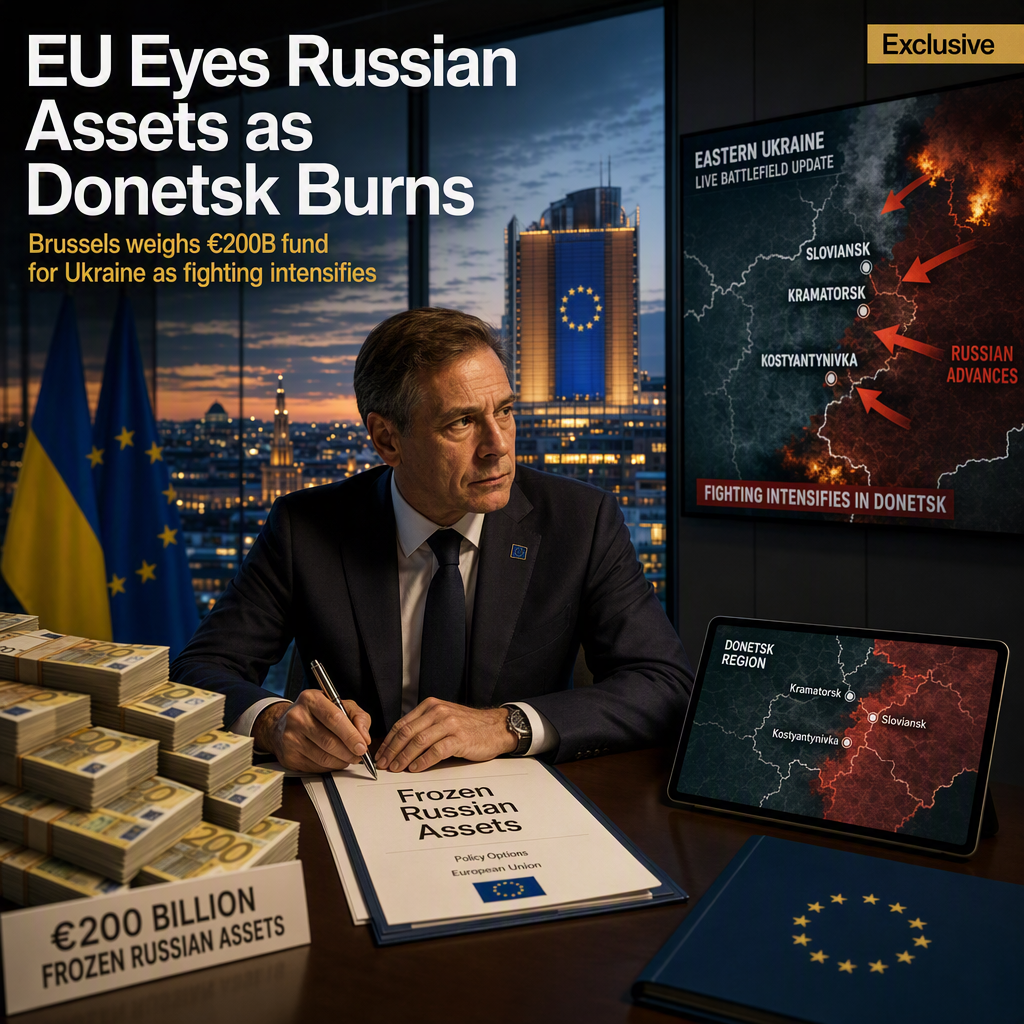
Russian forces have intensified their attacks in Ukraine's eastern Donetsk region, focusing on the strategic 'fortress belt' of industrial cities including Kostyantynivka, Kramatorsk, and Sloviansk, as part of ongoing efforts to capture the Donetsk Oblast—a key objective for the Kremlin after more than four and a half years of full-scale war [1]. Russia's Chief of the General Staff, Valery Gerasimov, stated that Russian troops had advanced to within four kilometers (2.5 miles) of Sloviansk's eastern outskirts and claimed to have breached the first defensive line of the Sloviansk-Kramatorsk fortified region in some areas, with operations progressing along a 160-kilometer front [1]. However, the Institute for the Study of War (ISW) challenged Gerasimov's assertions, suggesting that his statements were intended to create a narrative of widespread Russian military success and were 'divorced from reality' [1].
Ukrainian open-source mapping group Deep State reported that the most intense battlefield activity is currently centered around Kostyantynivka, which is considered the gateway to the broader Donbas region [1]. ISW analysts noted that Russian forces have increased efforts to advance toward Sloviansk from the east and southeast after previous unsuccessful attempts from the northeast [1].
In a significant political development, Ukraine's Foreign Minister Andrii Sybiha expressed strong support for a renewed initiative by four European Union member states—Spain, Sweden, Poland, and the Netherlands—to utilize over €200 billion ($232.9 billion) in frozen Russian central bank assets to fund Ukraine's defense [1]. Sybiha argued that it is 'fair and logical' to use Russian assets, rather than solely European taxpayers' money, to cover the costs of defending Ukraine and Europe from the Russian threat, emphasizing the need for a rational discussion on the matter [1].
The ministers from the four EU countries sent a letter to the European Commission urging Brussels to restart work on the plan, which had stalled last year due to Belgium's concerns over liability [1]. Russia has labeled the initiative as 'blatantly illegal' [1].
CONCLUSION
The escalation of fighting in Donetsk and the renewed EU push to use frozen Russian assets mark a critical juncture in the Ukraine conflict. While Russian officials claim battlefield advances, independent analysts question the accuracy of these statements. The EU initiative, if revived, could have significant financial and geopolitical implications for both Ukraine and Russia.