
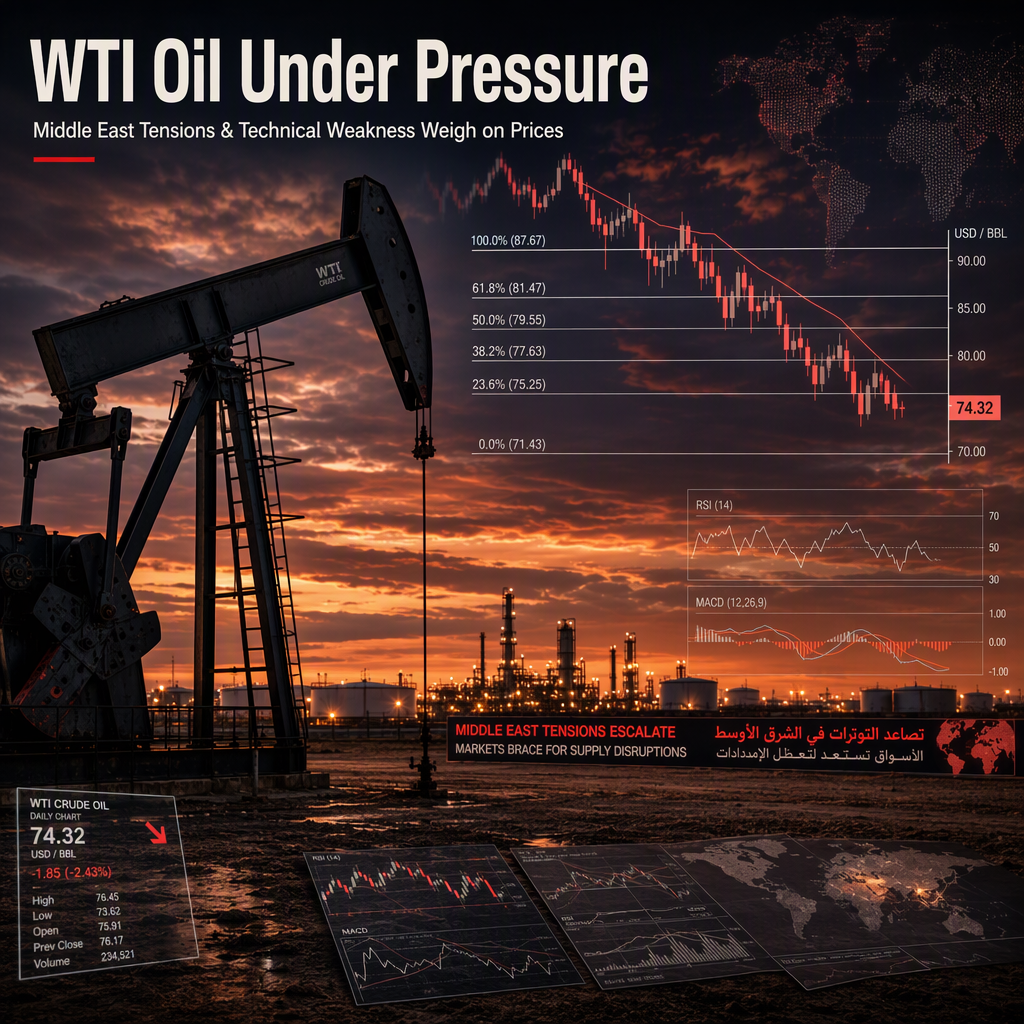
West Texas Intermediate (WTI), the benchmark US crude oil price, experienced renewed selling pressure during the Asian session on Thursday, reversing the modest recovery gains seen the previous day. Despite this, WTI managed to hold above the $88.00 mark and a nearly four-week low, as traders closely monitor developments related to the ongoing Middle East crisis [1].
A key factor weighing on crude oil prices is the recovery in flows through the Saudi East-West pipeline. However, the ongoing US-Iran standoff continues to maintain a geopolitical risk premium, which is helping to limit the downside for WTI. Hopes for a diplomatic resolution to the US-Iran conflict diminished after President Donald Trump rejected a seven-day peace proposal from Iran. Additionally, Trump reportedly told aides that he expects major combat operations and renewed bombing against Iran to resume following the November midterm elections [1].
From a technical perspective, WTI failed to find acceptance above the 200-period Simple Moving Average (SMA) on the 4-hour chart, and the subsequent decline favors bearish traders. The Moving Average Convergence Divergence (MACD) remains below zero with a slightly negative reading, and the Relative Strength Index (RSI) around 38 indicates ongoing downside pressure rather than a decisive oversold reversal. WTI prices are currently holding above the 50.0% Fibonacci retracement at $87.75, which is acting as a nearby pivot. A sustained break below this level could expose deeper supports at the 61.8% retracement at $84.37 and the 78.6% level at $79.56, with the cycle floor near $73.44. On the upside, initial resistance is at the 200-period SMA at $90.11, followed by the 38.2% Fibonacci retracement at $91.13, which capped the recent recovery attempt. A more substantial bullish move would require a break through the 23.6% retracement at $95.31 [1].
CONCLUSION
WTI crude oil remains under pressure due to a combination of technical weakness and ongoing geopolitical tensions, particularly between the US and Iran. While downside risks persist, the geopolitical risk premium is helping to limit further declines, with key technical levels providing nearby support and resistance. Traders are likely to remain cautious as they await further developments in the Middle East crisis.