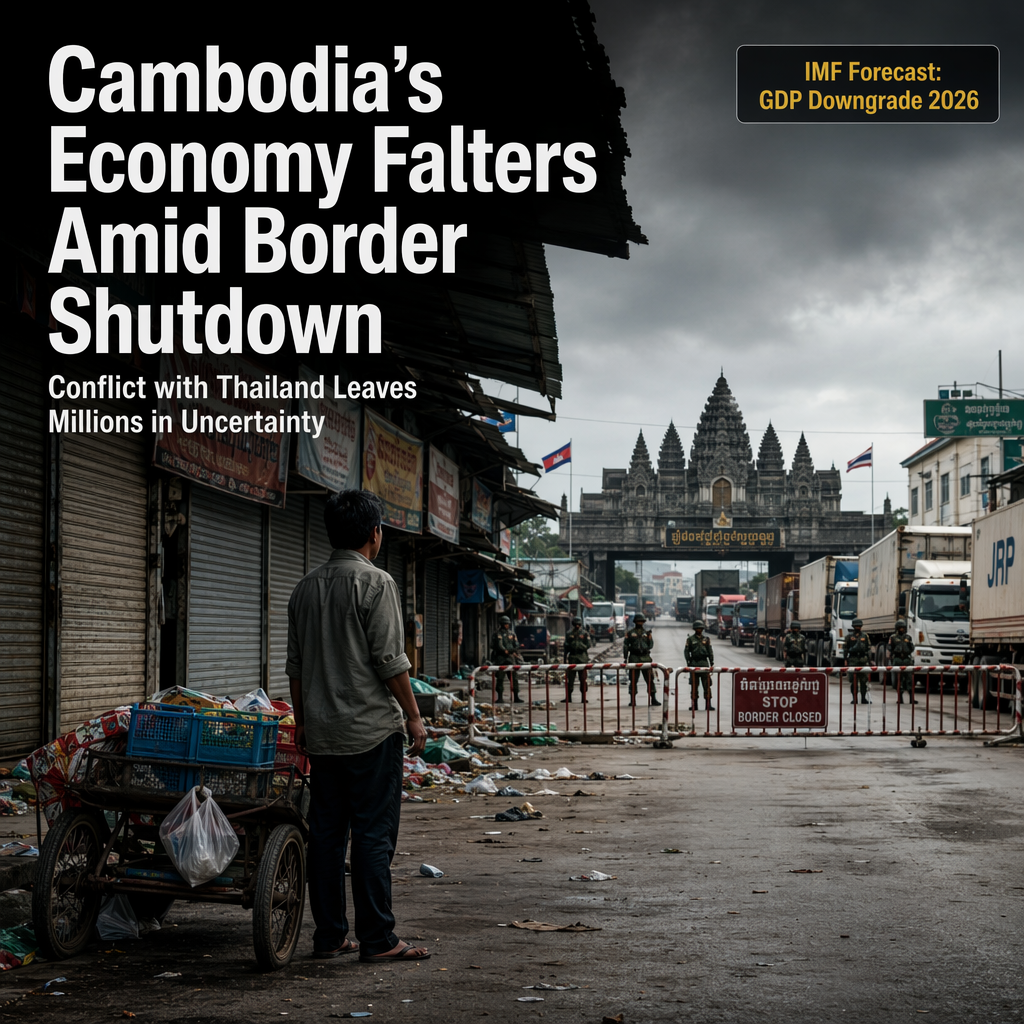
The Cambodian economy has suffered significant setbacks following the closure of its border with Thailand in June 2025, a move prompted by escalating political tensions and military clashes between the two countries [1]. The border shutdown has brought cross-border trade to a standstill, leaving millions of Cambodians who depended on employment and business opportunities linked to Thailand in search of alternative livelihoods [1]. In Poipet, a key border city, markets that once thrived on bilateral commerce now stand empty, underscoring the severe disruption to local economies [1].
Traders and transporters have reported substantial financial losses, and the volume of goods exchanged between Cambodia and Thailand has markedly declined [1]. The loss of access to Thai markets has forced many local businesses to reduce operations or close entirely, resulting in reduced incomes and a drop in tax revenues [1]. This has also negatively affected Cambodia's GDP growth forecasts, with the International Monetary Fund (IMF) sharply downgrading its economic outlook for the country in 2026, citing the border conflict as a primary factor [1]. The IMF warns of slower growth, higher unemployment, and increased economic vulnerability, particularly in border provinces [1].
Investor confidence in the region has been undermined, and the economic repercussions extend beyond Poipet, impacting nationwide supply chains, export sectors, and remittance flows from Cambodians working in Thailand [1]. Technical analysis by market observers indicates that the Cambodian economy is unlikely to return to pre-conflict GDP growth levels in the near term, with support now seen at much lower benchmarks as the country adjusts to the ongoing crisis [1].
Local authorities and business leaders have called for urgent diplomatic solutions to reopen the border and restore trade flows, but market sentiment remains pessimistic with no clear signs of recovery [1]. The ongoing Thailand-Cambodia conflict continues to cast a shadow over bilateral trade, leaving millions in economic uncertainty and threatening the stability of regional markets [1].
CONCLUSION
The closure of the Thailand-Cambodia border has triggered a sharp economic downturn in Cambodia, with downgraded growth forecasts and widespread job losses. Without a diplomatic resolution, market sentiment remains negative and the outlook for recovery is bleak.