
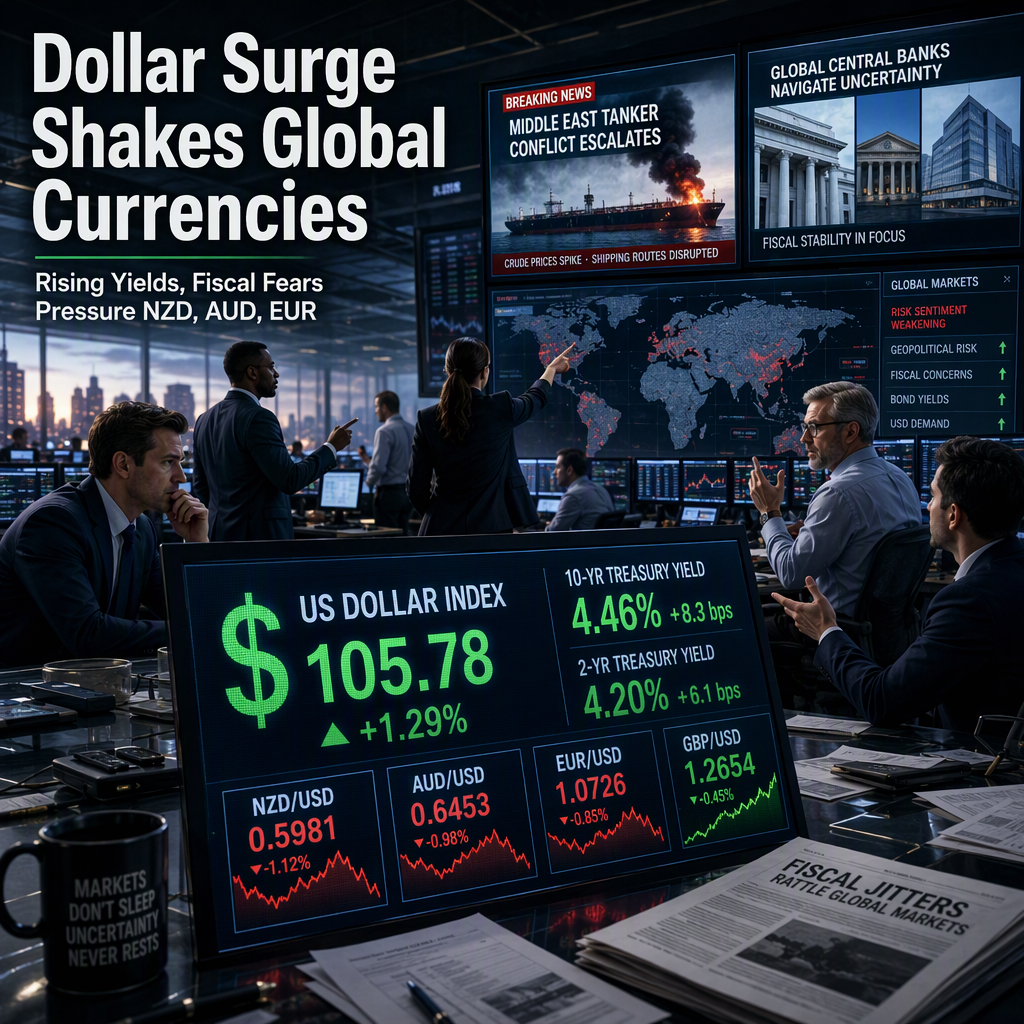
The US Dollar (USD) has strengthened against major currencies, driven by a rebound in US Treasury yields and persistent inflation fears, ahead of the Federal Open Market Committee (FOMC) Meeting Minutes. The 10-year Treasury yield is reported above 5.30% and the 30-year yield near 5.69%, reflecting concerns over expanding fiscal deficits and a surge in AI-related debt issuance, which continue to weigh on investor sentiment [1]. Crude oil prices have also climbed due to escalating geopolitical conflict in the Middle East, notably attacks on tankers in the Strait of Hormuz and clashes between Saudi forces and Houthi rebels, reinforcing expectations that central banks may maintain tight monetary policy to counter lingering price pressures [1][4].
The New Zealand Dollar (NZD) and Australian Dollar (AUD) have both depreciated against the USD. NZD/USD trades around 0.5610, extending its slide beneath key moving averages, with the 14-day Relative Strength Index (RSI) at 29.63 indicating oversold conditions [1]. The Reserve Bank of New Zealand (RBNZ) recently raised its official cash rate by 25 basis points to 2.75%, marking its second consecutive increase, and markets have fully priced in another hike by December, with the next policy decision scheduled for October 28 [1]. Meanwhile, AUD/USD trades around 0.6970-0.6965, stalling a three-day recovery as the USD remains firm. Softer Australian inflation data, with headline CPI rising 0.4% (consensus: 0.5%) to 4.0% y/y (consensus: 4.1%, prior: 3.5%), and trimmed mean CPI up 0.2% m/m (consensus: 0.3%) at 3.6% y/y, have tempered market conviction around further Reserve Bank of Australia (RBA) tightening [2]. The CME FedWatch Tool shows traders pricing in an 85% chance of a US rate hike by year-end [2].
The Euro (EUR) has extended losses against the British Pound (GBP), with EUR/GBP trading at 0.8473 and on track for a nearly 1.6% decline over nine days, exposing the yearly low at 0.8455 [4]. The Euro's brief recovery was triggered by a 17 basis point fall in France’s 10-year OAT yields following Marine Le Pen’s plan to slash government costs by 140 billion over five years, but renewed geopolitical tensions and rising oil prices have pressured the Eurozone economy [4]. Commerzbank notes that concerns over France’s national debt have revived memories of the sovereign debt crisis, limiting the Euro's recovery against the USD. The ECB remains tight-lipped on long-term yields, and the US Dollar is expected to remain in demand due to the resilient US economy and limited new data releases [5].
Rabobank strategists highlight that US Treasury yields fell across the curve yesterday, with the 2-year yield declining 2.3bp and the 10-year yield dropping 4.5bp to 5.26%, weighing on the USD, which was the third-worst-performing G10 currency of the day, though the DXY Index remains near 102 [3]. Fed officials, including Mary Daly and Schmid, emphasize inflation risks from AI, tariffs, and energy, suggesting the need for additional hikes. Rabobank forecasts one more Fed hike at the December 2026 FOMC meeting, followed by a prolonged hold through 2027 [3].
The British Pound (GBP) has outperformed, breaking above prior resistance and reaching a high of 1.3286 against the USD. UOB strategists see scope for a retest of 1.3285 but doubt a sustained break higher, with major resistance at 1.3315 unlikely to come under threat. Over 1–3 weeks, GBP may edge higher toward 1.3315, contingent on holding key support at 1.3200 [6].
According to the daily percentage change table, the Euro was the strongest against the New Zealand Dollar, while the USD gained 0.39% against the Euro and 0.28% against the NZD [4].
CONCLUSION
The US Dollar's strength, supported by rising Treasury yields and global fiscal concerns, has pressured the New Zealand Dollar, Australian Dollar, and Euro, while the British Pound shows modest outperformance. Market participants remain focused on upcoming central bank decisions and geopolitical developments, with expectations for further monetary tightening in the US and New Zealand. Overall, the market impact is high, with risk sentiment driven by inflation fears, fiscal uncertainty, and energy prices.