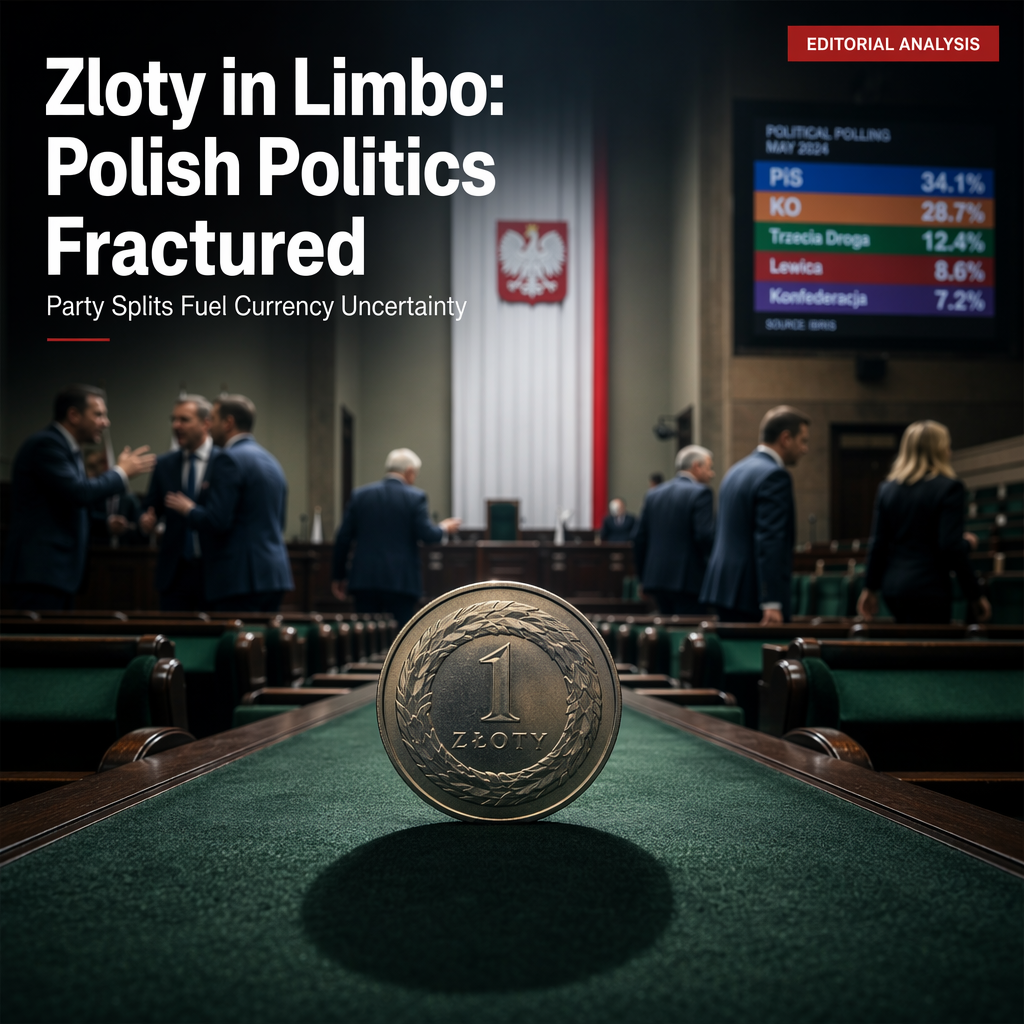
Commerzbank’s Tatha Ghose has highlighted a significant development in Polish politics, noting that the Law and Justice party (PiS) has split, with former Prime Minister Mateusz Morawiecki and over 30 MPs leaving the party after refusing to sign loyalty declarations demanded by PiS chief Jaroslaw Kaczynski [1]. Morawiecki has formed a new party, Development Plus, which is polling at 7.5%, surpassing the 5% threshold required for Sejm representation [1]. The latest polling data shows KO leading at 28.5%, rump PiS at 15.9%, the far-right Konfederacja at 13.5%, and Korona at 12.3% [1]. Based on these figures, KO and the Left would secure 207 seats, PiS, Konfederacja, and Korona would have 222 seats, and Morawiecki’s projected 31 seats could become decisive in coalition-building [1].
The immediate reaction might be to view the PiS fragmentation as positive for the Polish Zloty (PLN), as it could reduce the risk of a dominant PiS government and lower the political risk premium on the currency [1]. However, Commerzbank cautions that this conclusion is premature, as the split could also lead to increased competition for right-wing voters or result in a more fragmented and harder-to-manage right, potentially complicating coalition-building, especially if radical parties become indispensable [1].
At present, the implications for the zloty remain unclear. While the development is significant and warrants close monitoring, it does not yet constitute a clear positive for the PLN [1]. No immediate market reaction or forward-looking analyst consensus is provided beyond the observation that the situation introduces new uncertainties for risk pricing in the Polish currency [1].
CONCLUSION
The split within Poland’s Law and Justice party introduces new political uncertainties, with polling suggesting a more fragmented parliamentary landscape. While some might expect this to lower the zloty’s risk premium, Commerzbank emphasizes that the overall impact on the currency remains unclear and warrants further observation. Investors should remain cautious as coalition dynamics and political fragmentation evolve.