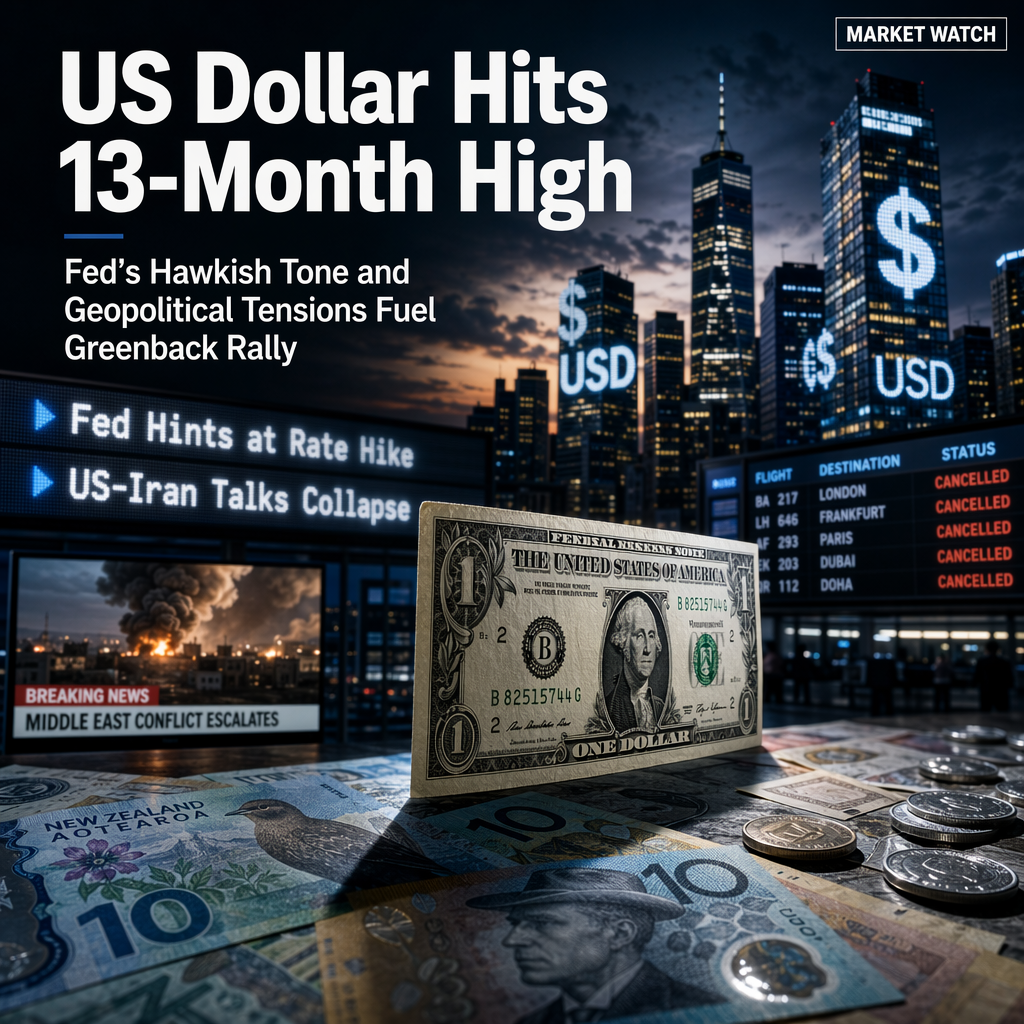
The US Dollar (USD) extended its rally to a 13-month high, buoyed by a combination of geopolitical tensions and a hawkish Federal Reserve policy outlook. The collapse of the anticipated US-Iran negotiations, following the cancellation of US Vice President JD Vance's trip to the Bürgenstock summit, contributed to a risk-averse market atmosphere and further strengthened the Greenback [3][4]. The Swiss Foreign Ministry confirmed that the meetings scheduled for Friday were called off, while Iranian state-aligned media attributed the postponement of their delegation's travel to ongoing Israeli attacks in southern Lebanon [3][4].
The Federal Reserve's hawkish tilt, reinforced by new Chairman Kevin Warsh's commitment to curbing inflation, has been a key driver of USD strength. Futures markets are now pricing a 77% chance of a Fed rate hike in October, up from less than 40% a week earlier, and nearly a 90% chance of at least one hike before year-end [1]. Nearly half of FOMC officials indicated that at least one more rate hike may be necessary later this year [4]. This policy stance has weighed heavily on risk-sensitive assets and currencies.
The New Zealand Dollar (NZD) and Australian Dollar (AUD) were among the worst performers against the USD. NZD/USD fell to 0.5724, approaching its year-to-date low of 0.5680, and was on track for a 1.65% weekly decline [1]. Technical indicators for NZD/USD remain bearish, with the Relative Strength Index (RSI) near 33 and the MACD below zero, suggesting further downside risk [1]. AUD/USD traded near the 0.7000 mark, with technical analysis indicating vulnerability below the 61.8% Fibonacci retracement and a path of least resistance to the downside [2]. The USD gained 1.62% against the NZD and 0.48% against the AUD this week, according to multiple sources [2][3].
In commodities, Silver (XAG/USD) extended its losses for a third consecutive day, trading around $64.70 per troy ounce. The metal faced pressure from both the fading optimism over US-Iran peace prospects and the Fed's hawkish outlook, which increases the opportunity cost of holding non-yielding assets like Silver [4].
Market sentiment remains cautious, with investors closely monitoring developments in the Middle East and central bank communications. The risk-off tone and expectations of higher US interest rates have broadly supported the US Dollar while weighing on risk assets and precious metals [1][2][3][4].
CONCLUSION
The collapse of US-Iran talks and the Federal Reserve's hawkish stance have propelled the US Dollar to its strongest level in over a year, pressuring risk-sensitive currencies and commodities. Market participants are bracing for further volatility as geopolitical risks persist and the Fed signals more tightening ahead.