
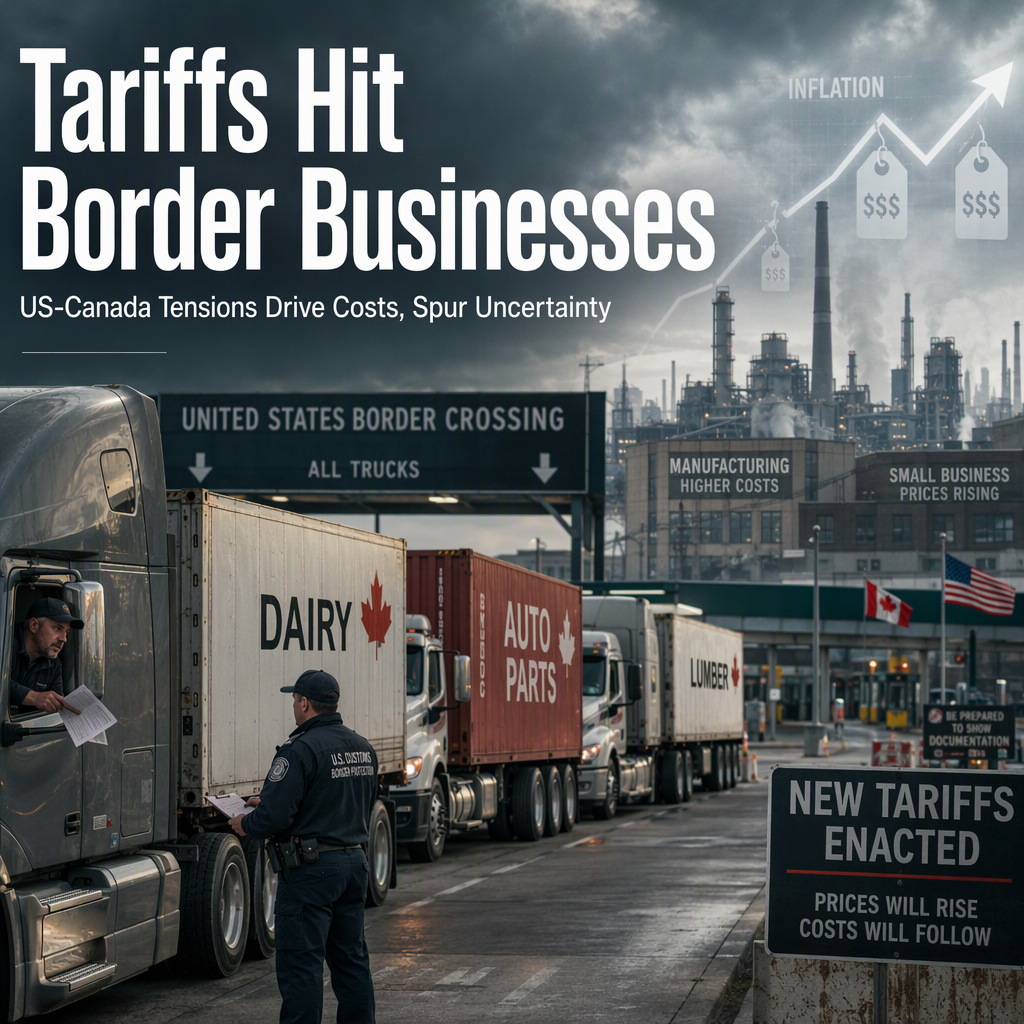
President Donald Trump has implemented a new series of import bans on certain Canadian goods, which took effect on Tuesday, impacting approximately $1 billion worth of products including dairy, alcohol, and certain automobiles [1]. According to Karan Ramchandani, managing director for capital markets at Post Oak Group, these tariffs are expected to disrupt the auto, steel, and lumber sectors, freeze long-term capital, and ultimately push costs onto American consumers and small business owners, particularly those near the U.S.-Canada border [1].
Ramchandani explained that while many of these goods were already subject to tariffs, the extension of tariffs—especially those set to take effect on January 1 for automobiles, steel, and lumber—will directly impact factories and production, leading to increased inflation and higher consumer prices if the situation does not stabilize [1]. He noted that producers and manufacturers initially absorb the cost increases, but these are eventually passed on to consumers if the tariffs persist [1].
Another significant concern highlighted is the uncertainty surrounding the United States-Mexico-Canada Agreement (USMCA). President Trump's decision not to participate in the automatic renewal of the USMCA means the agreement will now be reviewed annually instead of every 16 years, creating instability for long-term investment decisions [1]. Ramchandani emphasized that this uncertainty discourages large-scale investments, such as relocating manufacturing plants, as businesses are hesitant to commit capital without stable trade policies [1].
Overall, the combination of new tariffs and USMCA uncertainty is expected to have a long-term negative impact on the U.S. economy, particularly for small and mid-sized businesses and consumers, by increasing costs and deterring investment [1].
CONCLUSION
The newly imposed tariffs on Canadian goods and the annual review of the USMCA are creating significant uncertainty for American businesses and consumers. This environment is likely to result in higher costs, inflationary pressures, and reduced long-term investment, signaling a challenging outlook for affected sectors.