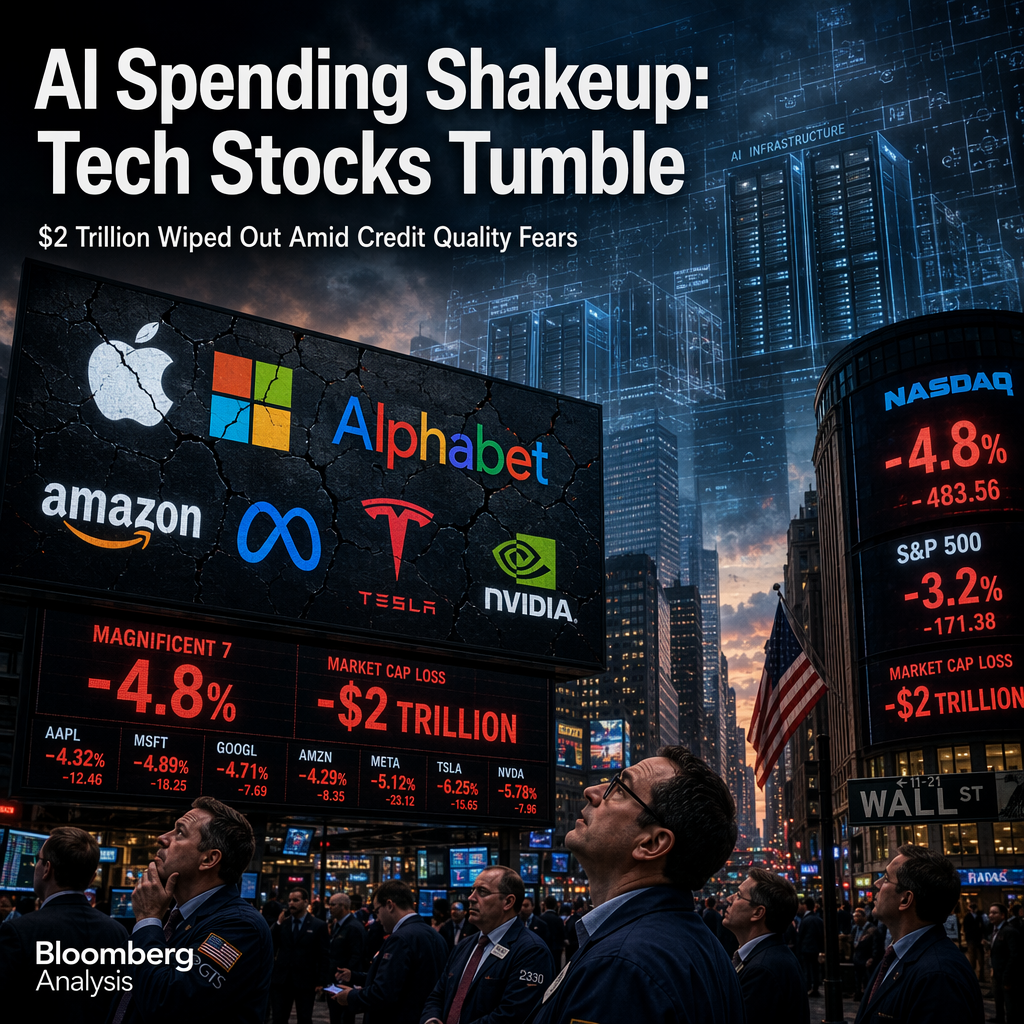
The Magnificent Seven technology stocks experienced a significant market downturn this week, with Bloomberg reporting a 4.8% drop in the group's index on Thursday, erasing approximately $787 billion in market value—the steepest single-day decline since April 2025 [1]. As of Thursday's close, the index was down about 11% from its late May record high, with a total of $2 trillion in market capitalization wiped out [1]. Over the past five trading days, six of the seven stocks saw declines: Tesla fell over 19%, Alphabet (Google) dropped 8.5%, Amazon 6.3%, Meta 6%, Microsoft 1.3%, and Apple 0.4%, while Nvidia was up 1.9% [1].
The selloff intensified after Alphabet and Tesla released earnings reports highlighting substantial increases in capital expenditures. Alphabet announced plans to spend about $200 billion on capex this year, up from a previous estimate of $190 billion, primarily for AI data centers and infrastructure. This surge in spending contributed to Alphabet's quarterly cash flow turning negative for the first time since Google went public [1]. Tesla's profits missed Wall Street estimates due to increased spending, with CEO Elon Musk stating that 2026 will be a "massive capex year" focused on AI, robotics, robotaxis, and autonomous vehicles [1].
Moody's Ratings issued a warning that the unprecedented AI infrastructure buildout is eroding free cash flow and increasing balance-sheet risk for hyperscalers such as Alphabet, Microsoft, Amazon, Meta, Oracle, and CoreWeave [2]. Moody's projects that capital expenditures for these companies will reach $785 billion in 2026 and about $1 trillion in 2027 [2]. The ratings firm noted that these investments are forcing even the most cash-rich corporations to rely heavily on debt, stock sales, and off-balance-sheet financing, including long-term data center leases, to fund their AI ambitions [2]. Direct debt across the six hyperscalers has reached approximately $460 billion, and Alphabet recently announced an $85 billion equity sale [2].
Despite these risks, Moody's stated that Microsoft, Alphabet, Amazon, and Meta still maintain some of the strongest corporate balance sheets globally [2]. However, the transition from asset-light to asset-heavy business models marks a significant shift for Silicon Valley, with Moody's warning that these moves "threaten credit quality" for the companies involved [2]. Analyst commentary from Edward Jones suggests that while the AI infrastructure buildout remains a durable theme, the negative share-price reaction indicates investors are increasingly focused on the returns generated from these massive investments [1].
CONCLUSION
The combination of soaring AI infrastructure spending and increased reliance on debt and equity financing has triggered a sharp selloff in major tech stocks and raised concerns about credit quality among leading hyperscalers. While the long-term AI buildout remains a key theme, investors are reacting negatively to the near-term financial risks and capital pressures. Market sentiment is currently cautious, with both equity and credit markets closely watching the sector's ability to generate returns on these unprecedented investments.