
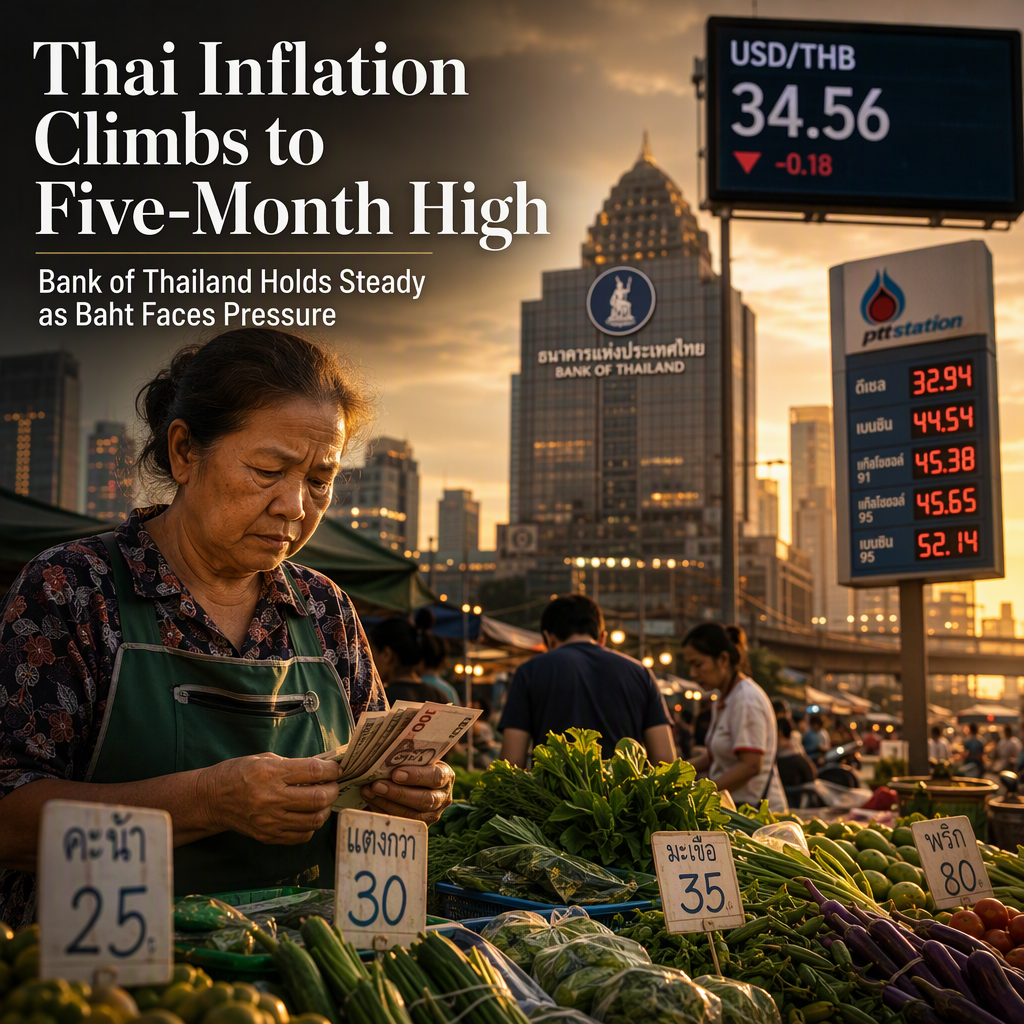
Thailand's September Consumer Price Index (CPI) rose by 2.8% year-on-year, marking the highest inflation reading since April, though it came in below the Bloomberg consensus estimate of 3.1% and up from 2.5% in August [1]. The increase was primarily driven by higher energy and food prices, with the Commerce Ministry subsequently lowering its 2026 inflation forecast to 1.8-2.2% from an initial 1.5-2.5%, as year-to-date inflation averaged around 1.5% [1]. Despite the recent uptick, headline inflation is now approaching the upper end of the Bank of Thailand’s (BoT) 1-3% target range [1].
Commerzbank economists anticipate that headline inflation will continue to rise in the coming months due to persistent supply-side pressures, including elevated fuel prices from ongoing energy supply chain disruptions and rising food prices caused by crop damage from recent flooding [1]. However, they note that high household debt and the elevated cost of living are likely to keep demand-side pressures subdued, limiting the risk of broader inflationary acceleration [1].
The September inflation data is not expected to prompt a change in the BoT’s policy stance. Commerzbank maintains that the rise in headline inflation is largely supply-driven, with core inflation and medium-term inflation expectations remaining stable. As a result, the BoT is likely to keep its policy rate at 1.00% for an extended period rather than react to what is seen as a temporary, supply-driven increase in headline inflation [1].
In foreign exchange markets, the USD/THB pair fell 0.2% to 33.62, attributed to easing oil prices and a softer US dollar. Nevertheless, downside risks for the Thai Baht remain elevated. The yield spread between the 10-year US Treasury and the 10-year Thai government bond widened to 291 basis points, the largest in a year, which reduces the attractiveness of Thai Baht-denominated assets [1].
CONCLUSION
Thailand's inflation is rising but remains primarily supply-driven, with the Bank of Thailand expected to keep rates steady. Despite a brief strengthening of the Baht, widening yield spreads and persistent supply pressures suggest ongoing downside risks for the currency.