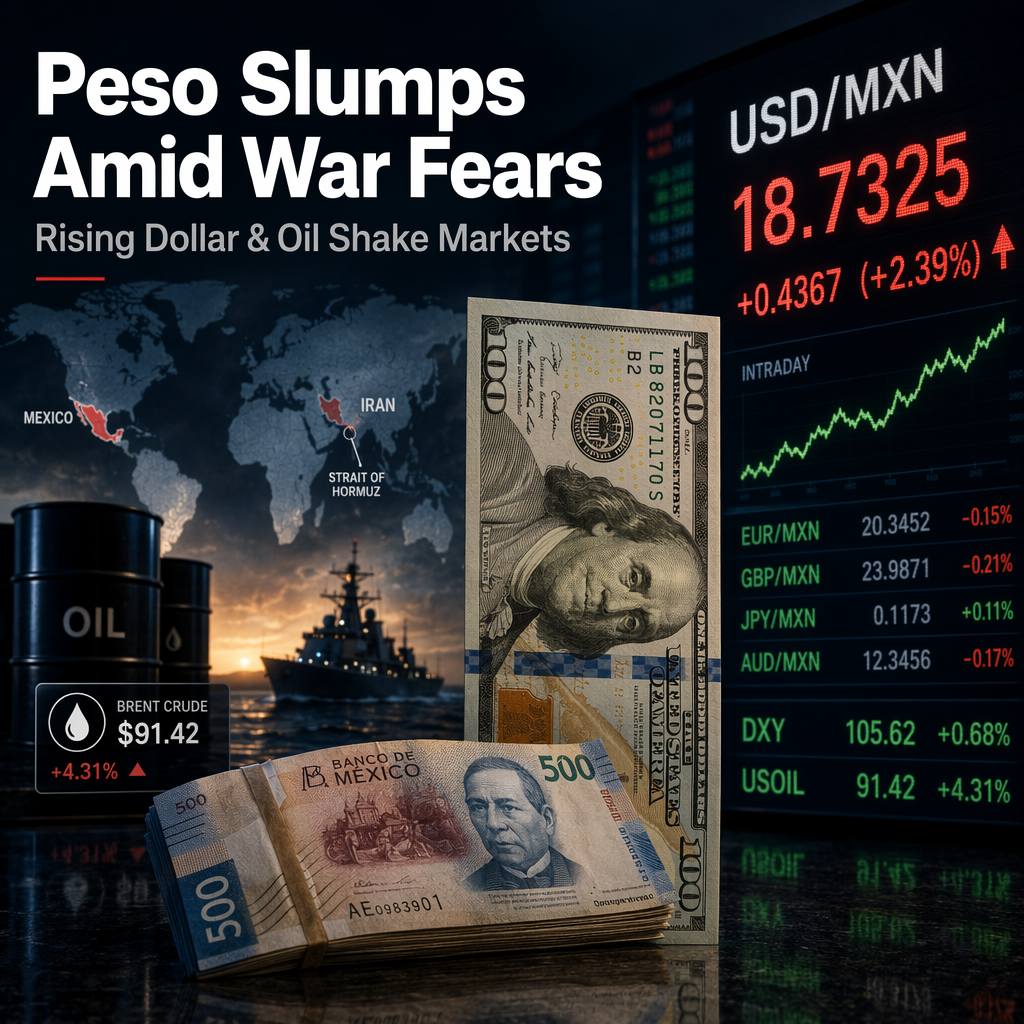
The Mexican Peso weakened against the US Dollar during Friday’s North American session, with the USD/MXN pair rising over 0.65% to trade at 17.53 after rebounding from a daily low of 17.41 [1]. This decline in the Peso was attributed to heightened geopolitical tensions surrounding the ongoing US-Iran conflict, which has increased demand for the US Dollar as a safe-haven asset [1]. Despite ongoing talks to end the war, the situation remains unresolved, fueling market uncertainty and risk aversion [1].
The rise in oil prices, driven by concerns over the conflict and potential disruptions in the Strait of Hormuz, further supported the US Dollar and led to speculation that the Federal Reserve might consider hiking interest rates, which could narrow the interest rate differential that previously favored the Peso [1]. However, benign US inflation data released recently was welcomed by investors, reducing the likelihood of a Fed rate hike at the September meeting [1]. The US Dollar Index (DXY) edged up by 0.05% to 100.76, providing additional support to the USD/MXN pair [1].
On the economic data front, the University of Michigan’s Consumer Sentiment Index for July rose from 50.7 to 54, indicating a slight improvement in US consumer optimism, while inflation expectations eased [1]. Cleveland Fed President Beth Hammack maintained a hawkish stance, emphasizing concerns about persistent inflation and highlighting the strength of the labor market and consumer spending [1].
In Mexico, there were no significant economic releases during the session, but upcoming data on retail sales, employment, and inflation for the first half of July are expected next week [1]. In the US, jobs data and S&P Global Flash PMIs are scheduled for release, with Federal Reserve officials entering a blackout period ahead of the July 29 policy meeting [1].
From a technical perspective, USD/MXN is trading above key moving averages, suggesting a constructive near-term bias, with immediate resistance at 17.5456 and further resistance at 18.1200. Initial support is seen at 17.3856 [1].
CONCLUSION
The Mexican Peso’s decline was driven by renewed geopolitical tensions and rising oil prices, which boosted the US Dollar’s safe-haven appeal. While US inflation data eased concerns about imminent Fed rate hikes, market sentiment remains cautious ahead of key economic releases in both the US and Mexico. The near-term outlook for USD/MXN remains constructive, with technical indicators pointing to further potential gains for the Dollar.