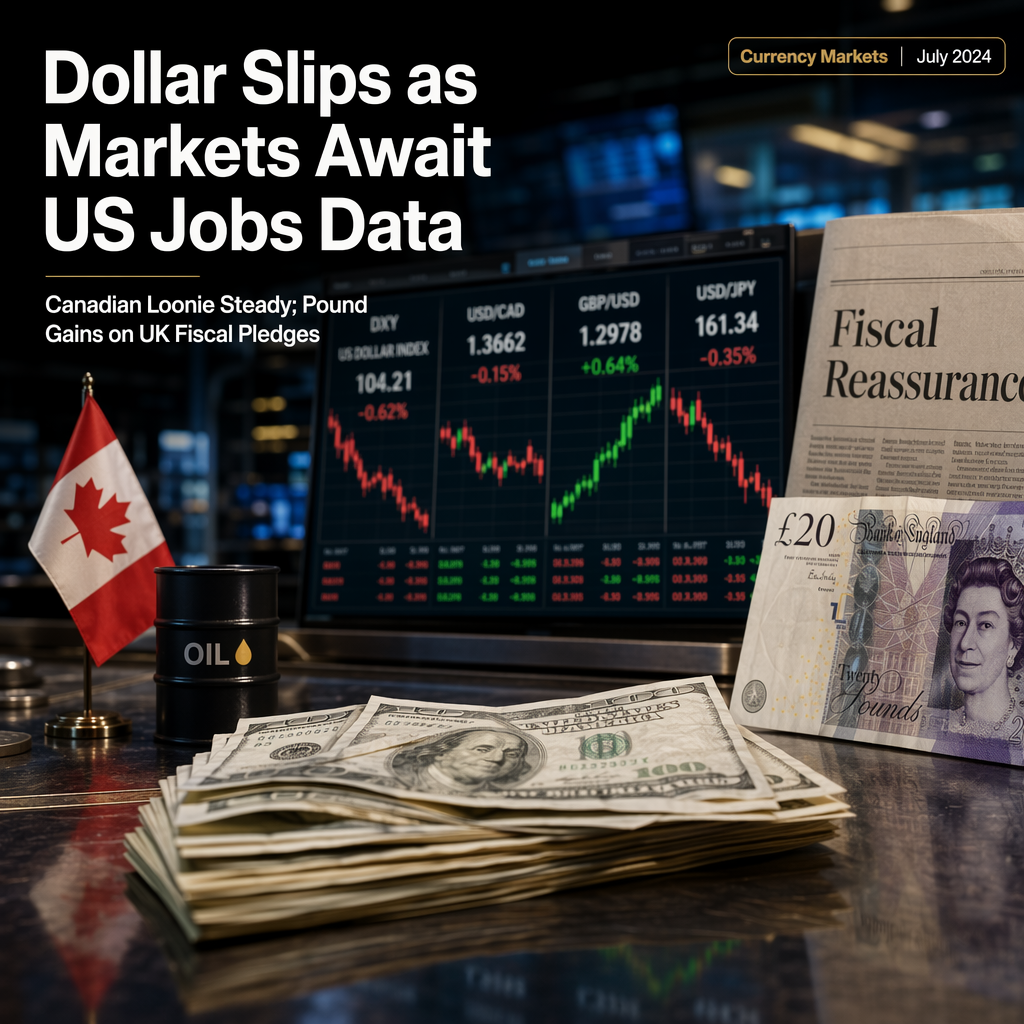
On Monday, the US Dollar (USD) edged lower against major currencies as investors awaited a series of key US labor market releases, including the May JOLTS Job Openings report, ISM Manufacturing PMI, June ADP Employment Change, and Thursday's June Nonfarm Payrolls (NFP) report [1][2]. The US Dollar Index (DXY) fell by 0.20% to 101.15, reflecting broad-based weakness in the Greenback [2].
The Canadian Dollar (CAD) consolidated around 1.4210 against the USD, with investors remaining cautious ahead of the upcoming US labor data. Despite a rebound in Oil prices—West Texas Intermediate (WTI) rose 0.68% to $70.60—CAD did not benefit, remaining weighed down by earlier crude losses and failing to gain traction from the oil recovery [1]. Scotiabank strategists Shaun Osborne and Eric Theoret noted that the USD/CAD's fundamental fair value is estimated at 1.4135, and that the US Dollar appears extremely overbought, which could cap further gains in the 1.4250-1.4300 range and potentially lead to a modest pullback toward 1.4075-1.4080 [1].
Meanwhile, the British Pound (GBP) advanced 0.40% against the USD, with GBP/USD trading at 1.3244 after touching daily lows of 1.3191 [2]. The move was attributed to comments from Andy Burnham, expected to become the new UK Prime Minister, who pledged to adhere to fiscal rules set by Chancellor Rachel Reeves and reaffirmed commitment to the Labour Party’s 2024 manifesto [2]. This reassurance calmed markets and supported the Pound, with investors relieved by Burnham’s fiscal discipline stance [2]. Technical analysis indicated that GBP/USD remains below key moving averages, suggesting rallies may be capped near 1.3424, with support seen around 1.3159 [2].
Both articles highlighted the market's focus on upcoming US economic data, which could influence Federal Reserve policy expectations. Money markets have priced in 30 basis points of Fed tightening by the end of 2026, according to Prime Terminal data [2]. Additionally, Fed Chair Kevin Warsh's participation at the ECB Sintra Symposium is being watched for potential policy signals [2].
CONCLUSION
The US Dollar's weakness ahead of critical labor market data has led to mixed reactions in major currencies, with the Canadian Dollar consolidating despite higher oil prices and the British Pound gaining on fiscal reassurance from UK leadership. Market participants remain attentive to upcoming US economic releases and central bank commentary, which are expected to shape near-term currency movements.