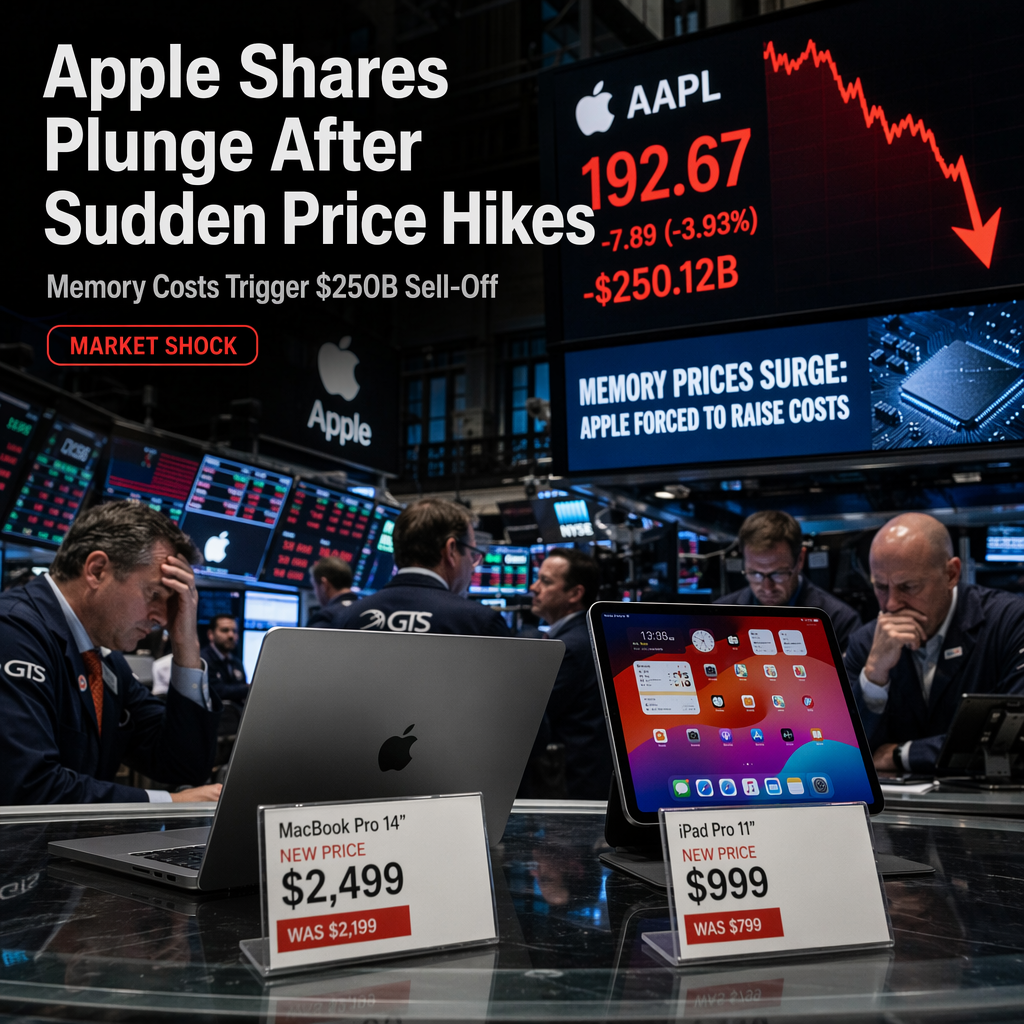
Apple shares experienced a sharp decline on Thursday, falling by nearly 6% as of 2:00 p.m. ET, marking the company's worst one-day performance in over a year and erasing approximately $250 billion in market value [1]. The sell-off followed Apple's announcement of immediate price increases on several of its flagship products, including the MacBook Neo, MacBook Air, iMac, and iPad lines, with some models seeing hikes as high as $200 [1]. The iPhone, Apple Watch, and AirPods were not affected by these changes [1].
Apple attributed the price increases to 'skyrocketing memory prices' driven by the rapid expansion of AI data centers, which has caused an extraordinary surge in demand for memory and storage components [1]. The company stated, 'We have never seen a component price increase this much, this quickly,' and emphasized that it had previously shielded customers from these costs but could no longer do so [1]. The new prices were already reflected on Apple's online store by midday Thursday [1].
CEO Tim Cook previously told The Wall Street Journal that 'price increases are unavoidable' due to the ongoing memory crunch, and that Apple is working to mitigate the impact of these cost increases [1]. The company described the memory shortage as 'an unprecedented challenge' and said it is 'working tirelessly to find solutions' [1].
The impact of rising memory prices is not limited to Apple. Microsoft's Xbox division also announced price increases of $100 to $150 for certain console models, citing a more than 2.5x increase in console storage and memory prices and warning of a potential doubling by fall 2027 [1]. The memory market is dominated by a handful of companies, including Samsung, SK Hynix, Kioxia, Micron Technology, and Sandisk, leading to tight supply and surging prices [1].
The abruptness of Apple's price hikes, without the introduction of new features or models, surprised longtime observers of the company [1].
CONCLUSION
Apple's sudden price hikes on key products, driven by soaring memory costs, triggered a significant market sell-off and highlighted the broader impact of AI-driven demand on the tech supply chain. With both Apple and Microsoft raising prices, the industry faces ongoing challenges from tight memory supply and escalating component costs.