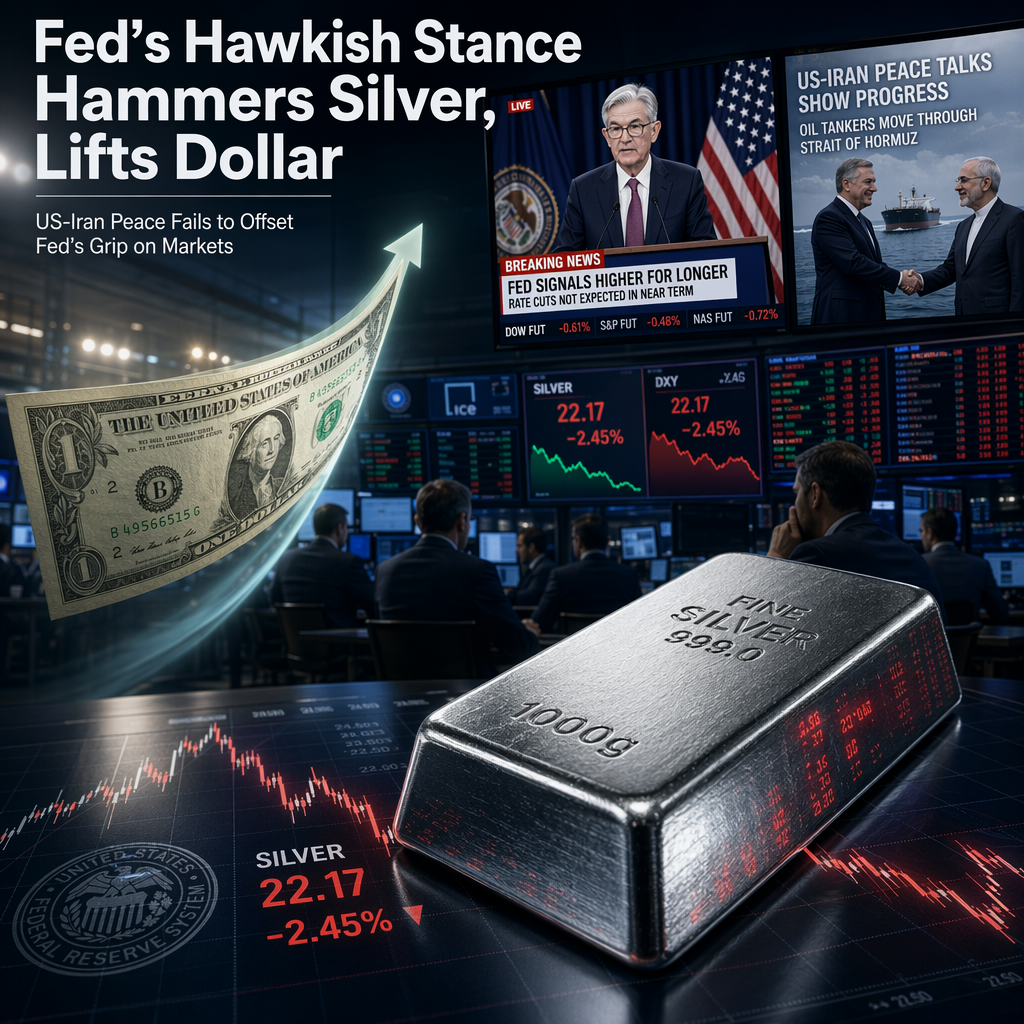
Silver prices (XAG/USD) extended their losses for the third consecutive day, trading around $24.40 per troy ounce during Asian hours on Friday, as traders responded to the hawkish sentiment from the Federal Reserve's latest policy outlook [1]. The US Dollar Index (DXY) remained flat after two days of gains, trading near 100.83, with the potential for further advances as market participants continued to price in the Fed's stance [2].
Both articles highlight the debut press conference of newly appointed Federal Reserve Chairman Kevin Warsh, who emphasized that 'price stability' is the Fed's ultimate guiding principle [1][2]. The Federal Open Market Committee (FOMC) voted unanimously on Wednesday to keep its benchmark overnight borrowing rate steady. However, there is a discrepancy in the reported rate range: Source 1 states 5.25%–5.50% [1], while Source 2 reports 3.5%–3.75% [2]. Both sources agree that the decision was accompanied by a hawkish tone, with nearly half of Fed officials signaling that at least one rate hike could be required later this year [1][2].
The hawkish Fed outlook has outweighed the positive impact of the US-Iran peace agreement, which has led to lower oil prices and eased inflation concerns [1][2]. The US and Iran have signed an initial agreement, initiating 60 days of negotiations on a final deal to end the war, according to CNN [1][2]. Additionally, the US military confirmed it ended its blockade on Iranian ports near the Strait of Hormuz, allowing millions of barrels to flow through the waterway again [1][2]. While these developments could boost riskier assets in the near term, traders remain cautious, expecting it to take months for shipping and energy flows to recover to pre-conflict levels [1].
Market implications discussed include the reduced appeal of non-yielding assets like silver due to higher borrowing costs, and the potential for the US Dollar to advance further if the Fed maintains its hawkish stance [1][2]. However, easing safe-haven demand from the US-Iran agreement could present challenges for the US Dollar and support riskier assets [2].
CONCLUSION
The Federal Reserve's hawkish policy outlook has put downward pressure on silver prices and supported the US Dollar, despite positive geopolitical developments between the US and Iran. Market participants remain focused on the possibility of further Fed rate hikes, while the impact of the US-Iran agreement is expected to unfold gradually. Overall, the market response is cautious, with monetary policy remaining the dominant driver.