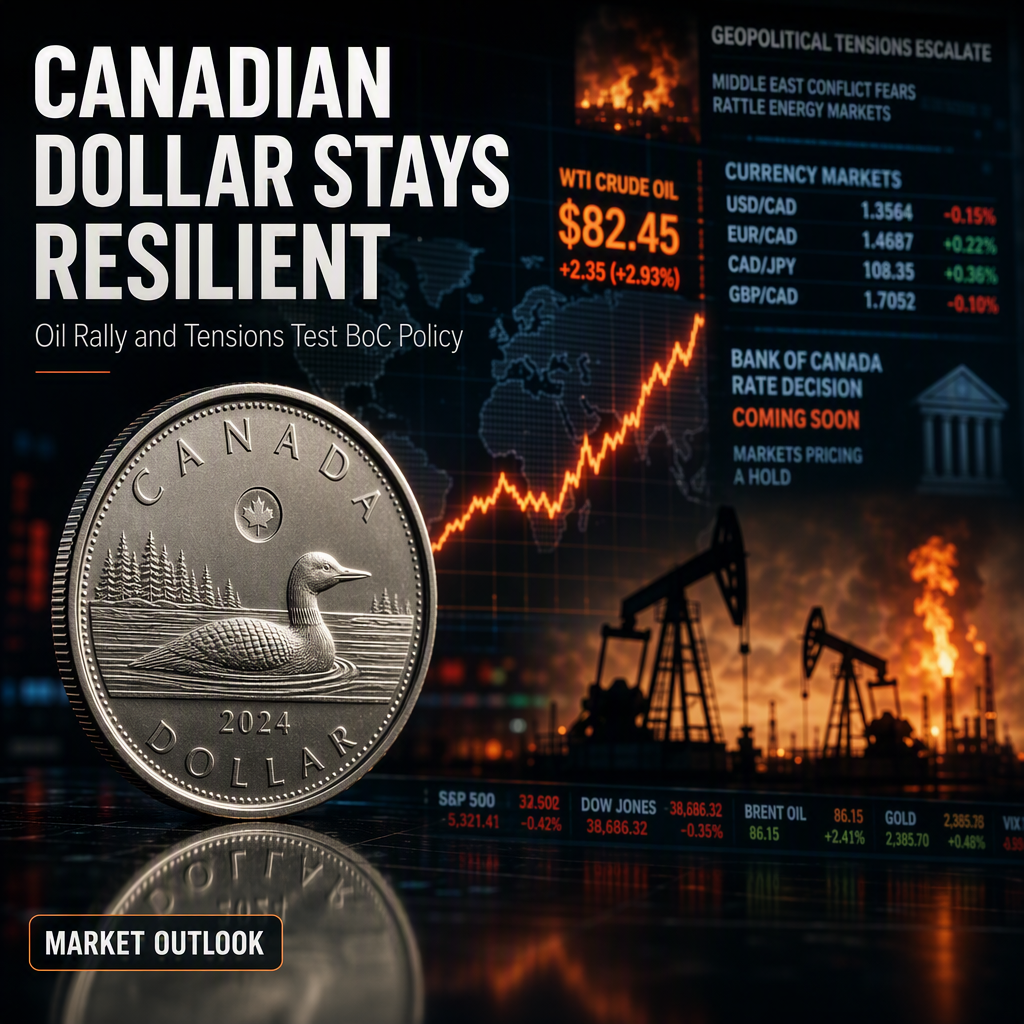
The Canadian Dollar (CAD) outperformed the US Dollar (USD) on Monday, with USD/CAD falling 0.24% and trading around 1.3870 after reaching its highest level in over two weeks earlier in the session [1]. This movement was driven by rising oil prices amid escalating geopolitical tensions between the United States and Iran. US forces struck two rocket launchers on Iran’s Larak Island, prompting Tehran to retaliate with ballistic missiles targeting two US bases in Jordan. These developments have fueled concerns over energy supplies, supporting oil prices and, by extension, the Canadian Dollar, given Canada’s status as a major oil exporter [1].
Despite the CAD's recent strength, strategists at Scotiabank note that the currency remains little changed on the session and has spent the past week trading at or slightly below their estimated fair value, which has nudged higher to 1.3920 due to wider front-end US/Canada swap spreads [1][2]. They highlight the CAD's resilience in the face of volatile Federal Reserve expectations and ongoing trade uncertainty, reaffirming their view that there is limited downside potential for the CAD at present [1][2]. However, both sources caution that the scope for further CAD gains is constrained by the wide interest rate gap between the US and Canada [1][2].
Market attention is now focused on the upcoming Bank of Canada (BoC) monetary policy decision scheduled for Wednesday. Both sources indicate that no change in policy is expected, with the BoC likely to maintain its cautious outlook [1][2]. Additionally, Friday’s employment reports from both the US and Canada are anticipated to provide further insight into the economic and monetary policy outlooks. Scotiabank expects a moderate gain of 15,000 jobs in Canada following a strong July report [2].
On the technical front, the USD closed last week on a strong note, reversing through the August bear channel. While there is room for the USD to correct further in the short term, resistance is expected at 1.3980/00, with support at 1.3845 and 1.3820/25 [2].
CONCLUSION
The Canadian Dollar has shown resilience amid rising oil prices and geopolitical tensions, but its upside remains limited by interest rate differentials. With the Bank of Canada policy decision and key employment data on the horizon, markets are likely to remain focused on these events for further direction. Overall, the CAD is expected to remain near fair value in the near term.