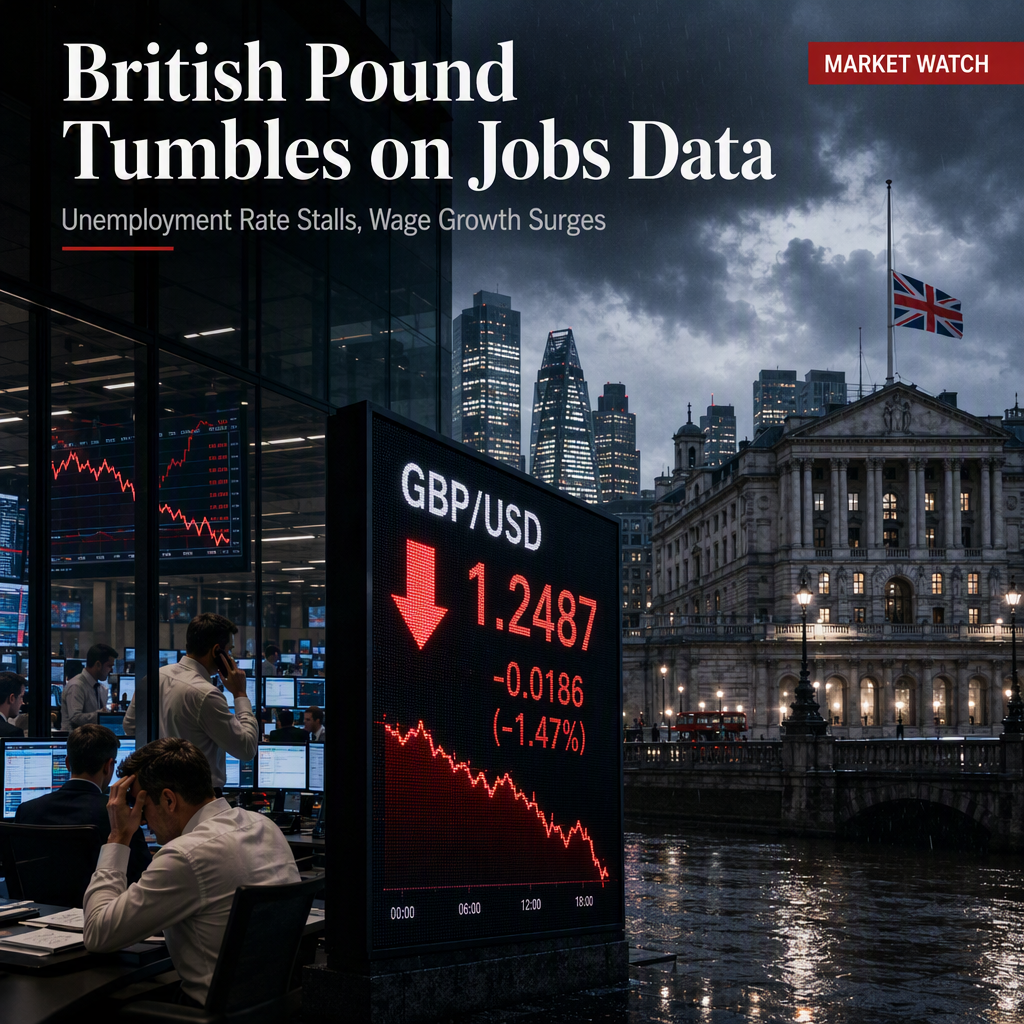
The British Pound (GBP) experienced selling pressure across multiple currency pairs following the release of UK employment data for the three months ending in June. The Office for National Statistics (ONS) reported that the UK ILO Unemployment Rate remained steady at 4.9%, above market expectations of 4.8% and unchanged from the previous period [1][2][3]. Employment increased by 83K, significantly lower than the 147K rise posted in May [1][2][3]. Meanwhile, the number of people claiming jobless benefits declined by 11K in July, outperforming expectations of an 11.2K gain and a prior revised decrease of 6.4K [1][2].
Wage inflation showed signs of acceleration, with Average Earnings Excluding Bonus rising by 3.5% year-on-year in the three months to June, up from 3.4% previously [2][3]. The wage growth measure including bonuses grew in line with 4.1% projections, but slowed from the previous reading of 4.4%, which was revised higher from 4.3% [3]. The mixed employment data led to immediate weakness in the Pound, with GBP/USD dropping to 1.3522 and GBP/JPY falling to near 215.95 [2][3]. EUR/GBP posted modest gains near 0.8550, as the Euro held firm against the Pound [1].
Market participants are bracing for further volatility in the Pound ahead of the UK Consumer Price Index (CPI) release scheduled for Wednesday, which is expected to show headline inflation accelerating to 2.9% year-on-year from 2.6% in June, while core CPI is seen growing at 2.5% versus 2.6% previously [3]. The inflation data is anticipated to have a significant impact on Bank of England (BoE) monetary policy expectations, though strategists at Rabobank expect the BoE to keep interest rates on hold through the end of the year [3]. Financial markets currently price in one 25 basis point interest rate hike by the end of 2026 [1].
On the technical front, EUR/GBP remains capped under the 100-day simple moving average (SMA), with a mildly bearish near-term tone and neutral momentum indicated by a Relative Strength Index (RSI) around 48.5 [1]. Immediate support is seen at 0.8530, while resistance levels are at 0.8555, 0.8582, and a significant cap at 0.8620 [1].
Geopolitical tensions in the Middle East have contributed to a risk-off market environment, supporting the US Dollar (USD). The Memorandum of Understanding between the US and Iran ended on Monday, with US President Donald Trump threatening military action and Iranian officials signaling a shift to a "fully offensive" stance [2]. Despite this, strategists at Scotiabank see the USD biased lower in the near-term due to soft US data and concerns about fiscal dynamics, expecting the DXY to retreat to the 97.5/98.5 range [2].
CONCLUSION
The British Pound weakened following disappointing UK employment data, with the unemployment rate remaining above expectations and wage growth accelerating. Market participants are awaiting the upcoming UK inflation report, which could influence Bank of England policy, though analysts expect rates to remain steady through year-end. Overall, the mixed labor data and rising geopolitical tensions have contributed to a risk-off sentiment, pressuring the Pound and supporting the US Dollar.