
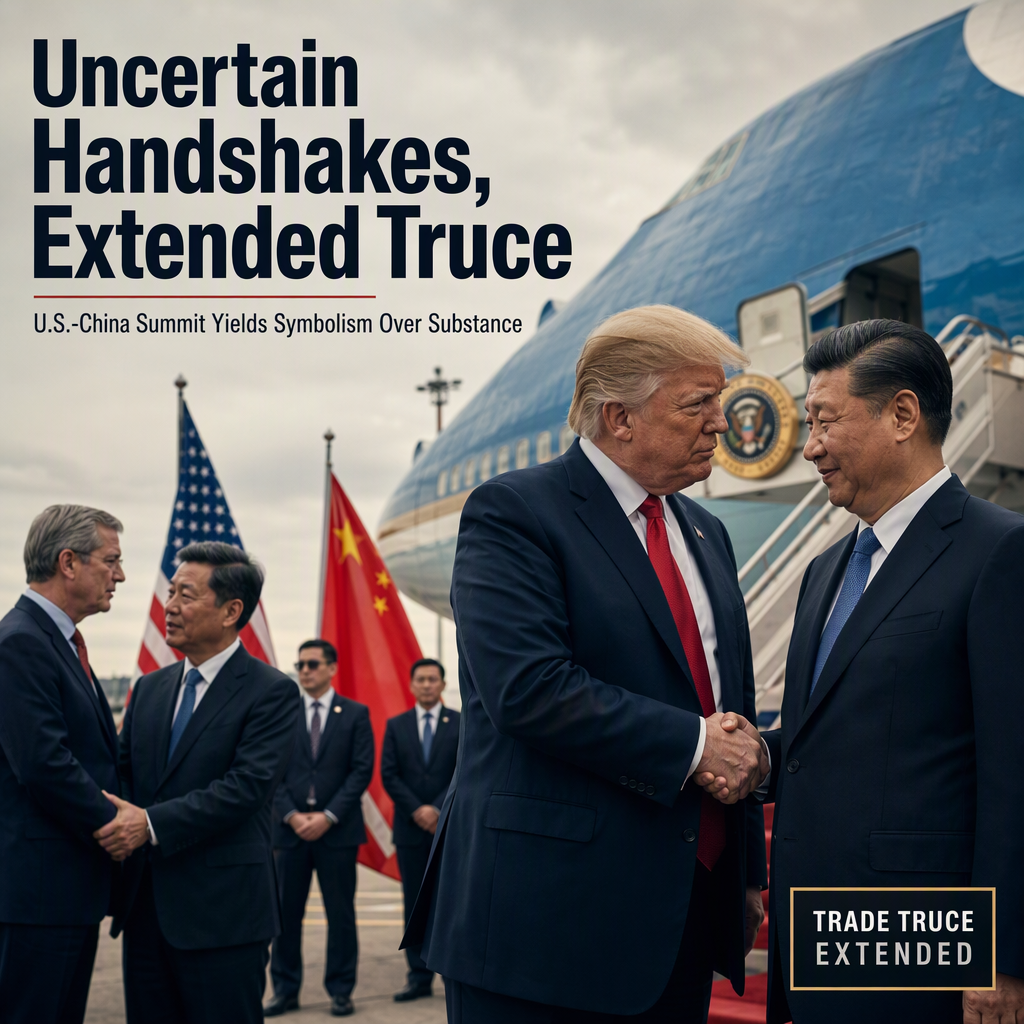
U.S. President Donald Trump and Chinese President Xi Jinping met in Washington on Thursday, marking their second face-to-face meeting this year after a previous summit in Beijing in May [1]. The White House emphasized the importance of the visit by having Trump personally greet Xi at Joint Base Andrews, a gesture described as unusual and significant [1]. Despite the ceremonial nature of the summit, the most consequential development occurred prior to the leaders' meeting: U.S. Treasury Secretary Scott Bessent, following talks with Chinese Vice Premier He Lifeng, announced an agreement to extend the U.S.-China trade truce by another two months [1]. This extension is seen as potentially more impactful for global economic stability than the summit itself [1].
During the summit, Xi Jinping sought reassurance regarding the U.S. position on Taiwan, according to a Xinhua readout [1]. He also called for cooperation on artificial intelligence, urging both countries to ensure that AI remains under human control [1]. While additional agreements may emerge, the summit's tangible achievements remain unclear, echoing the ambiguity of their previous meeting in Beijing [1].
The timing of the summit is notable, with U.S. midterm elections approaching. Trump appears eager to showcase progress in international relations, highlighting his strong working relationship with Xi despite the lack of breakthrough agreements [1]. The international community and media closely monitored the summit, anticipating major news, but the main takeaway was the absence of confrontation, dramatic breakthroughs, or a clear shift in U.S.-China relations [1].
Economists and policymakers continue to debate the value of the yuan, with estimates suggesting it remains as much as 30% undervalued. Calls for a stronger yuan to rebalance trade flows have intensified, particularly from Europe, though Beijing has allowed only managed appreciation due to concerns about domestic economic impacts [1].
CONCLUSION
The Trump-Xi summit was largely ceremonial, with the extension of the U.S.-China trade truce emerging as the most significant outcome. While the meeting avoided confrontation and produced no major breakthroughs, it provided both leaders an opportunity to demonstrate diplomatic engagement. The ambiguity surrounding the summit leaves the trajectory of U.S.-China relations unchanged for now.