
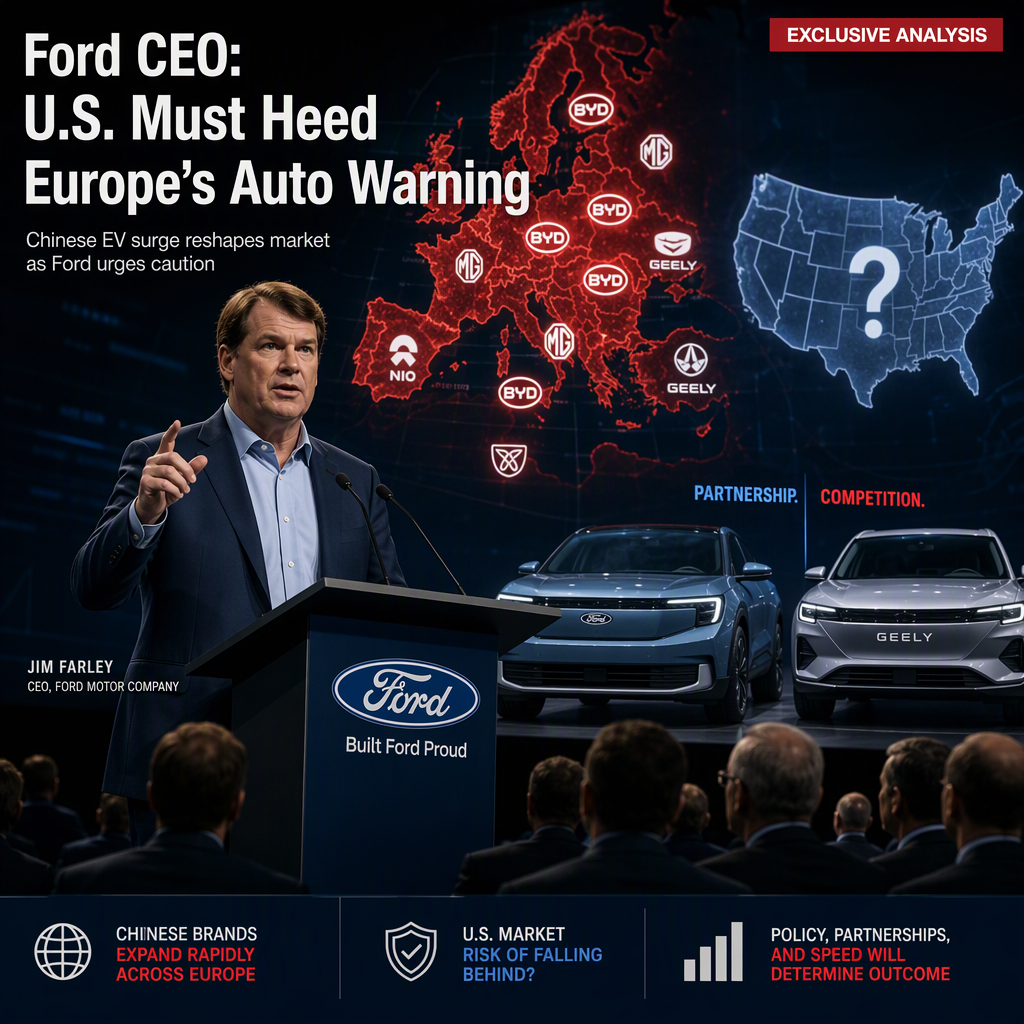
Ford CEO Jim Farley stated at the 2026 Automotive News Congress in Detroit that it is 'too late' for Europe to fend off the influx of Chinese automakers, but the United States still has time to make a careful decision regarding their entry into the market [1]. Farley emphasized the importance of learning from Europe's experience, noting that politicians should be 'considerate' when deciding whether to allow Chinese automakers into the U.S. [1]. He highlighted that Chinese brands' global market share surged nearly 70% from 2020 to 2025, and their market share in Europe rose from virtually nothing in 2020 to 12% in August 2026, according to Dataforce [1].
Ford is actively competing against Chinese automakers in Europe while also partnering with some Chinese companies for technology and plant operations. For example, Ford and Geely announced in July that Geely would build electric vehicles at Ford's Spain plant by early next year through a new manufacturing joint venture [1]. Farley explained Ford's strategy: 'We're going to partner with the Chinese where we don't have [intellectual property], where we can be more capital efficient in places like Europe or Southeast Asia,' but also stated Ford plans to compete directly, preparing to launch its 'universal electric vehicle' next year with a pickup truck [1].
The issue has drawn political attention in the U.S., with the Trump administration sending Ford a letter expressing 'profound concern' about its ties to Chinese companies and questioning its strategic direction. Ford defended its position as America's top-producing carmaker and largest employer of hourly workers in the country [1]. The debate follows a recent meeting between Chinese President Xi Jinping and President Donald Trump, who indicated he might be 'OK' with Chinese automakers entering the U.S. if they produced vehicles domestically [1]. Additionally, bills are pending in Congress that could restrict or permanently ban Chinese automotive brands from entering the U.S. market [1].
CONCLUSION
Ford CEO Jim Farley's remarks underscore the rapid rise of Chinese automakers in Europe and warn U.S. policymakers to proceed cautiously. With political scrutiny intensifying and legislative action possible, the market impact is significant as Ford balances competition and partnership strategies. The outcome could shape the future landscape of the U.S. automotive industry.