
The Norwegian Krone (NOK) has weakened against most major currencies following a modest decline in crude oil prices, according to Brown Brothers Harriman (BBH) [1]. Despite this softness, recent September Consumer Price Index (CPI) data from Norway suggest that the possibility of further interest rate hikes by Norges Bank remains, which is providing some support to the NOK [1].
Headline CPI for September rose to 3.4% year-over-year, slightly higher than August's 3.3% but below both the market consensus of 3.6% and Norges Bank’s own projection of 3.5% [1]. Underlying CPI held steady at 3.0% year-over-year for the second consecutive month, which was below the consensus estimate of 3.1% but above the central bank’s forecast of 2.9% [1].
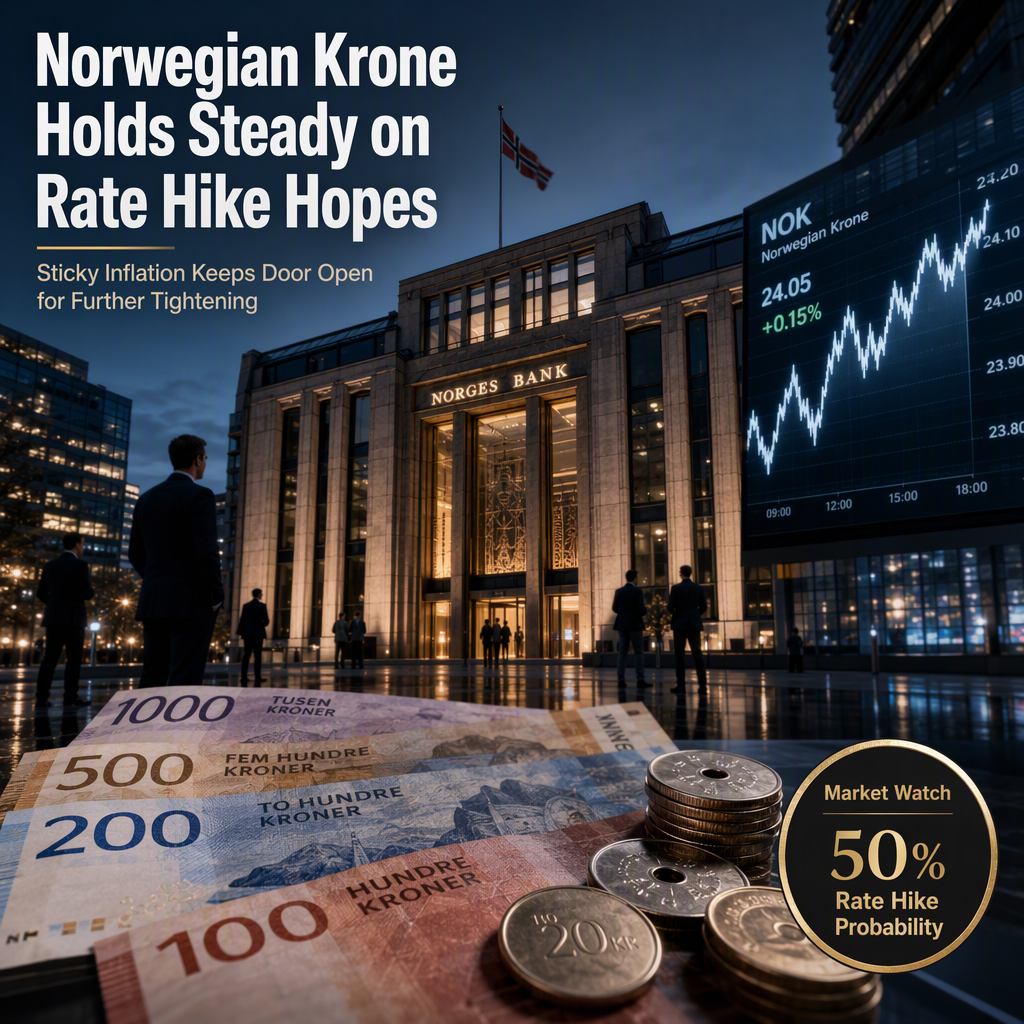
At its most recent meeting in September, Norges Bank raised its policy rate by 25 basis points to 4.50% and indicated its readiness to increase rates further if the inflation outlook warrants such action [1]. The persistence of underlying inflation above the central bank’s projections keeps the option for additional tightening open. Market pricing, as reflected in the swaps curve, currently assigns roughly a 50% probability to another 25 basis point rate hike to 4.75% by the end of the year [1].
CONCLUSION
Sticky underlying inflation in Norway, despite headline CPI coming in below expectations, is keeping the door open for further rate hikes by Norges Bank. Market participants are assigning a 50% chance of an additional hike by year-end, supporting the NOK even as it faces pressure from lower oil prices.