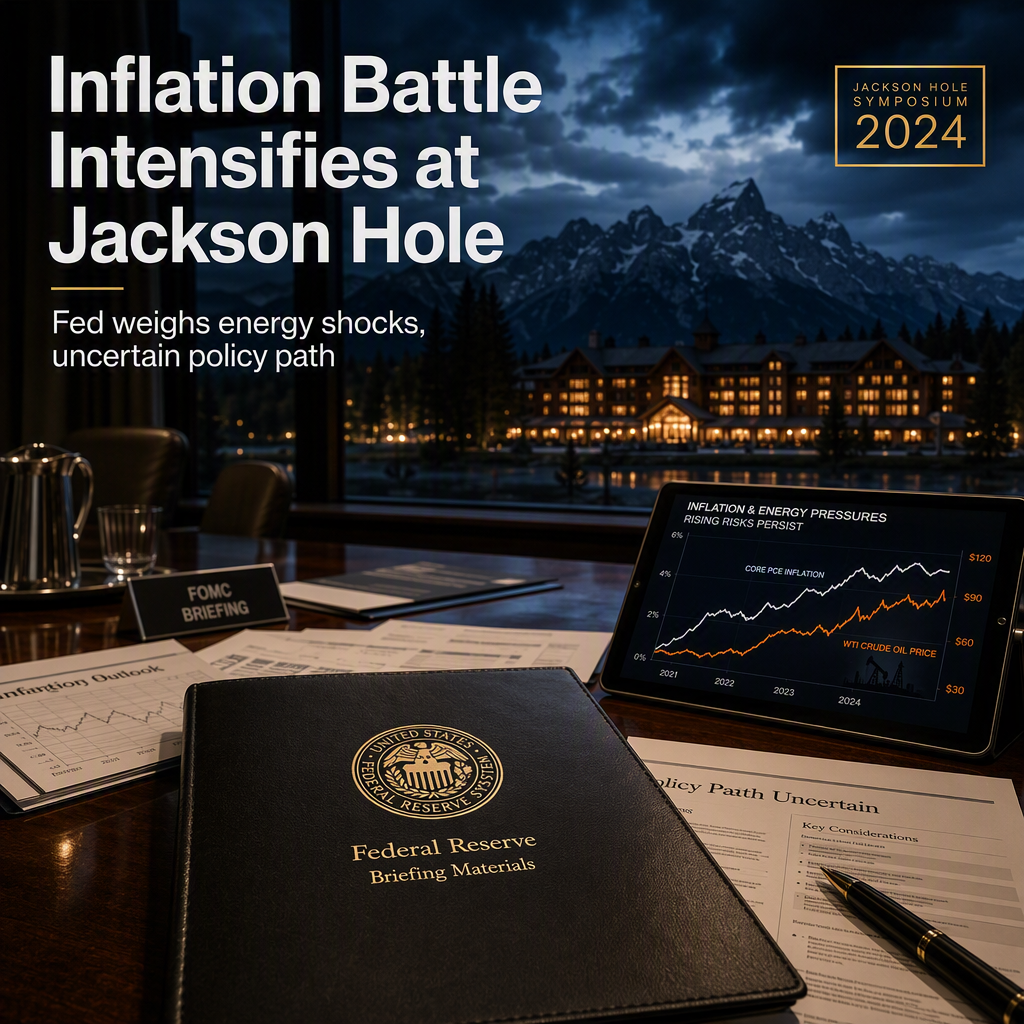
Federal Reserve officials expressed growing concern over persistent inflation and the impact of recent energy shocks on the broader US economy, as highlighted in remarks from Kansas City Fed President Jeffrey Schmid and Chicago Fed President Austan Goolsbee [1][2][3][5]. Schmid, speaking at the Jackson Hole Symposium, described inflation as 'stubborn and sticky,' noting that the current policy rate of 3.5%-3.75% may not be restrictive enough to curb price pressures [5]. He emphasized the need for more data before supporting any further rate hikes, stating, 'I don't know what we're restricting currently with the rate policy that we're at today,' and reiterated the Fed's commitment to returning inflation to its 2% target [1][5]. Schmid also warned that the energy shock is 'leaking into the economy,' complicating the inflation outlook [1][3][5].
Goolsbee echoed concerns about inflation, highlighting that tariffs and war-related price increases are making the Fed's job more difficult. He warned that political interference with the central bank could further fuel inflation, and described the current labor market as 'low-hire, low-fire,' which is unusual [2]. Goolsbee's biggest short-term fear is that inflation is not under control, though he noted that recent three-month inflation data 'doesn't look terrible' [2].
Recent economic data reinforce these concerns. The US Personal Consumption Expenditures (PCE) Price Index, the Fed's preferred inflation gauge, showed core prices rising 3.3% year-over-year, well above the 2% target [4][5]. Headline PCE increased 0.2% month-over-month and 3.7% year-over-year, while real personal spending stalled [4]. Initial Jobless Claims fell to 203,000 for the week ending August 22, below expectations, indicating continued labor market strength [3]. The US Dollar Index (DXY) consolidated gains, testing resistance at its 200-day moving average, but analysts at Brown Brothers Harriman (BBH) suggest the dollar remains vulnerable to a dovish Fed repricing, as futures markets price in only a 36% chance of a 25 basis point hike at the September meeting [3][4].
Looking ahead, traders and analysts are focused on Fed Chair Kevin Warsh's upcoming speech at the Jackson Hole Symposium for further guidance on the interest rate path, though clear policy signals are expected to be scarce [3][4]. Schmid also mentioned the possibility of reducing the number of FOMC meetings per year, an idea raised by Warsh in July [1][5]. Across the Atlantic, the European Central Bank is also weighing further tightening, with policymakers signaling readiness to act if inflation does not improve [3].
CONCLUSION
Fed officials are signaling heightened concern about persistent inflation, driven in part by energy shocks and geopolitical factors. With inflation measures remaining above target and uncertainty about the restrictiveness of current policy, markets are bracing for continued volatility and closely watching for signals from the Jackson Hole Symposium. The Fed's next moves remain data-dependent, with no imminent rate hike assured.