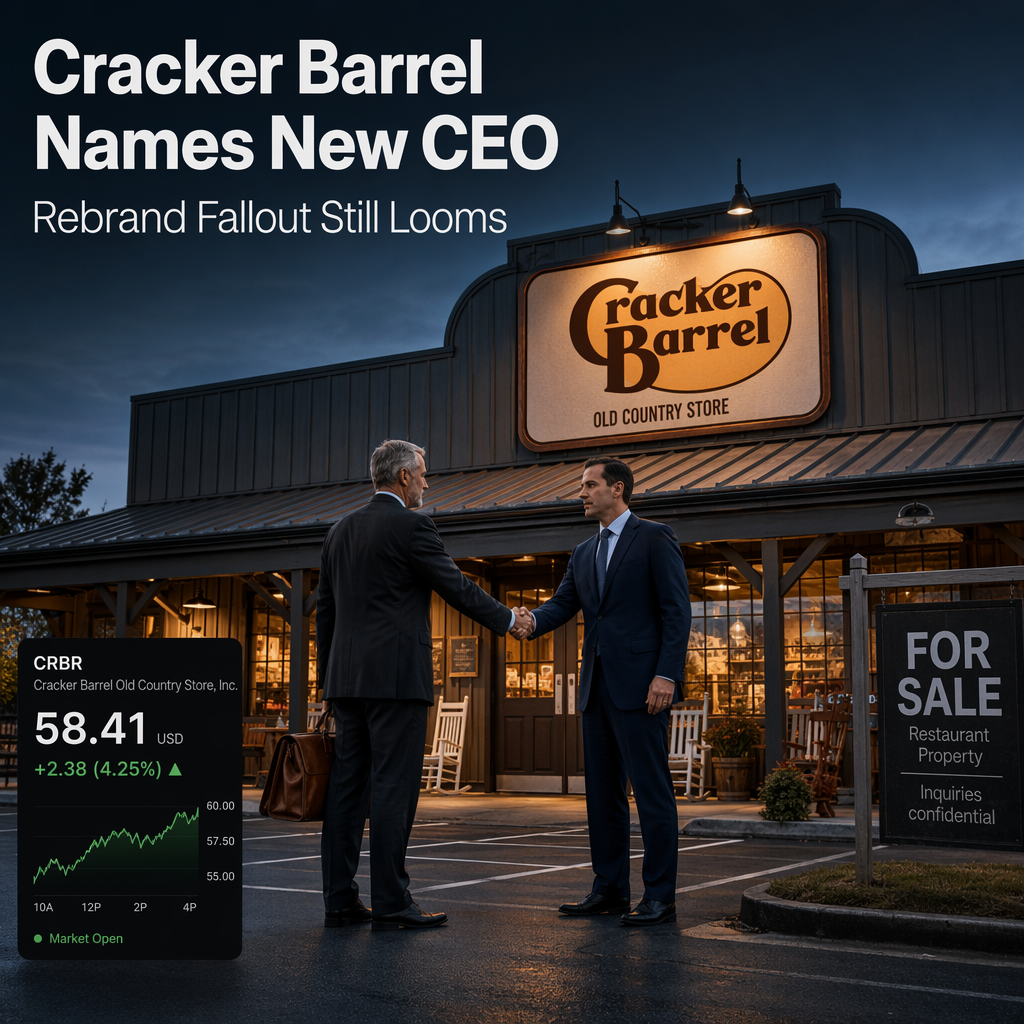
Cracker Barrel Old Country Store Inc. announced that CEO Julie Masino will step down effective August 10, with David Deno set to assume the role as the company continues to recover from the negative impact of its failed rebrand last year [1]. The rebrand, which included removing the 'old timer' from the logo and altering the restaurant's traditional interior layout, led to a slump in sales and a decline in customer traffic that has yet to fully rebound, according to company executives on the most recent earnings call [1].
In its third-quarter earnings, Cracker Barrel reported that comparable store restaurant sales decreased by 2.6%, driven by a 6.7% decline in traffic. CFO Craig Pommells noted that while traffic remained negative, there was a gradual improvement in the underlying trend compared to the previous year [1]. CEO Julie Masino stated, 'Q3 results exceeded our expectations, driven by our operating and cost actions, while guest-facing metrics continue to improve, and position us for further traffic recovery' [1].
Cracker Barrel's stock price is down approximately 18% from a year ago and remains below pre-rebrand levels. However, the company has made significant progress in 2026, with the stock up 105% since the start of the year [1]. On the day of reporting, CBRL shares closed at $52.48, down $1.23 or 2.29% [1].
To strengthen its financial position, Cracker Barrel recently announced the sale of some restaurant properties and its exit from the Maple Street Business Company. The company sold the Maple Street brand and 35 locations to Biscuit Belly LLC, closing the remaining 16 Maple Street restaurants [1]. Additionally, a sale-leaseback deal involving 26 company-owned locations generated about $77 million in net proceeds, which the company plans to use to pay down debt while continuing to operate the restaurants under lease agreements [1].
Brand expert Bruce Turkel commented, 'A brand isn’t what management wants it to be. It’s what customers believe it is' [1].
CONCLUSION
Cracker Barrel is navigating a leadership transition and implementing strategic financial moves as it works to recover from the fallout of its failed rebrand. While traffic and sales remain below prior-year levels, gradual improvement and decisive actions signal cautious optimism for the company's ongoing turnaround.