
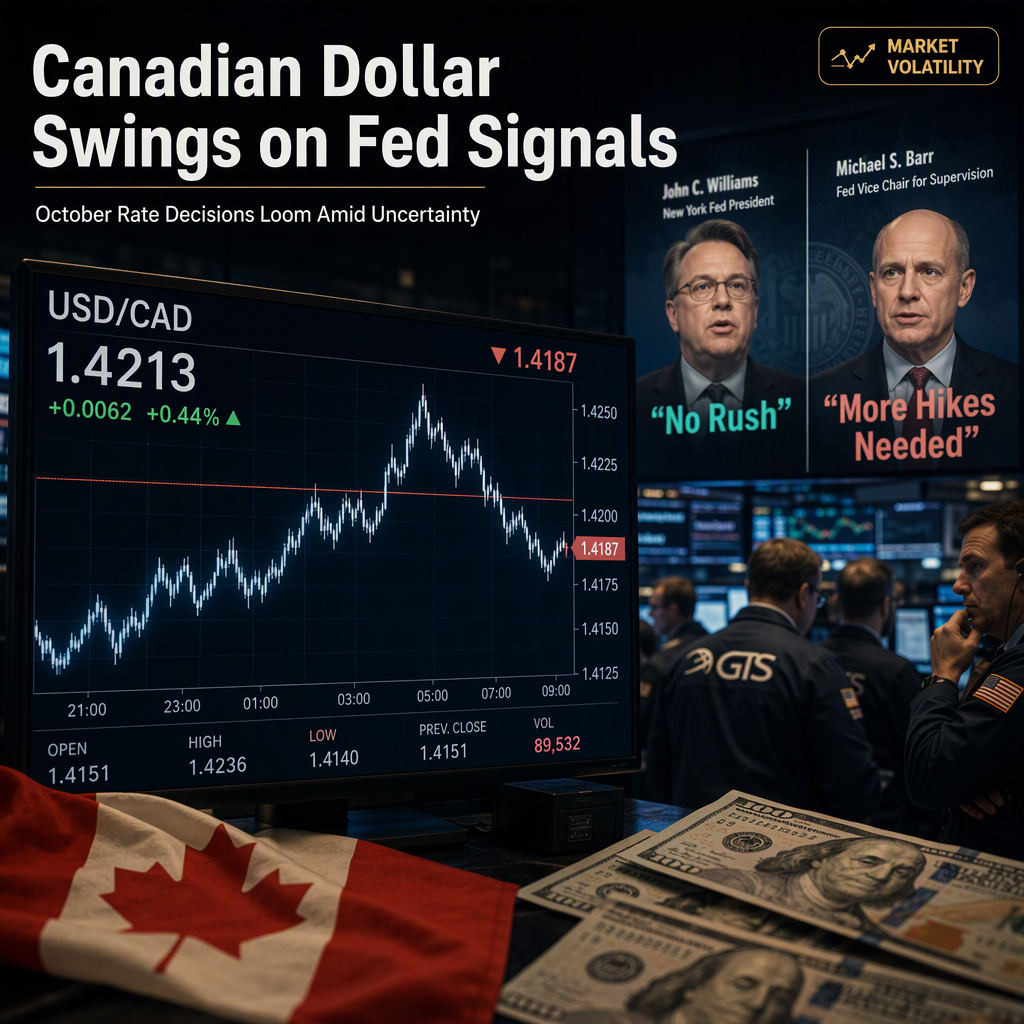
The Canadian Dollar (CAD) experienced notable volatility on Tuesday, with USD/CAD rising above 1.4200 for the first time since early July before retreating twice, largely in response to differing signals from Federal Reserve officials regarding the timing of future rate hikes [1]. New York Fed President Williams, a permanent voter on rates, stated there is 'no rush to hike again,' which triggered the second drop in USD/CAD. However, Fed Governor Barr later indicated that high energy prices and artificial intelligence investment could necessitate more hikes, causing the pair to make another run at session highs [1].
US job openings fell to 7.079 million in August, below the forecast of 7.23 million, but USD/CAD recovered after Barr's comments [1]. Fed funds futures are pricing about a 70% chance of an October hike, with both the Fed and Bank of Canada (BoC) set to decide on rates on October 28. Williams suggested inflation may not return to the Fed's target until 2028 and sees no urgency for further hikes, while swaps indicate slightly better than even odds for a BoC hike on the same day [1].
Statistics Canada reported the economy was flat in July, matching forecasts, after 0.4% growth in June. Construction rose 1.3% and utilities 1.7%, offsetting a 0.9% drop in manufacturing. The early estimate for August is 0.2% growth, with National Bank of Canada projecting third-quarter growth near 2.0% annualized, ahead of the BoC's 1.5% forecast [1]. BoC Governor Macklem previously stated the central bank was prepared to raise rates more than once if inflation remained high [1].
The BoC also announced, via Deputy Governor Gravelle at a Bloomberg conference, that its Government of Canada bond buying could start in late 2027 or possibly 2028, later than previous estimates. This routine bond buying is not considered stimulus and primarily affects bond holdings rather than rates [1].
CONCLUSION
The Canadian Dollar's volatility reflects uncertainty around central bank policy, with Fed officials offering mixed signals on rate hike timing and the BoC potentially outpacing its own growth forecasts. Market participants are closely watching the October 28 decisions from both the Fed and BoC, as well as evolving economic data and forward guidance. The outlook remains cautious, with swaps and futures indicating moderate odds for rate hikes amid ongoing inflation concerns.