
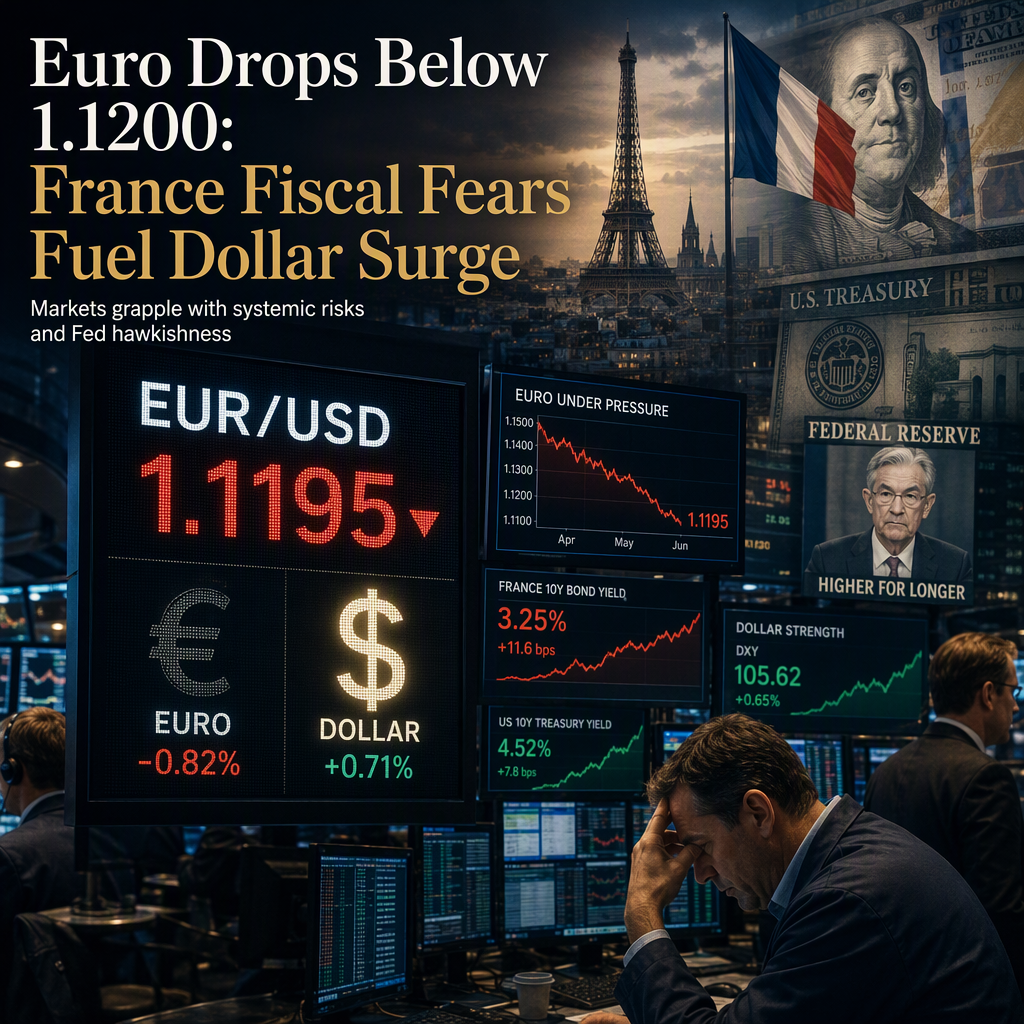
The Euro (EUR) has experienced renewed selling pressure against the US Dollar (USD), with EUR/USD dropping to 1.1164 before rebounding to close at 1.1195, marking a 0.56% decline on the day [1][2]. UOB strategists note that while downward momentum has slowed, the Euro remains vulnerable as long as resistance near 1.1265 holds, and there is scope for a test of 1.1140 in the coming weeks, though a deeper slide below that level is viewed as less likely for now [1]. Technical analysis confirms a bearish tone for EUR/USD, as the pair remains below key trend metrics, including the 100-day simple moving average and the Bollinger middle band, with oversold conditions prevailing [2].
France's fiscal concerns have been a significant driver of Euro weakness, as rising borrowing costs amid a global bond rout have prompted a selloff in the shared currency. Traders are worried that France's fragile public finances could pose systemic risks for Europe, with Citadel's head of Economic Research for Fixed Income & Macro, Ubide, stating, "France is very big. If we are discussing a systemic problem with France, we are discussing a systemic problem for Europe. I would hope and expect that we don't get to the point of having that discussion" [2]. ABN Amro strategists highlight that changes in interest rate spreads have encouraged speculative investors to take short euro and long dollar positions, and that periods of fiscal and political uncertainty in the eurozone often coincide with net short euro positions and a lower EUR/USD [2].
On the US side, the Federal Reserve's September meeting minutes revealed that policymakers were united in backing the recent rate hike, and most officials assessed that another hike would be appropriate by year-end. This hawkish outlook, combined with elevated US bond yields, has supported the US Dollar, which trades near its annual high, with the US Dollar Index (DXY) at 102.28 and 10-year US Treasury yields up 0.6% to near 5.32% [2][3][4]. The selling pressure in US bonds remains intact as Fed officials continue to warn of upside inflation risks [3].
Market sentiment for the Euro remains negative, with ABN Amro suggesting that "sentiment may remain negative in the near term, but we do not expect the sell-off to continue," maintaining their end-2026 EUR/USD forecast at 1.15 [2]. Meanwhile, other major currency pairs such as GBP/USD and USD/JPY are also affected by the strong US Dollar. GBP/USD trades near 1.3200, close to its lowest level since late June, as the Dollar retains its bullish undertone amid Fed hawkishness and elevated bond yields [4]. USD/JPY is up 0.13% to near 158.23, with the Japanese Yen giving back early gains despite stronger-than-expected current account data [3].
CONCLUSION
The Euro's decline below 1.1200 is driven by France's fiscal concerns and the US Dollar's strength amid hawkish Fed signals and rising US yields. Market sentiment remains bearish for the Euro in the near term, though analysts do not expect a prolonged sell-off. The broader FX market is also impacted, with GBP/USD and USD/JPY reflecting the Dollar's dominance.