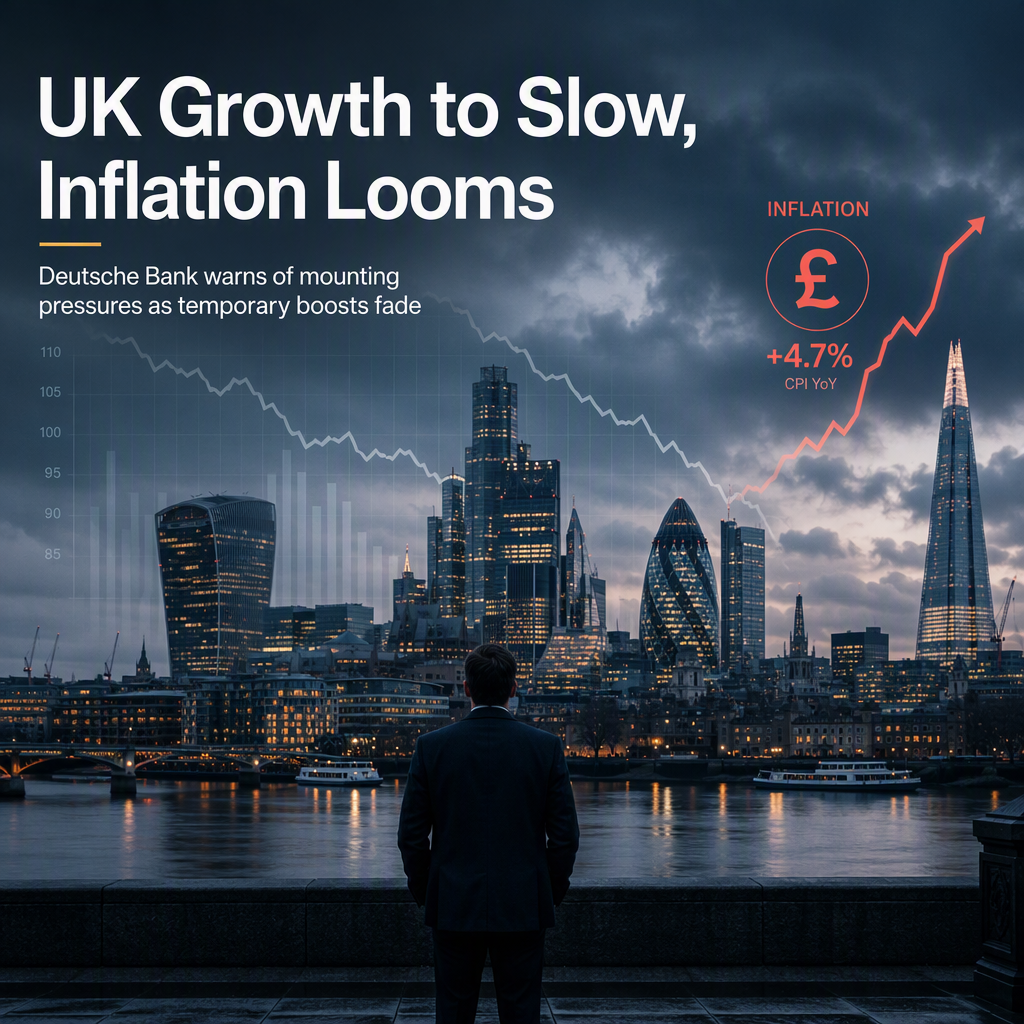
Deutsche Bank economists Sanjay Raja and Maui Brennan report that the United Kingdom entered autumn as the fastest-growing G7 economy, driven by robust investment in ICT and AI and improving productivity [1]. However, they caution that this growth momentum is expected to moderate in the second half of the year as temporary boosts from a hot summer and the World Cup dissipate, higher energy prices take effect, and retail spending fatigue and seasonal factors weigh on economic activity [1].
The economists highlight that while the UK economy has outpaced its G7 peers so far this year, several headwinds are emerging. They note that credit card lending may have supported spending in the first half, but anticipate that rising prices—particularly higher household dual fuel bills from the third quarter onwards—will squeeze real disposable incomes [1]. Additionally, they do not expect the UK to sustain its annualized growth rate of approximately 2% into the second half of the year [1].
On the inflation front, Deutsche Bank observes that inflation has reached its lowest point but warns that emerging pressures are likely to push the Consumer Price Index (CPI) well above the Bank of England’s target in the coming quarters [1]. The report suggests that while hopes for a productivity revival are rising and signs of labor market stabilization are appearing, the overall outlook is clouded by these inflationary risks and the fading of temporary growth supports [1].
CONCLUSION
Deutsche Bank sees the UK's strong growth momentum slowing in the second half of the year as temporary supports fade and inflationary pressures build. The outlook is tempered by expectations of higher energy costs and squeezed real incomes, with inflation likely to exceed the Bank of England's target in the near term. Investors should monitor AI investment and productivity trends as key factors for the UK's economic trajectory.