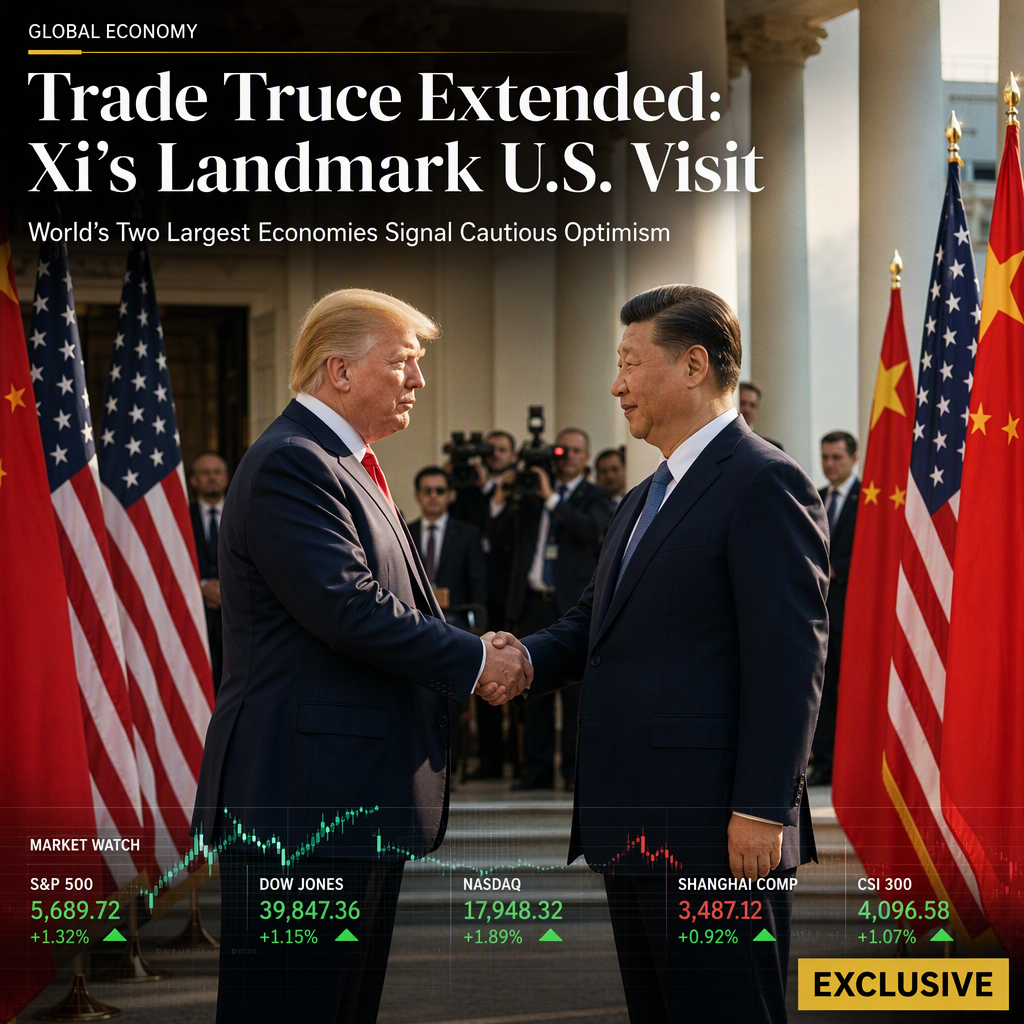
President Donald Trump welcomed Chinese President Xi Jinping to Washington for Xi's first U.S. state visit in more than a decade, amid ongoing tensions between the world's two largest economies over trade, Taiwan, and artificial intelligence (AI) [1][2]. The visit was marked by significant diplomatic pageantry, with Trump greeting Xi and his wife at Joint Base Andrews, Maryland, and both leaders emphasizing their personal rapport [1].
A major development coinciding with Xi's arrival was the announcement by U.S. Treasury Secretary Scott Bessent that the United States and China have agreed to extend their trade truce, known as the 'Busan Agreement,' which was previously set to expire on November 10, through January 10 [2]. This agreement followed an unscheduled meeting between Bessent and China's vice premier He Lifeng in Washington [2]. Bessent indicated that while a larger economic package could be agreed upon by January, it is also possible that the current deal could simply be extended further [2]. He noted that there have been shortcomings in Chinese compliance with the agreement, and the U.S. expects more fulsome enactment in the coming months [2].
The extension of the trade truce is seen as a significant win for economic stability in both countries, especially given the backdrop of a trade war that had previously unsettled global markets [1][2]. The announcement was made just minutes after Xi's arrival, underscoring the importance of the state visit to ongoing economic negotiations [2]. Bessent also suggested that further announcements could be forthcoming from the Chinese delegation, including potential agreements to purchase more American agricultural products and possible deals in the financial services sector [2].
In addition to trade, AI remains a key area of competition and concern. Both sides have proposed exchanging safety alerts for AI-related incidents that could affect national security, but experts believe it is unlikely that a major security agreement on AI will emerge from this summit [1][2]. U.S. Trade Representative Jamieson Greer mentioned that the two countries could agree on lists of goods for lower tariffs, with consumer goods and low-tech items from China and energy, agricultural goods, and potentially medical devices from the U.S. being considered [2].
Despite the positive optics and the extension of the trade truce, analysts remain cautious about the summit's substantive outcomes. Allen Carlson of Cornell University noted that Trump is in a weaker domestic position due to inflation, falling approval ratings, and an unpopular war with Iran, which may limit the administration's leverage in negotiations [1]. Orville Schell of the Asia Society highlighted the strong personal chemistry between Trump and Xi, but experts suggest that Trump is seeking the ability to declare victory regardless of the summit's substantive results [1].
CONCLUSION
The extension of the U.S.-China trade truce through January 10 provides a measure of economic stability and signals ongoing dialogue between the two powers. While the summit is high on diplomatic symbolism, concrete breakthroughs on contentious issues like AI and broader trade reforms remain uncertain. Markets are likely to view the truce extension positively, but the long-term outlook depends on further negotiations and compliance.