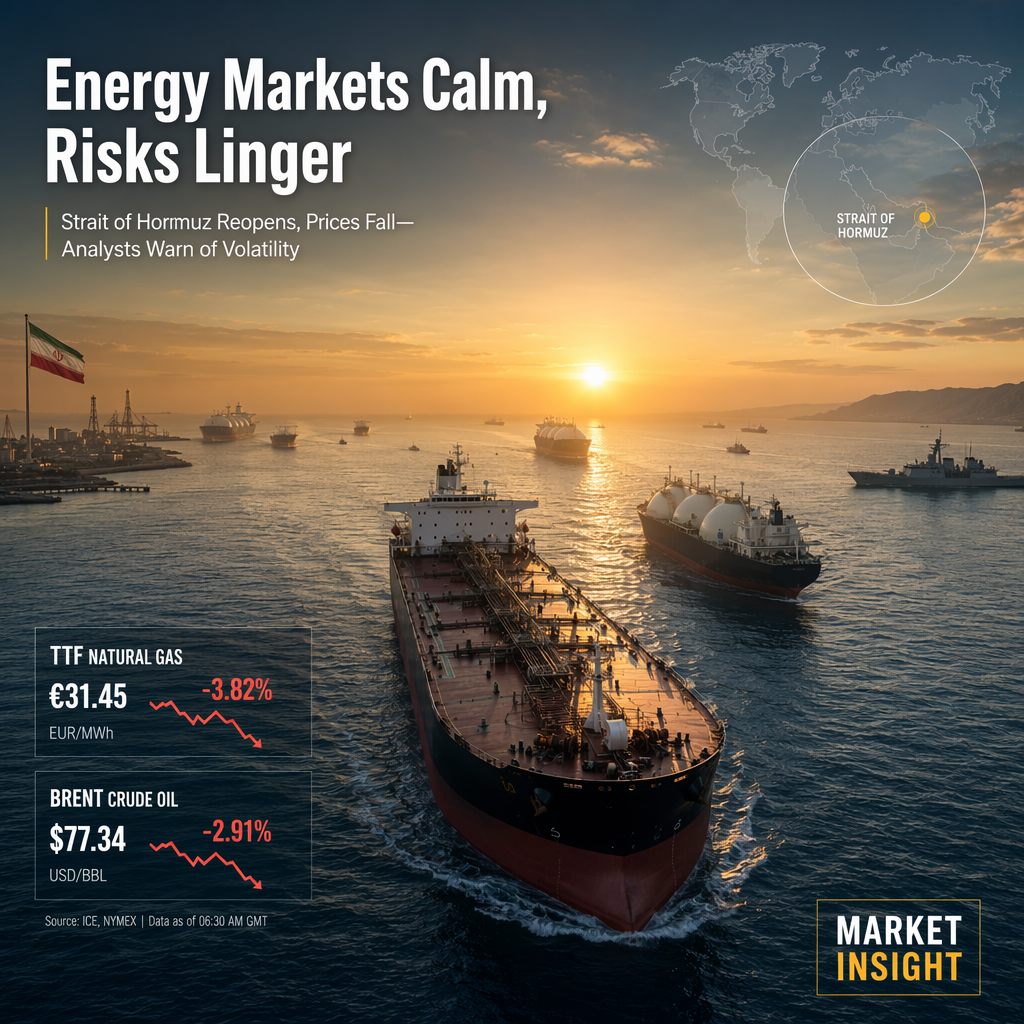
Rabobank’s energy strategists, Joe DeLaura and Florence Schmit, have revised their TTF Natural Gas price forecasts downward, citing easing supply risks following the reopening of the Strait of Hormuz. The new forecasts are €47/MWh for Q3 and €50/MWh for Q4, compared to previous estimates of €60/MWh and €69/MWh respectively, with a long-term projection of €42/MWh for 2027. However, Rabobank warns that tighter winter balances, stronger Asian LNG demand, and unresolved geopolitical issues, particularly concerning US-Iran peace talks, pose significant upside risks to gas prices. For the upcoming winter, Rabobank expects TTF prices in the €49-50/MWh range, but cautions that large upside risks remain tied to potential deterioration in peace negotiations between the US and Iran [1].
Commerzbank’s Carsten Fritsch reports that Brent oil prices have dropped below USD 80, briefly touching USD 76.5, following the US Treasury Department's announcement that Iran is permitted to export oil and oil products until at least August 21. Despite some normalization in ship traffic through the Strait of Hormuz, volumes remain significantly below pre-blockade levels, with more than 100 ships, including about 30 oil tankers, previously crossing daily. Commerzbank judges that further downside in oil prices is limited due to these constrained flows. Additionally, Commerzbank notes that LNG supply remains tight, and combined with higher summer demand, this could lead to rising gas prices [2].
Both sources highlight that while immediate supply risks have eased, particularly due to the reopening of the Strait of Hormuz and US sanctions relief for Iran, underlying market conditions remain fragile. Rabobank emphasizes the risk of tighter winter balances and unresolved geopolitical tensions, while Commerzbank points to constrained ship traffic and limited downside for oil prices. The bearish price response in gas markets following the signing of the MoU is already triggering a demand reaction, but both banks caution that upside risks persist, especially if peace talks falter or demand surges [1][2].
CONCLUSION
Energy markets have responded to eased supply risks with lower gas and oil price forecasts, but analysts from Rabobank and Commerzbank warn that upside risks remain due to tight winter balances, strong Asian LNG demand, and unresolved geopolitical issues. While immediate price declines have occurred, the potential for renewed volatility persists if supply constraints worsen or peace talks deteriorate. Investors should remain cautious as market conditions could shift rapidly.