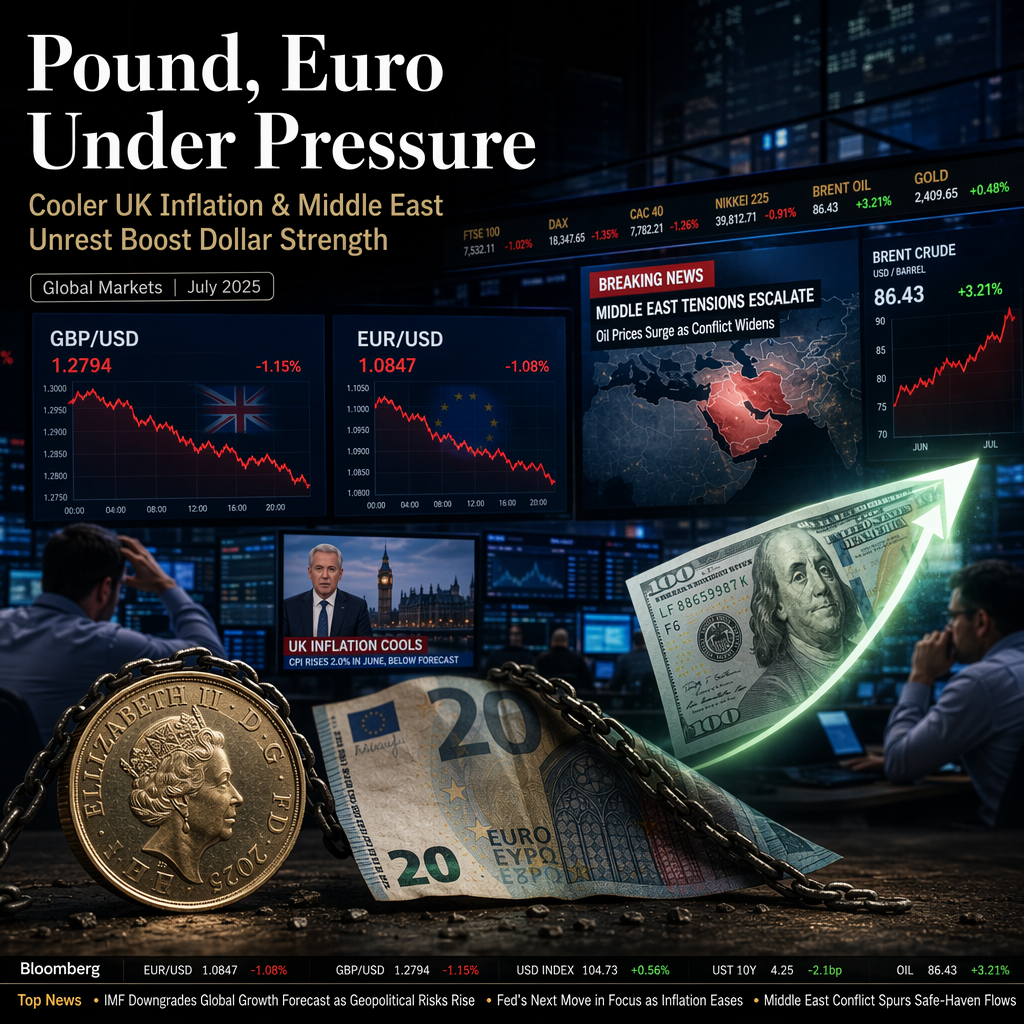
The British Pound continued its decline, albeit at a slower pace, following the release of the UK’s June inflation report. The Office for National Statistics reported headline Consumer Price Index (CPI) inflation at 2.6% year-over-year, below the 2.7% consensus and down from 2.8% in May, marking the lowest annual rate since March 2025. Services inflation eased to 3.6% from 3.7%, with a monthly gain of just 0.1%. The main contributors to the downside were transport and food prices. Despite the softer inflation print, core inflation remained steady at 2.6%, slightly above the 2.5% consensus, complicating the outlook for further Bank of England (BoE) rate hikes. Markets had been pricing in roughly one more move to 4.00% in the coming months, but the June data has pushed expectations for additional tightening further out. The GBP/USD pair touched the 1.3350 area, its weakest level in over a week, and is on track for a fifth straight daily decline, though the pace of the fall has slowed. Price action suggests exhaustion rather than a reversal, with the Pound unable to reclaim key resistance levels and remaining vulnerable to further downside. Political developments in the UK, including John Healey’s appointment as Chancellor, were noted, but the fiscal program that could impact gilt markets remains undefined [1].
Simultaneously, the Euro also struggled to capitalize on general US Dollar weakness, with EUR/USD consolidating near 1.1400, up just 0.08%. The escalation of the US-Iran conflict, including US President Donald Trump’s warnings of retaliation and continued US strikes for the twelfth consecutive day, has supported the Dollar. The UK Maritime Trade Operations reported an attack on a tanker in the Red Sea, and Yemen’s Houthis claimed attacks on two Saudi oil tankers. These events pushed West Texas Intermediate (WTI) crude oil prices up nearly 8% to $88 per barrel, increasing expectations that the Federal Reserve could tighten monetary policy sooner. Money markets now price a 37% chance of a Fed rate hike at the July 29 meeting, up from 23% a day earlier. The EUR/USD technical outlook remains bearish, with the pair trading below key moving averages and support at 1.1396, while resistance levels remain well above current prices. The Relative Strength Index (RSI) at 43.38 indicates weak downside momentum, but not yet oversold conditions. The European Central Bank is expected to keep its deposit facility rate unchanged at 2.25% in its upcoming decision [2].
Overall, both the Pound and the Euro are under pressure due to a combination of softer UK inflation data, persistent geopolitical tensions in the Middle East supporting the US Dollar, and shifting expectations for central bank policy in the US and Europe. Market participants remain cautious, with technical and fundamental factors suggesting limited upside for both currencies in the near term [1][2].
CONCLUSION
The British Pound and Euro remain on the defensive as cooler UK inflation data and escalating Middle East tensions bolster the US Dollar. With central bank policy expectations in flux and technical barriers capping rallies, both currencies face continued downside risks in the short term.