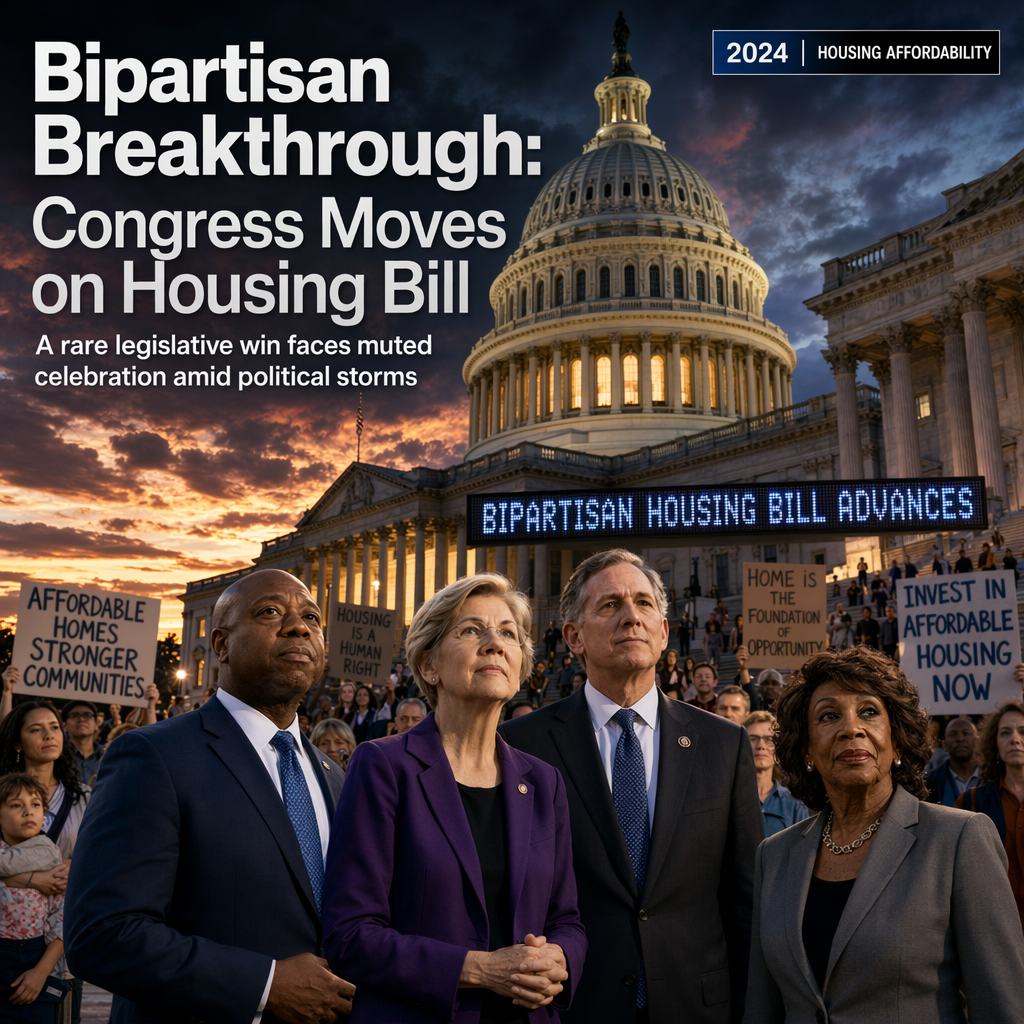
Congress is on the verge of passing a significant bipartisan housing affordability bill, marking a rare legislative victory during President Donald Trump’s second term [1]. The Senate is expected to pass the legislation this evening, following an 87-8 vote to advance it last week. The bill will then proceed to the House for a final vote before being sent to President Trump for his signature [1].
The legislation is seen as a much-needed win for Republicans, whose midterm election prospects have been hampered by voter concerns over the cost of living and perceptions that the Trump administration and GOP-controlled Congress have not done enough to address economic issues. According to a new AP-NORC poll, Trump’s overall job approval rating stands at 37%, with only 33% of U.S. adults approving of his handling of the economy [1].
The bill was crafted through a bipartisan effort led by Sen. Tim Scott (R-S.C.), Sen. Elizabeth Warren (D-Mass.), Rep. French Hill (R-Ark.), and Rep. Maxine Waters (D-Calif.). It includes provisions favored by both parties: Republicans have emphasized measures to cut red tape and increase housing supply, while Democrats, including Warren, have highlighted restrictions on institutional investors, aiming to prevent private equity from buying large numbers of single-family homes and driving up costs for consumers [1]. President Trump has also championed the bill’s ban on large Wall Street investment firms purchasing thousands of single-family homes, a point he emphasized in his State of the Union address [1].
Despite the legislative progress, the achievement has been overshadowed by other political developments, including ongoing controversy over Trump’s Iran deal negotiations, the expiration of the FISA Section 702 surveillance program, and drama surrounding the stalled nomination of Jay Clayton for director of national intelligence. These distractions have limited the attention Republicans can draw to their legislative success on housing affordability [1].
CONCLUSION
Congress is poised to deliver a rare bipartisan win on housing affordability, addressing a key voter concern and providing a legislative boost for both parties. However, the impact of this achievement is being muted by competing political controversies, potentially limiting its effect on public perception and market sentiment.