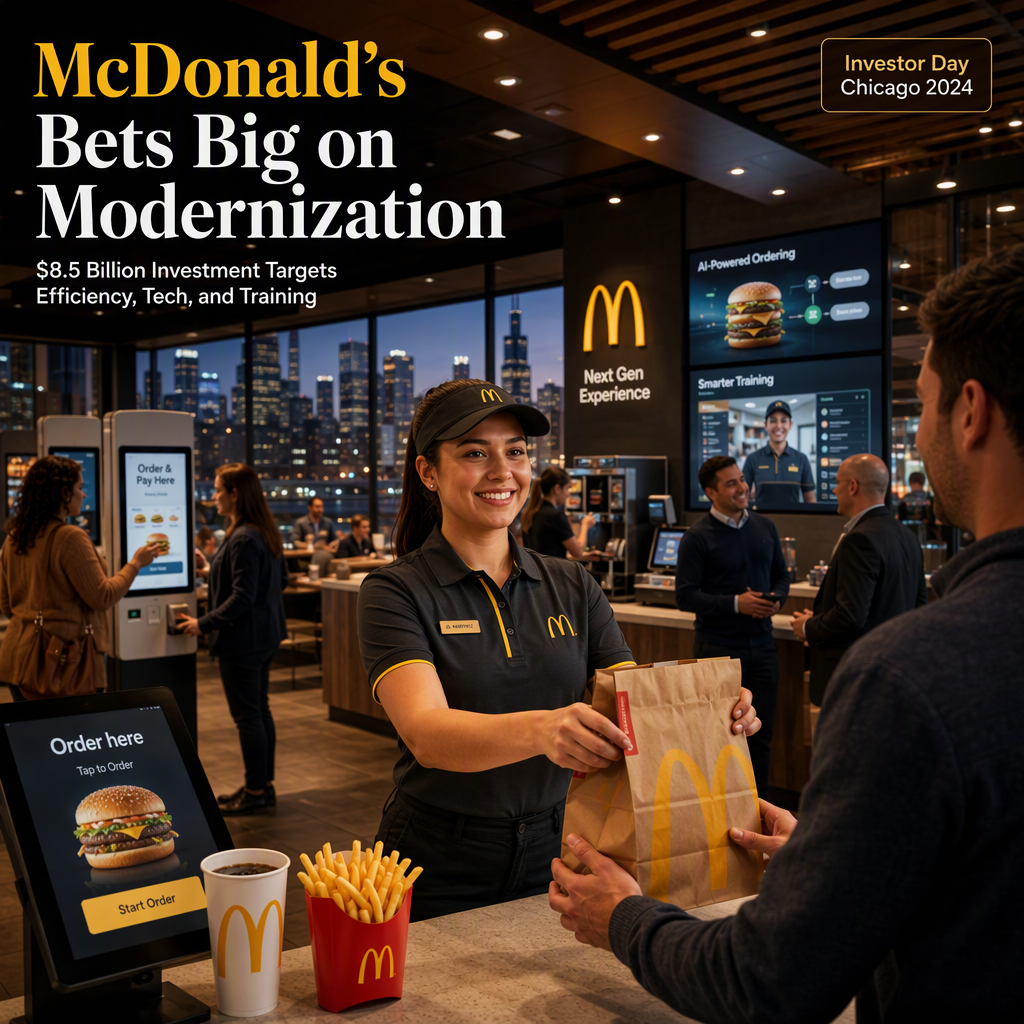
McDonald's announced a significant $8.5 billion investment as part of its NEXT growth and productivity strategy, revealed during an investor day at its Chicago headquarters. The plan focuses on upgrading restaurants, deploying new technology, and enhancing staff training to drive sales and operational efficiency through 2036, with approximately $5 billion allocated through 2030. This support for franchisees will include capital support and rent relief, aiming to accelerate modernization and operational improvements across the system [1].
The company targets about 250 basis points of gross restaurant-level efficiency improvements, which is expected to translate into roughly $100,000 in annual cash flow benefits for the average restaurant, with most of these gains benefiting the bottom line over time. Key initiatives include simplified operations, modernized restaurant design, and the deployment of generative AI-enabled ArchIQ at scale. Additionally, McDonald's introduced a new customer service initiative and a multiyear training program called 'Make it Golden,' set to begin on Founder's Day, October 5, to improve service consistency and encourage repeat visits [1].
CEO Chris Kempczinski emphasized McDonald's unique scale, customer insights, and operational capabilities, stating that the NEXT strategy is designed to make McDonald's the first choice for more customers while strengthening restaurant operations. The company also set new market share targets, aiming for 1.5 percentage points of growth in both chicken and beverages by 2030, while maintaining its leadership in beef market share. Sales growth from unit expansion is projected to contribute nearly 2.5% to system-wide sales growth in 2027, moderating to about 2% by 2030 [1].
Following the announcement, McDonald's shares closed at $236.78, down $13.59 or 5.43% on the day, indicating a negative immediate market reaction to the news [1].
CONCLUSION
McDonald's unveiled an ambitious $8.5 billion investment plan to modernize its restaurants and enhance staff training, aiming for operational improvements and market share growth. Despite the company's optimistic outlook and clear targets, the market responded negatively, with shares falling over 5% following the announcement. The long-term impact will depend on the successful execution of these initiatives and their effect on sales and profitability.