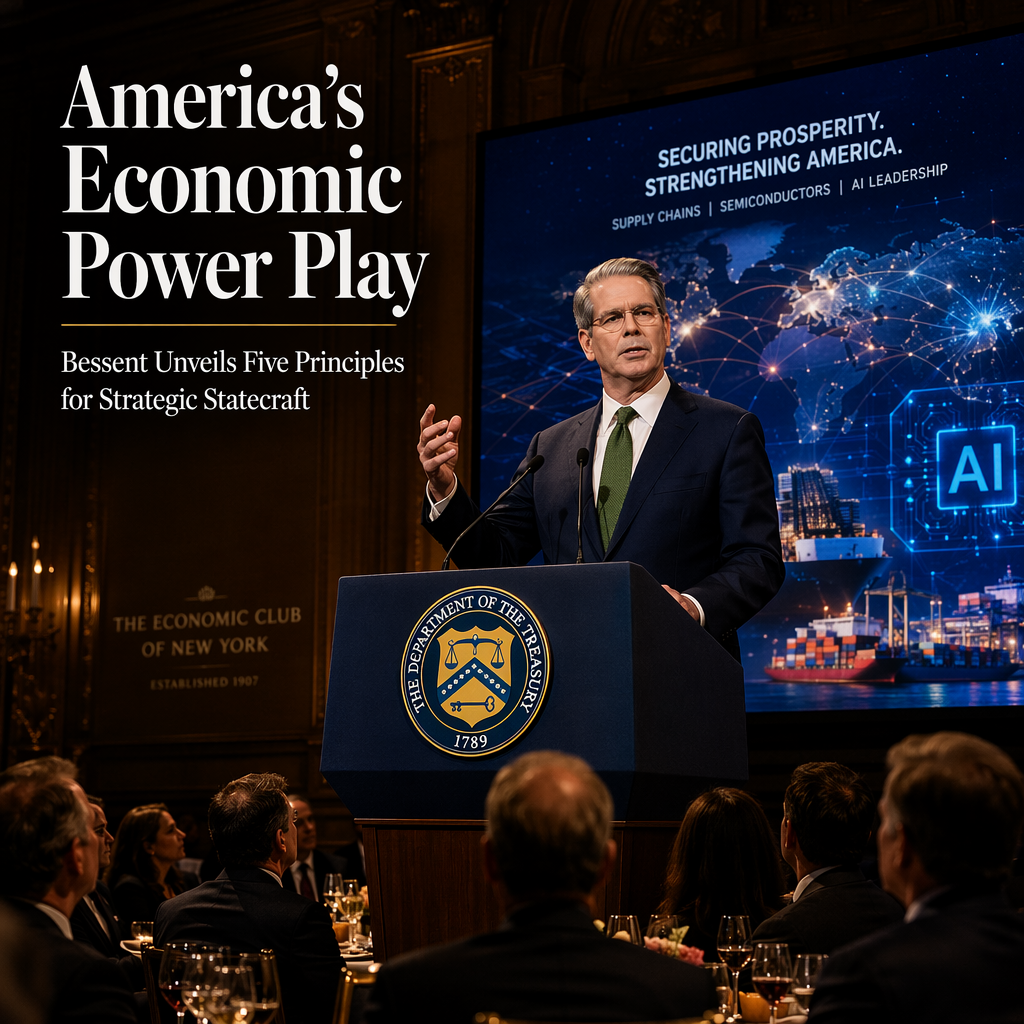
U.S. Treasury Secretary Scott Bessent delivered a speech at the Economic Club of New York's America 250 gala dinner on Tuesday, where he outlined five core principles guiding the Trump administration's approach to economic statecraft [1]. Bessent emphasized that economic security begins at home, highlighting the importance of building and financing industries such as semiconductors and artificial intelligence (AI), which he described as sources of national power in which the United States must lead [1].
Bessent noted that past decisions had allowed strategic industries and critical supply chains to migrate overseas, exposing U.S. firms to unfair competition and creating vulnerabilities that other countries have exploited as leverage [1]. He argued that repairing these imbalances does not mean retreating from global engagement, but rather engaging on terms that strengthen America, insisting on trade that is fair, reciprocal, and consistent with national interests [1].
Among the five principles, Bessent stressed the need for U.S. leadership in sectors such as semiconductors, AI, quantum computing, advanced manufacturing, critical minerals, and pharmaceuticals [1]. He underscored the importance of supply chain resilience, advocating for diversification away from dangerous concentrations and identifying vulnerabilities before crises occur, rather than requiring every component to be domestically sourced [1].
On trade, Bessent asserted that the U.S. is the 'best economic partner in the world' due to its market depth, the dollar's dominance, and innovation, but warned that these benefits are not unconditional for trading partners [1]. He criticized discriminatory taxes, industrial policies, intellectual property transfers, and efforts to evade sanctions, emphasizing the need for reciprocal market access [1].
CONCLUSION
Treasury Secretary Bessent's remarks signal a strategic shift toward strengthening domestic industries and supply chain resilience, while insisting on fair and reciprocal trade relationships. The outlined principles suggest a more assertive U.S. economic policy stance, with potential implications for global supply chains and international trade dynamics.