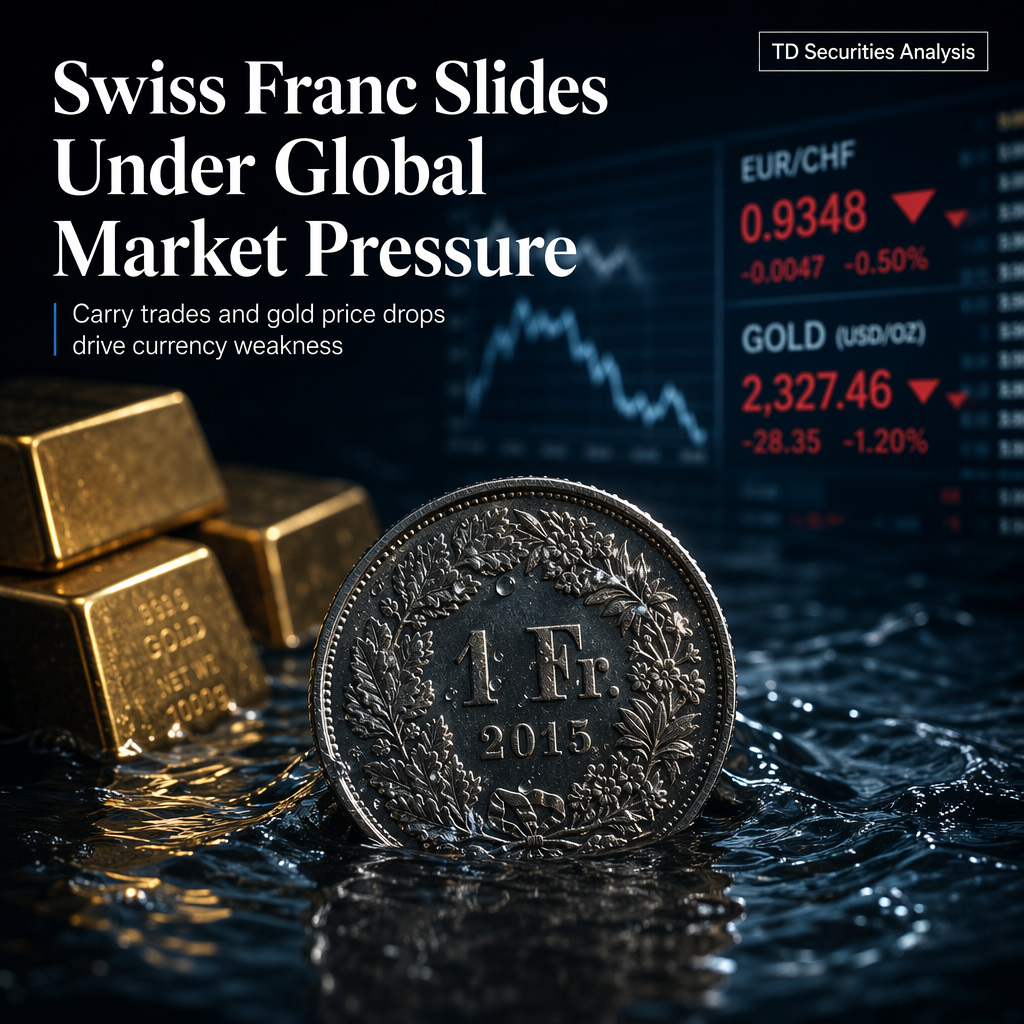
According to TD Securities strategists, the Swiss Franc (CHF) has been one of the worst-performing global currencies since the Iran shock at the end of February 2026, alongside the Swedish Krona (SEK) [1]. The brief support for CHF from risk-off sentiment in early March was quickly replaced by a sustained downtrend [1]. The strategists attribute this underperformance to a combination of low-yield carry dynamics and the currency's sensitivity to gold prices [1].
The Swiss National Bank (SNB) is expected to keep its policy rate on hold for the foreseeable future, with sight deposits showing only muted changes in 2026 [1]. This has shifted the focus to global rate paths and commodity prices as the main drivers for CHF crosses, particularly EUR/CHF [1]. TD Securities notes that while CHF has historically been a low-yielding currency, carry trades have not always led to CHF weakness; for example, during the 2022 global rate hiking cycle, CHF rallied as SNB sight deposits fell [1].
The strategists highlight that the recent CHF weakness is largely attributed to carry trades, but they also emphasize the importance of falling gold prices in this trend [1]. They suggest that the EUR/CHF rally could end if the European Central Bank (ECB) pauses rate hikes after September 2026, and that further gold price declines would be necessary for CHF to remain weak [1]. TD Securities forecasts that gold prices could fall to $3,900 per ounce in the near term before recovering into a new uptrend [1].
Looking ahead, TD Securities sees limited scope for a prolonged global rate hiking cycle and only modest downside for gold prices [1]. Their FX forecast projects EUR/CHF to remain around 0.93 into year-end 2026 [1].
CONCLUSION
TD Securities identifies carry trade dynamics and gold price movements as key factors behind the Swiss Franc's recent underperformance. With the SNB expected to keep rates steady and only modest gold price downside anticipated, the firm forecasts EUR/CHF to stabilize near 0.93 by the end of 2026.