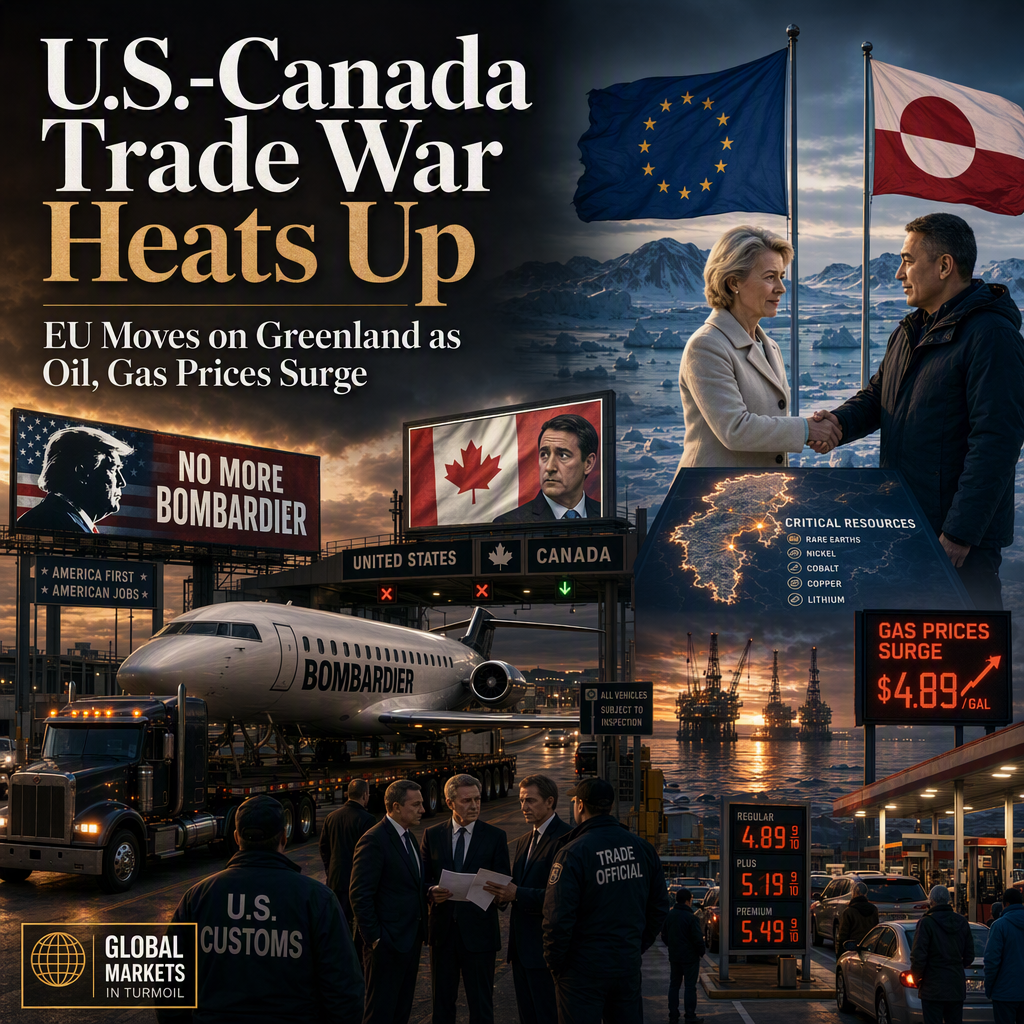
U.S.-Canada trade relations have intensified, with U.S. President Donald Trump declaring that Canadian airplane manufacturer Bombardier must build its products in the United States to maintain access to the American market. Trump stated on Truth Social, 'NO MORE SELLING BOMBARDIER IN THE UNITED STATES! If they want our Market, they must build here, and stop treating America like a 'piggybank.'' This marks a continuation of the ongoing trade war between Washington and Ottawa, further straining cross-border economic ties [1].
Simultaneously, the European Union is reinforcing its relationship with Greenland, announcing a 200-million-euro ($232.3 million) funding package aimed at enhancing connectivity, clean energy, and critical raw materials. This move comes as President Trump maintains a strong interest in Greenland, which has become a significant trans-Atlantic issue since the start of the year. European Commission President Ursula von der Leyen emphasized the strategic importance of this funding in the context of Arctic relations [1].
Energy markets are also reacting to heightened geopolitical tensions. Oil prices extended their gains on Tuesday, reaching a six-week high the previous day, as U.S.-Iran hostilities in the Middle East escalated with reciprocal strikes over the weekend. These developments have contributed to broadly lower U.S. futures, with investors closely monitoring the situation in the Middle East. Asian stock markets showed mixed performance on Tuesday [1].
Additionally, gasoline prices in the United States surged to a record high for Labor Day, with the national average for a gallon of regular unleaded gas reaching $4.15 on Monday, according to AAA. This surpasses the previous Labor Day record of $3.82 set on September 3, 2012. The increase in fuel costs is expected to impact travel expenses during one of the busiest holiday weekends of the year, as noted by rental car company Hertz [1].
CONCLUSION
Rising trade tensions between the U.S. and Canada, coupled with the EU's strategic investment in Greenland, are reshaping geopolitical and economic dynamics. Escalating energy prices and market volatility underscore the broader impact of these developments on global markets and consumers.