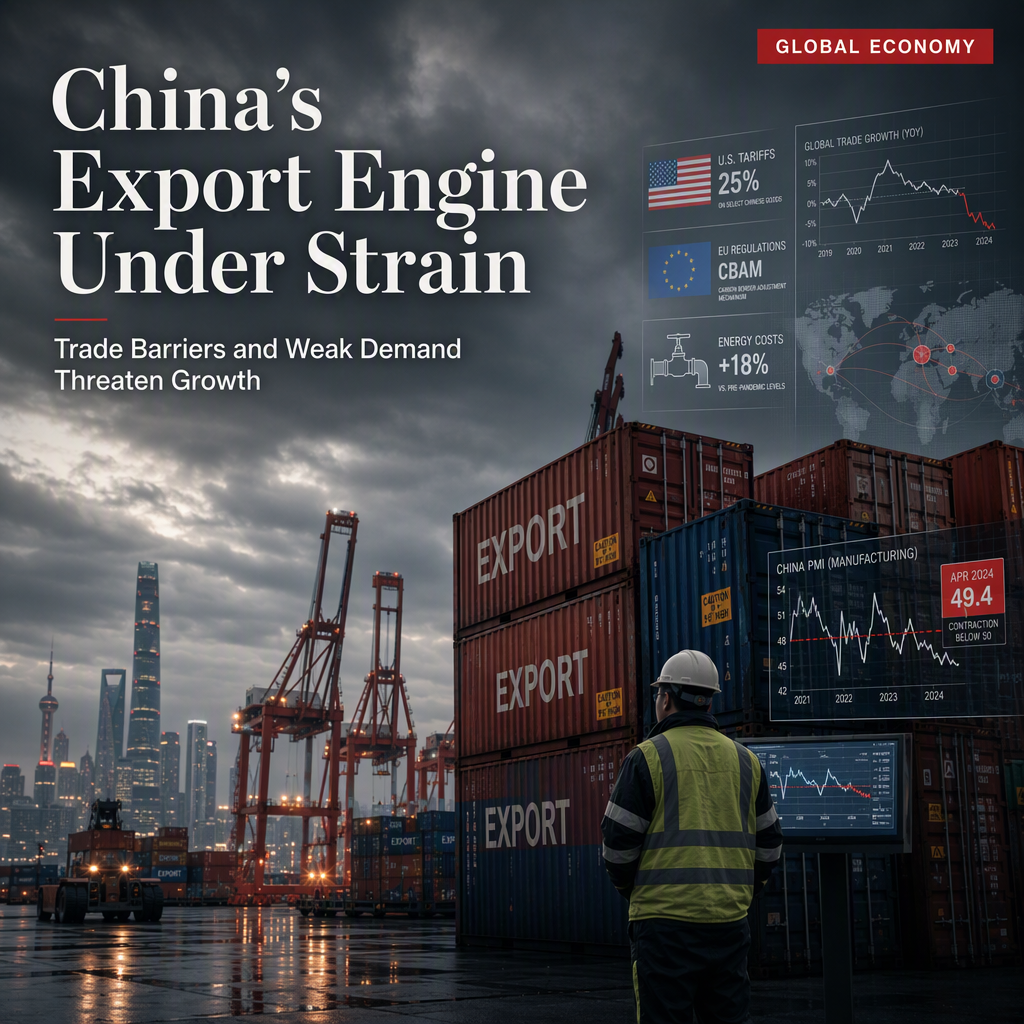
Rabobank strategists have highlighted increasing pressure on China’s trade model as US-led restrictions target the country’s energy links with Iran and Venezuela, alongside growing barriers to Chinese exports globally [1]. China currently maintains a large trade surplus, equivalent to 1% of global GDP, as it attempts to compensate for weak domestic demand by boosting exports [1]. Official Purchasing Managers' Index (PMI) figures released recently indicated a slight improvement in the manufacturing sector but further deterioration in non-manufacturing, with both sectors remaining below the threshold that separates contraction from expansion [1].
Unofficial PMI data released today showed manufacturing expanding at a faster rate than anticipated by surveyed economists. If accurate, this suggests China’s weak domestic demand and large exportable surplus are worsening, as the country relies even more heavily on external demand to absorb its output [1]. However, if the unofficial figures are not reflective of the true situation, it raises concerns that even China’s export engine is faltering, putting the official growth target in jeopardy [1].
Policy-driven barriers are increasingly threatening China’s ability to export its way out of an economic slowdown. The US’s systematic efforts to cut off China’s access to low-cost energy and the proliferation of trade barriers are described as “death by a thousand cuts” for the Chinese economy [1]. European Commission President Ursula von der Leyen has warned that if trade negotiations do not reduce the EU’s record trade deficit with China, the EU may resort to regulatory measures, including the 'trade bazooka' anti-coercion instrument [1].
The analysis underscores that the traditional Ricardian comparative advantage model is under strain, as major trading partners consider regulatory interventions to address perceived imbalances [1].
CONCLUSION
China’s reliance on exports to offset weak domestic demand is facing significant headwinds from US-led restrictions and potential EU regulatory actions. The mixed PMI data and growing policy barriers suggest heightened risks to China’s growth outlook, with the country’s trade-driven recovery model increasingly under threat.