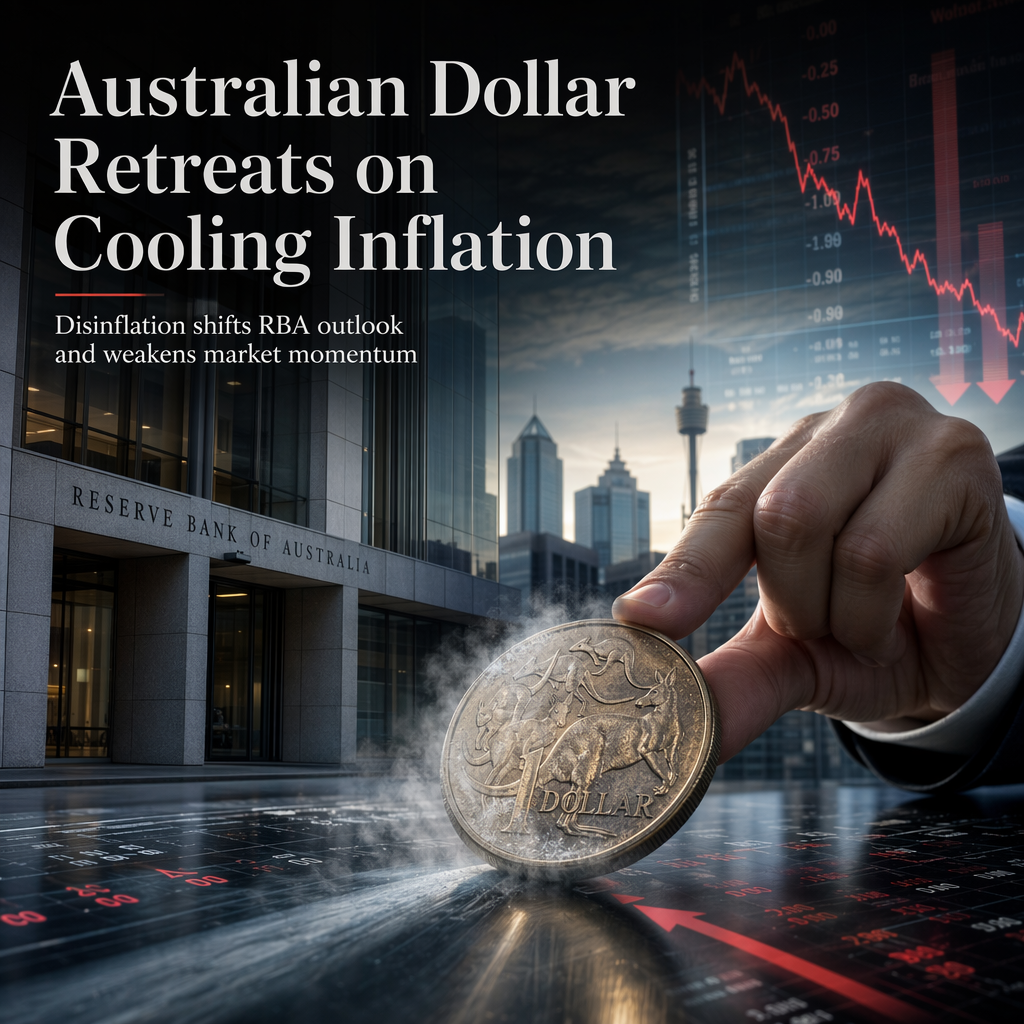
The Australian Dollar (AUD) has retreated toward the 0.6900 level against the US Dollar, following renewed signs of cooling inflation in Australia. Recent domestic data revealed that the Melbourne Institute inflation gauge fell for a second consecutive month in June, with both headline and underlying trimmed mean figures pulling back significantly, indicating a broader disinflationary trend is taking hold in the Australian economy [1].
This shift in inflation dynamics has led major financial institutions to reassess their outlook for the Reserve Bank of Australia (RBA). According to BNY macro strategists, the easing of price pressures—driven in part by lower global fuel costs—suggests that the RBA may abandon its previously hawkish policy stance. Market pricing for 35 basis points of additional RBA tightening by year-end is now seen as increasingly vulnerable if the current trend of softer inflation persists [1].
From a technical perspective, the Australian Dollar's recent bullish momentum has faded. UOB's strategy team notes that after a sharp multi-day rally, the AUD/USD pair has entered a holding pattern, with technical indicators signaling a build-up of downward bias. While the immediate downside is expected to be limited to a test of 0.6910, the overall bias for the AUD remains tilted to the downside [1].
Looking ahead, both BNY and UOB anticipate a cooling near-term trajectory for the Australian Dollar. UOB projects a multi-week consolidation phase with the AUD/USD pair likely to remain range-bound between 0.6870 and 0.6980, but maintains a structurally bearish outlook over the next one to three months. The bank warns that a technical breakdown could eventually push the currency down to major downside targets at 0.6835 and 0.6707 [1].
CONCLUSION
Cooling inflation data in Australia has undermined expectations for further RBA rate hikes, leading to a retreat in the Australian Dollar and a shift toward a bearish market outlook. Analysts foresee a period of consolidation with downside risks, as the currency's yield advantage erodes amid persistent disinflationary pressures.