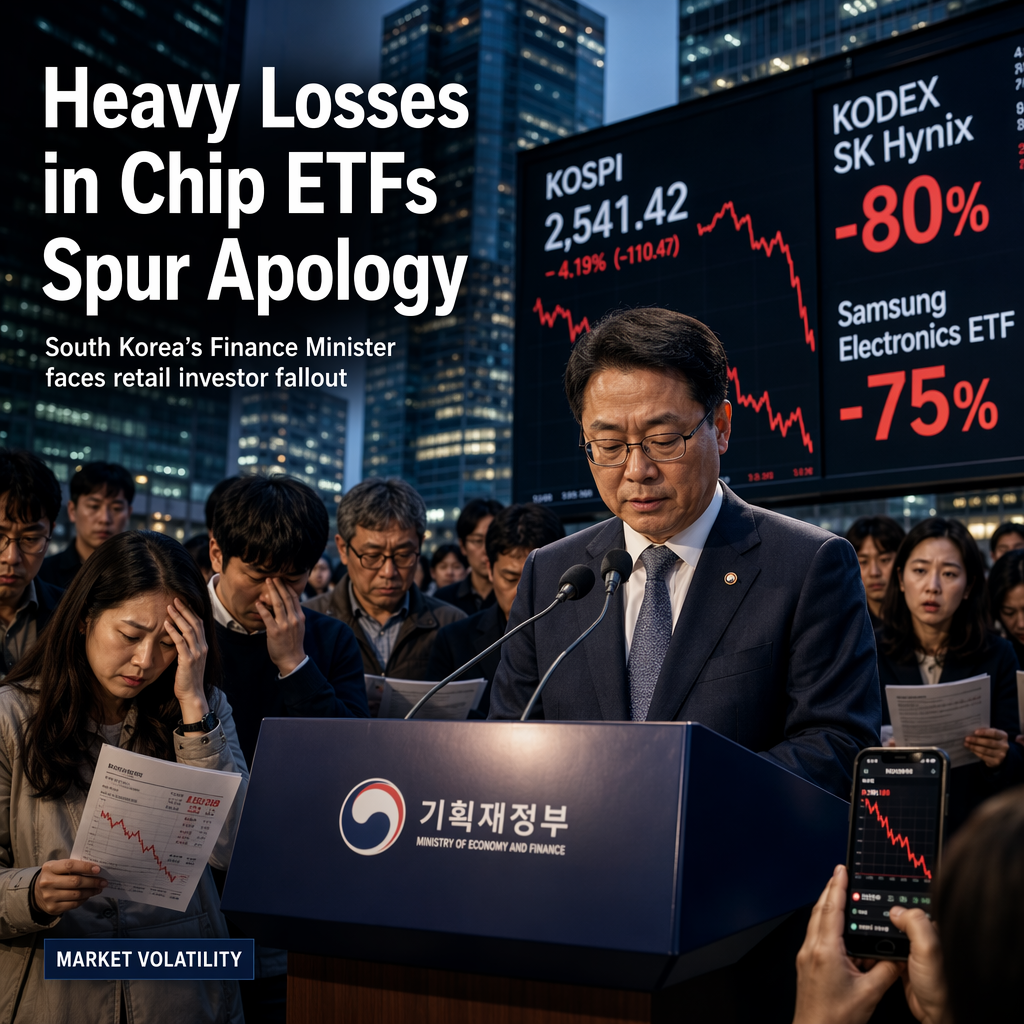
South Korea's finance minister, Koo Yun-cheol, issued a public apology on Wednesday after retail investors incurred significant losses from leveraged bets on chip stocks, following the introduction of single-stock leveraged Exchange Traded Funds (ETFs) earlier in the year [1]. Since the launch of these products on May 27, Korean retail investors have made net purchases totaling 14 trillion won ($9.7 billion), compared to approximately 2 trillion won by foreign investors, according to KB Financial Group [1].
The speculative trading boom initially fueled a rally in the Korean equity market, but a sharp correction in the Kospi index—driven by a downturn in chip stocks—has led to heavy losses for retail investors. The KODEX SK Hynix Single Stock Leverage ETF, which aims to deliver twice the daily movement of SK Hynix shares, has plummeted more than 80% since its June 23 peak, while the equivalent product tracking Samsung Electronics has dropped nearly 75% from its June 3 peak, based on LSEG data [1]. Over the past month, the Kospi index has fallen almost 35% as investor concerns have rattled its largest constituents [1].
In response to the losses and market volatility, the Financial Services Commission's Lee Eog-weon stated that the regulator is considering restricting access to these leveraged products to professional investors only. Lee also mentioned the possibility of lowering the leverage multiple of single-stock leveraged ETFs, noting that the current two-times leverage is too high and reducing it could help ease market volatility. Any such changes would require legislative action and input from investors through beneficiary general meetings [1].
The developments highlight the risks associated with leveraged investment products, particularly for retail investors, and have prompted calls for tighter regulation and oversight in the South Korean market [1].
CONCLUSION
The sharp downturn in chip stocks and leveraged ETFs has resulted in substantial losses for South Korean retail investors, prompting an official apology and potential regulatory changes. Authorities are considering restricting access to these high-risk products and reducing leverage to mitigate future volatility. The episode underscores the need for careful oversight of complex financial instruments in volatile markets.