
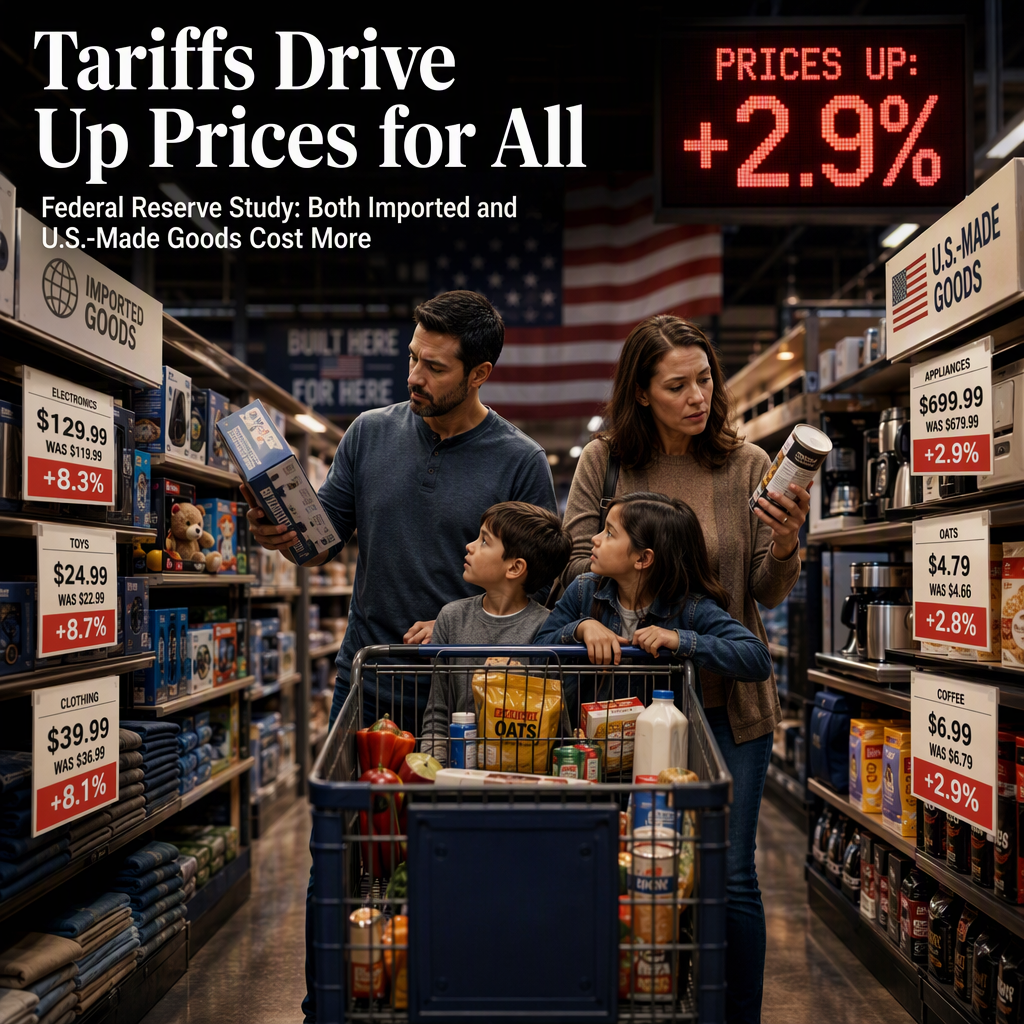
New research from the Federal Reserve Bank of New York has found that President Donald Trump's tariffs have not only increased the cost of imported goods but have also made American-made products more expensive for consumers [1]. The study indicates that, absent these tariffs, prices for many everyday goods would have declined last year and into early 2026 [1]. Instead, the tariffs added approximately 2.9 percentage points to the prices of the consumer goods examined [1].
The research further breaks down the impact, estimating that about two-thirds of the tariff-related price increases stemmed from imports, while roughly one-third affected products manufactured in the United States [1]. This finding challenges the notion that tariffs primarily impact foreign goods, showing a broader effect on the domestic market [1].
The White House has defended the tariff policy, with spokeswoman Taylor Rogers stating that the 'America First' trade agenda is designed to reduce the trade deficit, revitalize American manufacturing, and deliver lasting benefits to U.S. workers, farmers, and producers [1]. The administration maintains that foreign exporters will ultimately bear the cost of tariffs due to their reliance on the U.S. market [1].
However, Scott Lincicome, vice president of general economics at the Cato Institute, noted that consumers are unlikely to see significant price relief as long as tariffs remain in place, and it remains uncertain whether prices will stabilize or continue to rise if companies further pass on costs to shoppers [1].
CONCLUSION
The Federal Reserve Bank of New York's research highlights that Trump's tariffs have broadly increased consumer prices, affecting both imported and American-made goods. While the administration argues the policy will benefit U.S. workers in the long run, current data points to higher costs for consumers with uncertain prospects for price relief as long as tariffs persist.