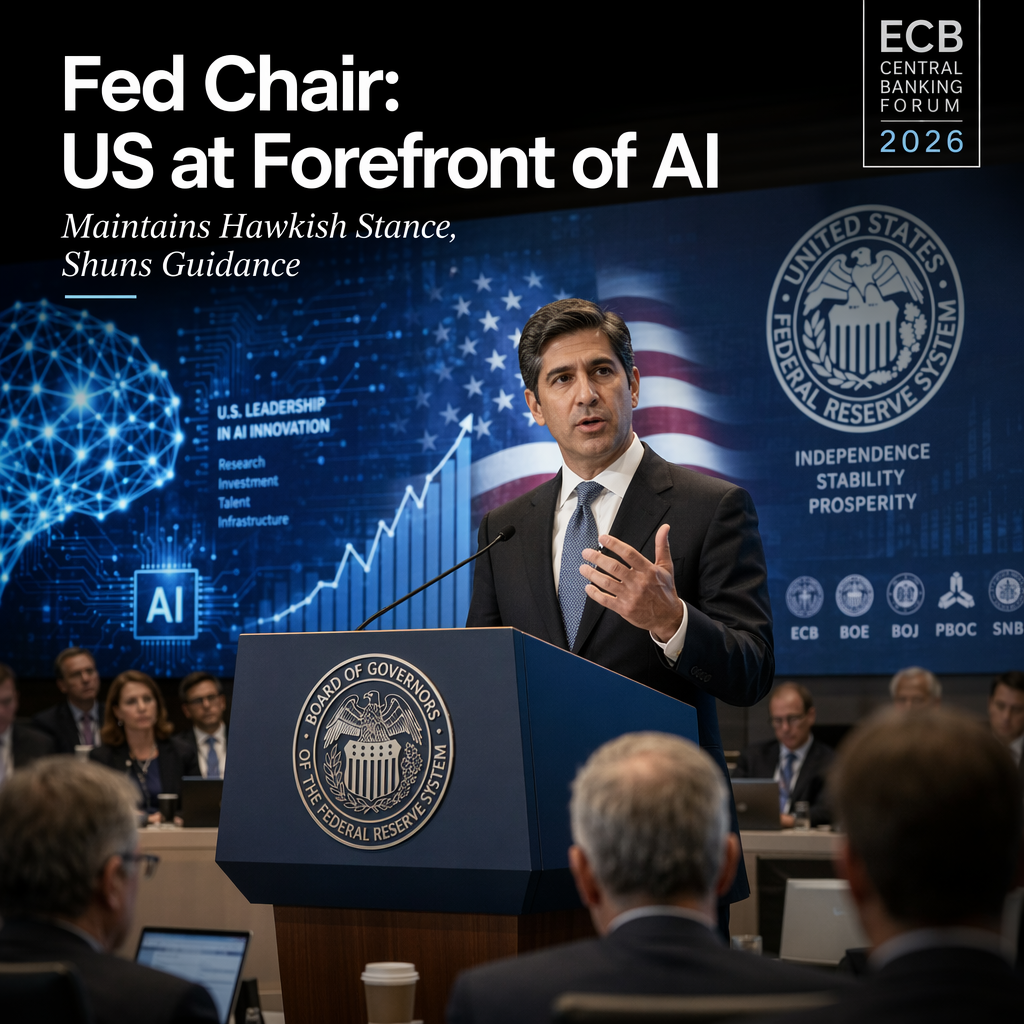
Federal Reserve Chairman Kevin Warsh, speaking at the ECB Forum on Central Banking 2026, reiterated his refusal to provide forward guidance on monetary policy, emphasizing a data-dependent approach and reaffirming the Fed's commitment to its 2% inflation target [1]. Warsh stated, "It's up to the central bank to decide if AI is inflationary," and highlighted that the AI boom is manifesting most prominently in the United States, positioning the country as a likely big winner in this technological revolution [1]. He described the current period as an "exciting, consequential time to be a central banker," and noted that the US is only in the early stages of the AI revolution, with labor markets remaining steady and the supply side solid [1].
Warsh underscored that inflation expectations and risks have come down over the past four weeks, but made it clear that the Fed would not tolerate inflation above 2%, stating, "If anyone thought we'd be happy with inflation above 2%, they will be disappointed" [1]. He also mentioned that volatility and yields are down, and that potential growth appears to be trending upward, referencing positive indications from the last four quarters [1]. Warsh confirmed that the Fed's view on the balance sheet has not changed in his first four weeks as Chair, and any future changes would be well deliberated and communicated [1].
The FXS Speechtracker assigned Warsh's remarks a moderately hawkish score of 5.6/10, reflecting a cautious but not aggressive stance, while the FXS Fed Sentiment Index remained virtually unchanged at a firmly hawkish 123.64, indicating continuity in the Fed's policy bias [1]. Market participants are expected to focus on the lack of forward guidance and the Fed's evolving assessment of AI's inflationary implications for the US Dollar [1]. Warsh also indicated that there may be news next week regarding leaders of task forces, but did not provide further details [1].
CONCLUSION
Fed Chair Warsh's remarks signal a steady, hawkish policy stance with no forward guidance, reinforcing the Fed's commitment to price stability amid optimism about the US's leadership in AI. Markets are likely to interpret the speech as a sign of policy continuity, with attention shifting to the Fed's ongoing evaluation of AI's impact on inflation.