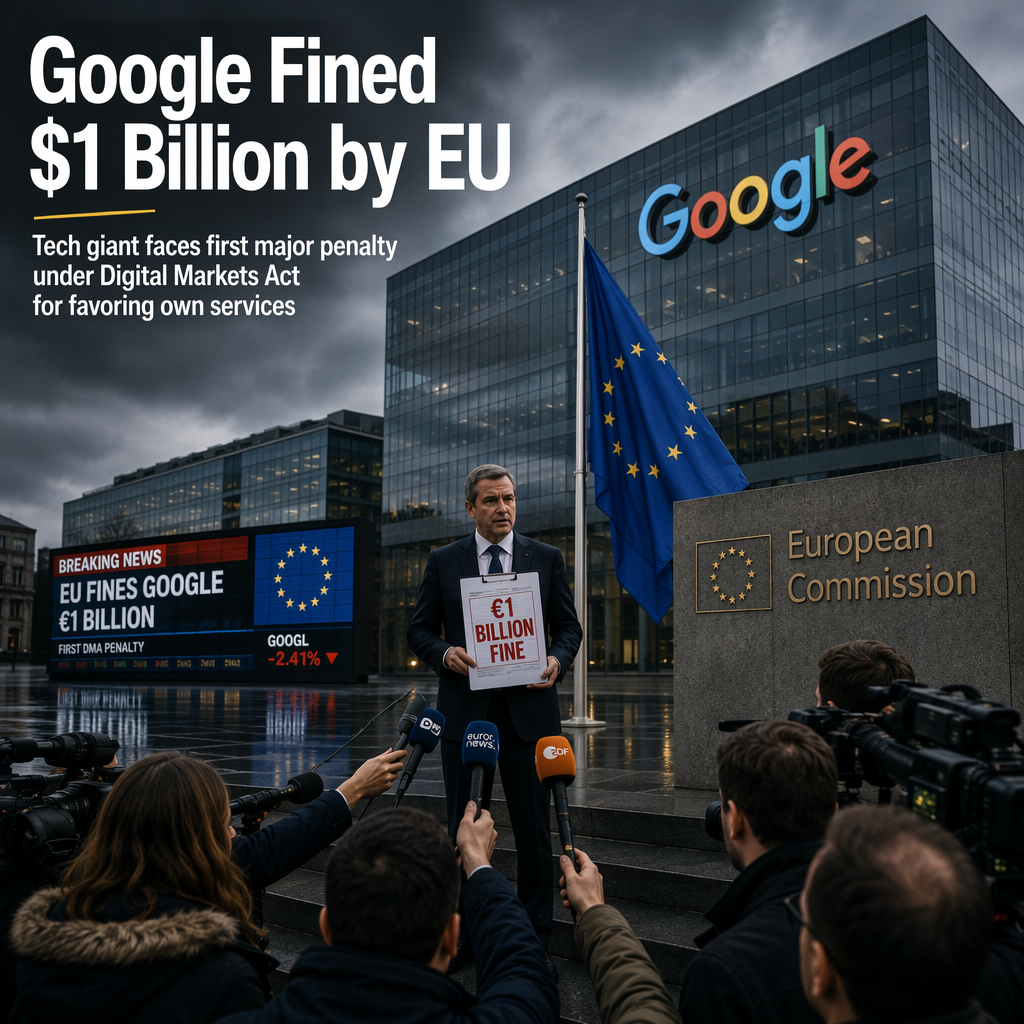
The European Commission has fined Google 890 million euros ($1 billion) for allegedly giving preferential treatment to its own services, such as shopping and hotels, over those of third parties in search results, marking the first fine issued to Google under the European Union's Digital Markets Act (DMA) [1]. The Commission found that Google displays its own services more prominently in search results, while third-party services do not receive the same visibility [1]. Additionally, Google was found in breach of anti-steering measures, as it prevented app developers from freely communicating and promoting offers and concluding contracts with users in distribution channels of their choice, including third-party app stores [1].
Shares of Alphabet, Google's parent company, fell around 4% in premarket trading, reflecting investor concerns not only about the fine but also about rising AI spending highlighted in the company's recent earnings report [1]. The European Commission has ordered Google to treat third-party services in search results in a 'fair and non-discriminatory manner' and to allow app developers to promote offers and conclude contracts with users both within and outside the Google Play Store [1].
In response, Kent Walker, president of global affairs at Google and Alphabet, criticized the implementation of the DMA, stating that compliance would require Google to remove real-time search features and safety protections that users value, and argued that the regulation leads to product degradation rather than fair competition [1]. Google is currently reviewing the decision and considering whether to appeal [1].
The Commission acknowledged that Google has proposed and begun testing changes to how it presents its own services in search results and has rolled out changes related to its steering terms in the app store. The regulator stated it would monitor the implementation of these changes, which it described as 'substantial progress towards compliance' [1].
CONCLUSION
Google faces a significant $1 billion fine under the EU's Digital Markets Act for favoring its own services and restricting app developer communications. The penalty has led to a notable decline in Alphabet's share price and signals increased regulatory scrutiny for Big Tech in Europe. The outcome of Google's potential appeal and the effectiveness of its compliance measures will be closely watched by the market.