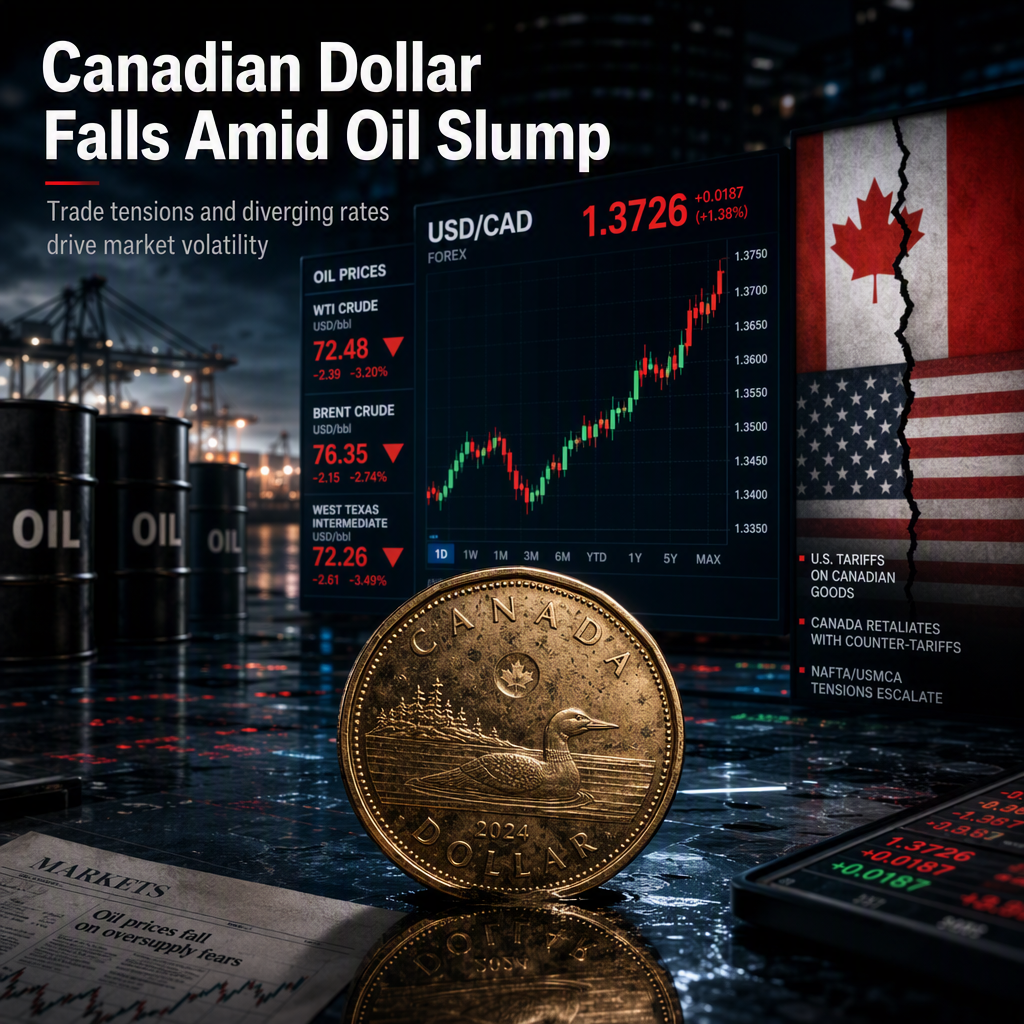
The Canadian Dollar (CAD) appears vulnerable near its August 7 low, pressured by a combination of sliding crude oil prices and escalating trade tensions between the US and Canada [1]. The USD/CAD currency pair attracted dip-buyers at the start of the week, stalling a modest pullback from levels above the 1.4000 psychological mark, which is the highest since August 7 [1]. Crude oil prices have dropped to an over one-week low as increased shipments from Saudi Arabia have eased supply concerns, further weighing on the CAD [1].
Trade tensions intensified after the US imposed steep 50% tariffs on approximately $20 billion worth of Canadian goods on August 22, prompting Canada to retaliate with tariffs ranging from 15% to 50% on roughly $20 billion worth of US goods on September 8 [1]. Additionally, the widening interest rate gap between the US and Canada has contributed to the CAD's underperformance. The Bank of Canada (BoC) maintained its key policy interest rate at 2.25% earlier this month, while the US Federal Reserve (Fed) raised rates for the first time in over three years last Wednesday [1].
The US Dollar (USD) remains supported by the Fed's hawkish stance and ongoing geopolitical tensions in the Middle East, including recent attacks in Riyadh by Iran-backed Houthis and Iran's conditions for restarting talks with the US [1]. The Fed's dot plot indicates that officials expect at least one more rate hike this year, reinforcing the bullish tone for the USD [1]. Technical analysis shows that USD/CAD maintains a bullish near-term bias above key support levels, with immediate resistance at the 61.8% Fibonacci retracement near 1.4052 and a stronger barrier at the 78.6% level around 1.4137 [1].
Overall, the combination of lower oil prices, trade frictions, and diverging monetary policy continues to favor USD strength against the CAD, with the path of least resistance for USD/CAD remaining to the upside in the near term [1].
CONCLUSION
The Canadian Dollar faces significant headwinds from falling oil prices, heightened US-Canada trade tensions, and a widening interest rate gap. Market sentiment remains bearish for the CAD, with technical and fundamental factors supporting further USD/CAD upside. Investors are likely to monitor upcoming developments in trade policy and central bank actions for further direction.