The United States and China have agreed to extend their bilateral trade truce, known as the 'Busan Agreement,' until January 10, 2027, according to statements from US Treasury Secretary Scott Bessent and Chinese Vice Premier He Lifeng following an unscheduled meeting in Washington [1][3][4][5]. The truce, originally set to expire on November 10, was established by President Donald Trump and President Xi Jinping in October 2025 to ease economic tensions between the two nations [4][5]. Bessent indicated that the extension is intended to provide more time for further economic negotiations, with the possibility of a larger economic package being agreed upon by January, though it is also possible the current deal could simply be rolled over again [3][4][5].
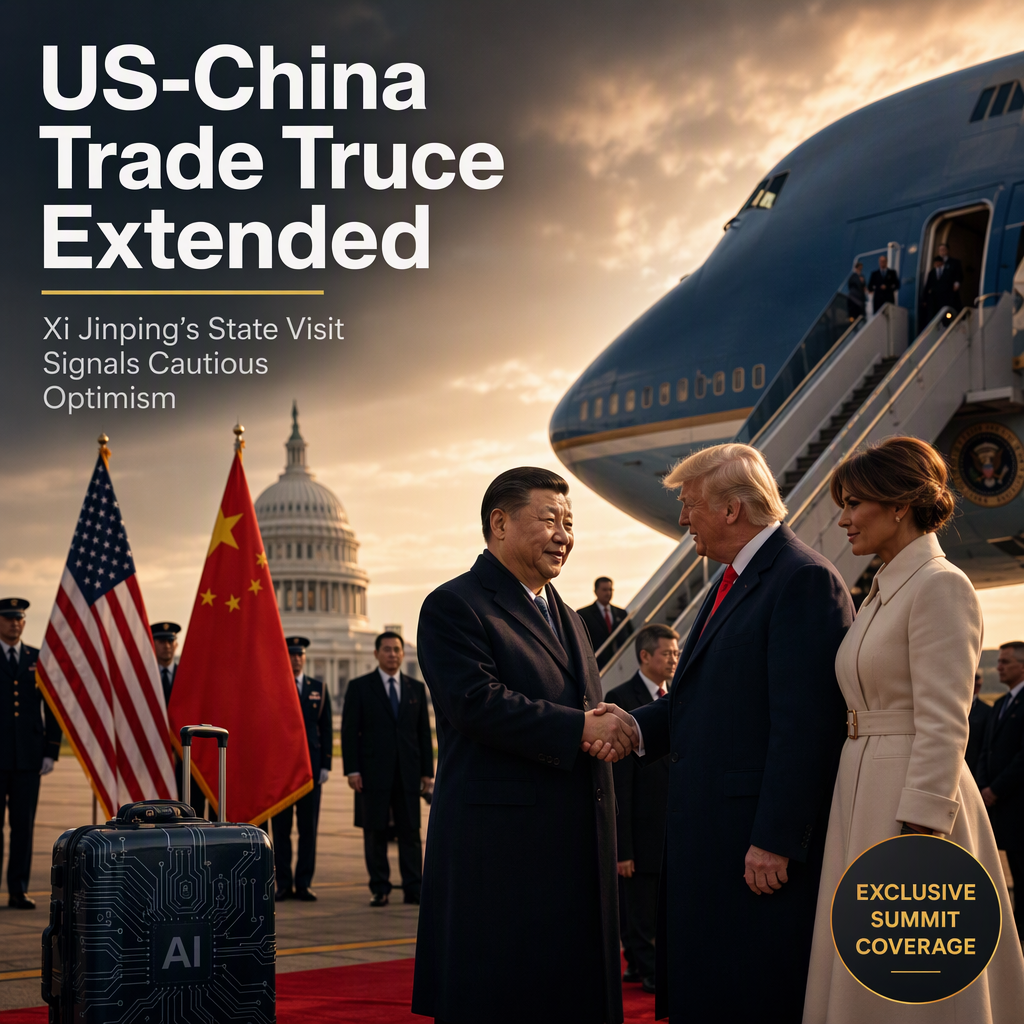
Chinese President Xi Jinping arrived in Washington for a three-day state visit, greeted by President Trump and First Lady Melania Trump in a rare tarmac ceremony, underscoring the ceremonial importance of the summit [1][2][3][5]. The summit agenda includes high-stakes discussions on trade negotiations, artificial intelligence cooperation, and the broader trajectory of US-China relations, with both sides expected to seek incremental progress and conflict avoidance rather than major breakthroughs [2]. Key sectors such as aerospace are in focus, with Trump touting an expected sale of 200 Boeing jets to China [2].
The trade truce extension aims to keep tariffs lower for longer and ensure the continued flow of rare earth materials [5]. However, Bessent emphasized that Beijing needs to fulfill more deliverables as part of the agreement [5]. Since the imposition of US tariffs, Chinese purchases of US soybeans have dropped sharply, from nearly $18 billion in 2022 to $3 billion in 2025, benefiting competitors like Brazil and Argentina [1]. Market sentiment remains cautious, with investors awaiting clear signals on tariff relief or further talks. At the time of reporting, the AUD/USD pair was down 0.06% at 0.7034, reflecting muted market reaction [3].
Both sides continue to debate 'nonsensitive' tariff cuts, and discussions on setting up an alert system for artificial intelligence incidents were held between Bessent and He Lifeng [2][5]. China has slow-walked yuan appreciation amid calls for trade rebalancing and rebuffed requests for an AI development slowdown, signaling a cautious approach to broader economic and technology issues [2]. Strategic tensions persist, particularly regarding US arms sales to Taiwan and ongoing maritime disputes [2]. Analysts suggest that while the summit may yield incremental progress, fundamental differences on trade policy, technology standards, and regional security remain unresolved [2].
According to Secretary of State Marco Rubio, regular contact between the US and China is essential for responsible statecraft, highlighting the importance of ongoing engagement between the world's two largest economies [1].
CONCLUSION
The US-China trade truce has been extended for two months, providing a temporary reprieve from escalating tariffs and allowing further negotiations on economic and technology issues. While the summit signals a willingness to engage, market sentiment remains cautious as investors await concrete progress on tariff relief and broader deliverables. Fundamental differences between the two nations persist, suggesting that only incremental gains are likely in the near term.