
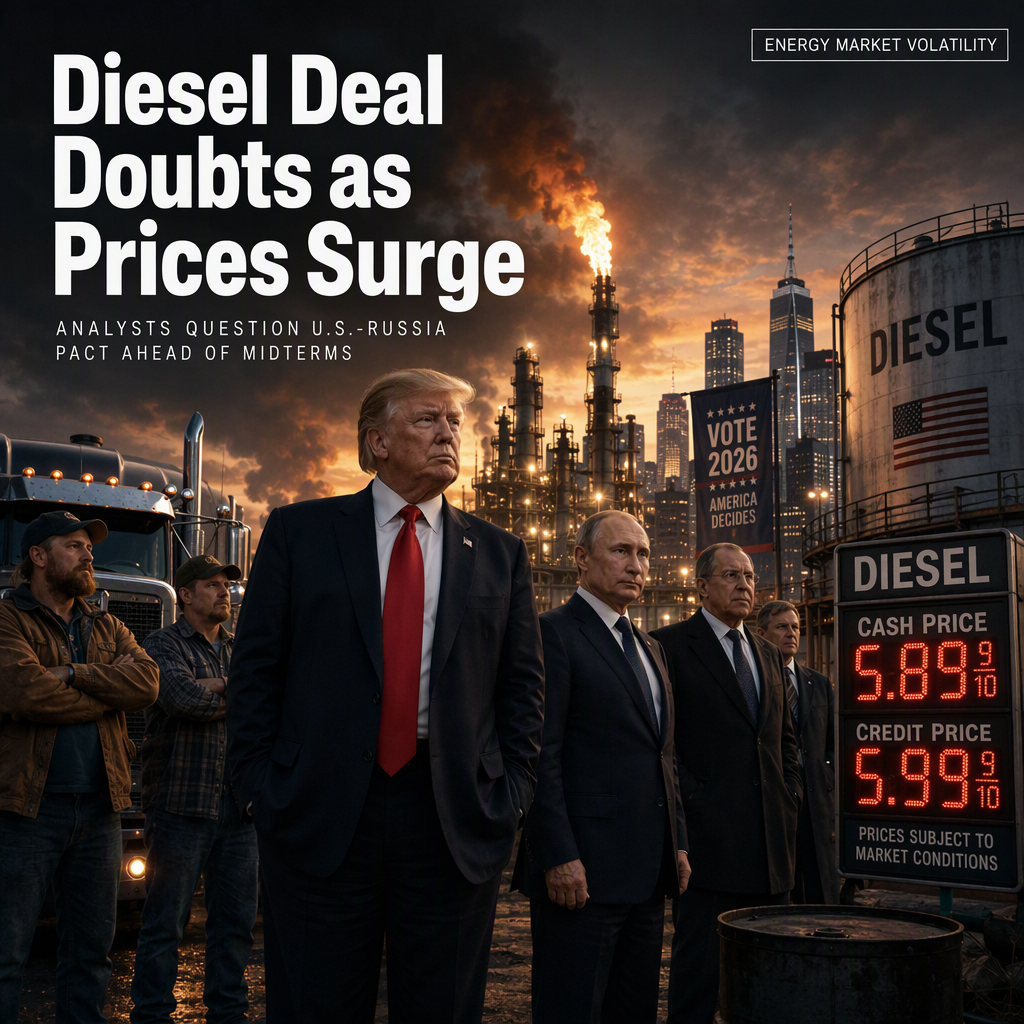
President Donald Trump has announced a diesel deal with Russia, aiming to supply 4.8 million metric tons of diesel to the U.S. market. However, analysts are expressing skepticism about the deal's effectiveness, noting that this amount represents just over a single day of global demand and is unlikely to significantly lower fuel prices for U.S. truckers and farmers [1]. The deal comes as President Trump faces mounting pressure to address high energy prices with the U.S. midterm elections less than a month away [1].
Meanwhile, commodity trader Paul Tudor Jones stated on CNBC's 'Squawk Box' that oil prices could rally another $20-$25 due to the ongoing Iran conflict, further highlighting the volatility in energy markets [1]. U.S. banks such as JPMorgan Chase, Wells Fargo, Goldman Sachs, and Citigroup have reported mixed financial results, with concerns cited around rising borrowing costs, AI adoption, and persistently high oil prices [1]. Bank of America, set to report earnings on Wednesday, has been fined over $1.2 billion for alleged violations of sanction and anti-money laundering laws [1].
The broader market is closely monitoring interest rate outlooks, especially after recent comments from New York Federal Reserve President John Williams, which have diverged from the consensus among other central bank members and the market [1]. In the technology sector, Apple introduced HomeView, a new voice-controlled smart home hub, marking CEO John Ternus' first major product launch since succeeding Tim Cook [1].
On the global economic front, the International Monetary Fund raised its 2026 global growth forecast to 3.1%, up slightly from its July projection, though IMF Economic Counsellor Silvana Tenreyro cautioned that global resilience remains 'under strain' with risks tilted to the downside [1].
CONCLUSION
The U.S.-Russia diesel deal is unlikely to provide significant relief from high energy prices, according to analysts, as the supplied volume is minimal relative to global demand. With energy prices remaining elevated and geopolitical risks persisting, market sentiment is cautious, especially ahead of the U.S. midterm elections. Broader economic and financial market uncertainties continue to weigh on investor outlook.