
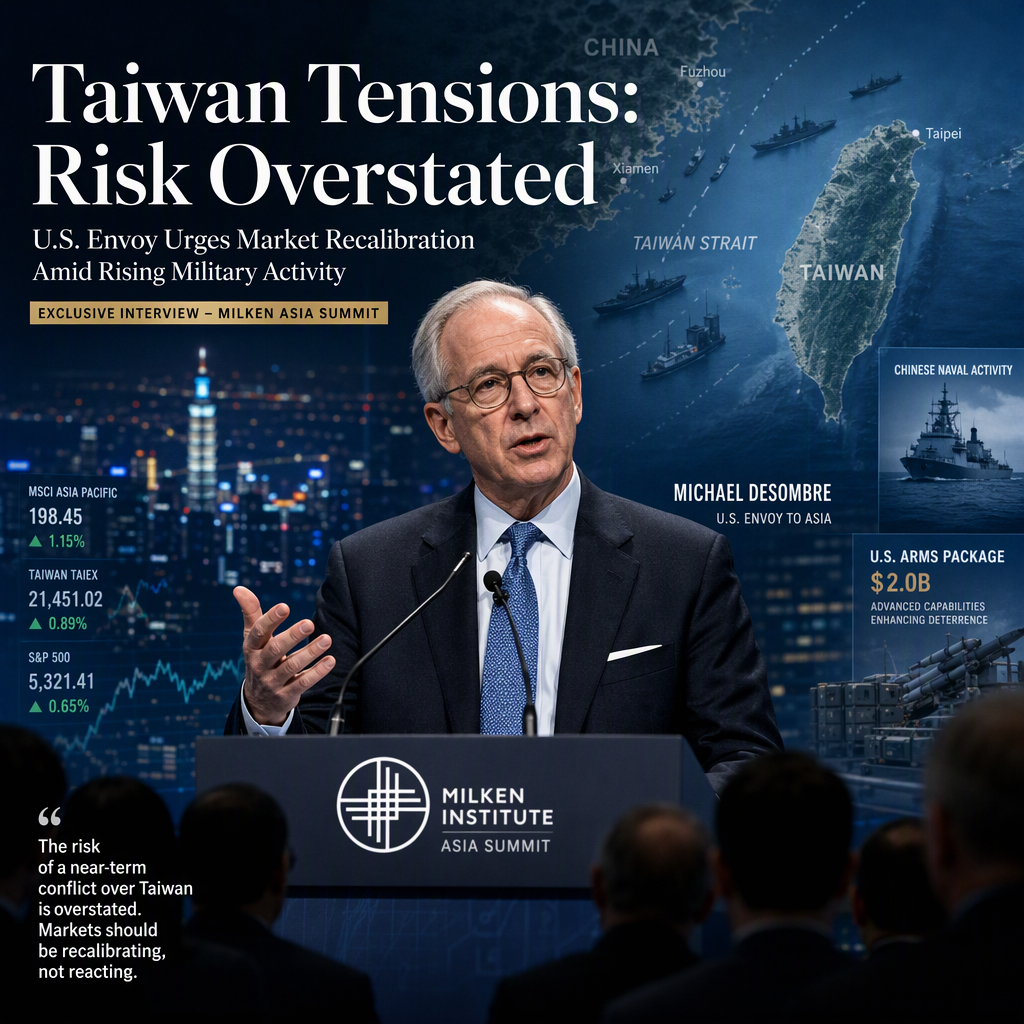
Michael DeSombre, the U.S. assistant secretary of state for East Asian and Pacific affairs, stated that investors are overestimating the risk of conflict across the Taiwan Strait. He emphasized that deterrence and the prospect of 'substantial consequences' would prevent Beijing from taking military action against Taiwan by 2027, despite increased Chinese military activity near the island in recent months [1].
DeSombre noted that both China and the U.S. do not want conflict and that current market concerns are 'priced at too high a level.' He made these remarks during an exclusive interview at the Milken Institute Asia Summit, highlighting that the most significant mispricing in the market relates to Taiwan risk [1].
Recent developments include an unprecedented sighting of a Chinese military vessel off Taiwan's Pacific coast in August, as well as Beijing's ongoing efforts to court Taiwan's opposition party, the Kuomintang, ahead of the 2028 presidential election. The U.S. President has delayed approval of a new $14 billion arms package to Taipei following a previous $11 billion package that drew a sharp response from Beijing in December [1].
Diplomatic efforts continue, with no public agreement on Taiwan emerging from the recent summit between U.S. President Donald Trump and Chinese President Xi Jinping. Meanwhile, Taiwanese Foreign Minister Lin Chia-lung visited Arizona for the opening of a new de facto consulate in Phoenix days after the summit [1].
DeSombre described Chinese President Xi Jinping as 'a very rational actor,' suggesting that if Xi believes reunification cannot be achieved without significant consequences, he will not pursue it. The diplomat underscored the importance of maintaining deterrence to prevent conflict [1].
CONCLUSION
Market concerns over a potential Taiwan conflict may be overstated, according to a top U.S. diplomat, who points to strong deterrence and rational decision-making by Chinese leadership. While tensions and military activity have increased, the U.S. sees the risk as overvalued by investors, suggesting a possible market correction if these views gain traction.