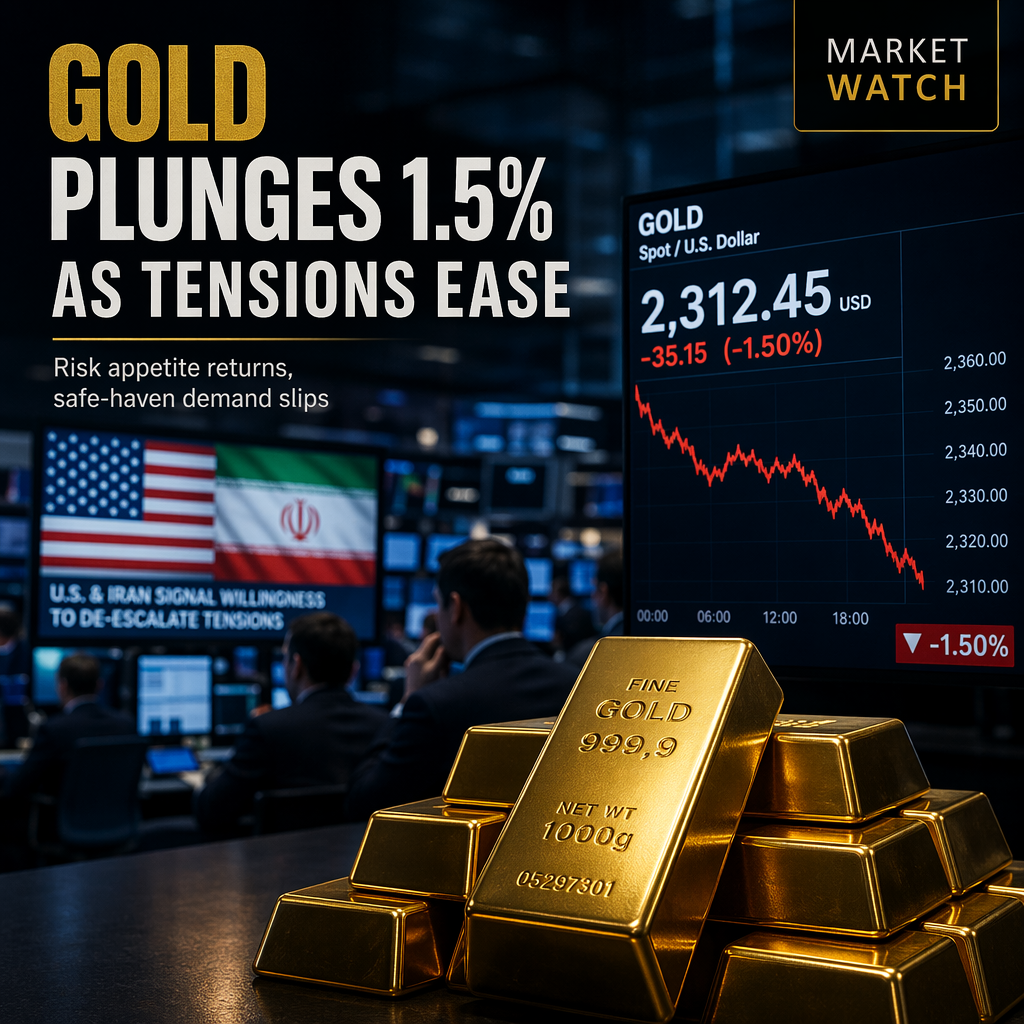
Gold (XAU/USD) prices fell by approximately 1.50% on Monday, trading at $4,021 after reaching a daily high of $4,088, as risk appetite improved following a halt in hostilities between the US and Iran over the weekend. The easing of tensions, which had previously threatened negotiations and oil flow through the Strait of Hormuz, reduced demand for the safe-haven asset [1]. Talks between the US and Iran are set to resume, according to a US official, further contributing to the improved market sentiment [1].
The US Dollar Index (DXY) declined nearly 0.30% to 101.10, while US Treasury yields remained steady. Market participants are now focusing on upcoming US economic data, including the Nonfarm Payrolls for June, ISM Manufacturing PMI, Job Openings and Labor Turnover Survey (JOLTS), and jobless claims, which are expected to provide guidance on the Federal Reserve's next moves. The new Fed Chair, Kevin Warsh, is also scheduled to appear at the ECB Sintra Symposium in Portugal [1].
Money markets are currently pricing in 34 basis points of Fed tightening, with a 64% probability of the first rate hike occurring in September. The Federal Reserve is expected to hold rates at the upcoming July meeting. The JOLTS report, due Tuesday, is anticipated to show a decrease in vacancies from 7.618 million in April to 7.3 million in May. Additional data releases include the Chicago PMI and Consumer Confidence from the Conference Board [1].
From a technical perspective, gold is forming a bearish harami candlestick pattern, having declined from around $4,400 in mid-June toward the year-to-date low of $3,959. The Relative Strength Index (RSI) indicates that sellers are in control, suggesting further downside is likely. If XAU/USD falls below the $4,000 psychological level, the next supports are at $3,983 (June 26 daily low), the YTD low, $3,950, and $3,900. On the upside, resistance levels are at $4,096 (June 26 high), $4,100, and $4,115 (June 24 high) [1].
CONCLUSION
Gold prices have retreated sharply as geopolitical tensions between the US and Iran eased, reducing safe-haven demand. With key US economic data and Federal Reserve signals on the horizon, traders are watching for further direction, while technical indicators point to potential additional downside for gold.