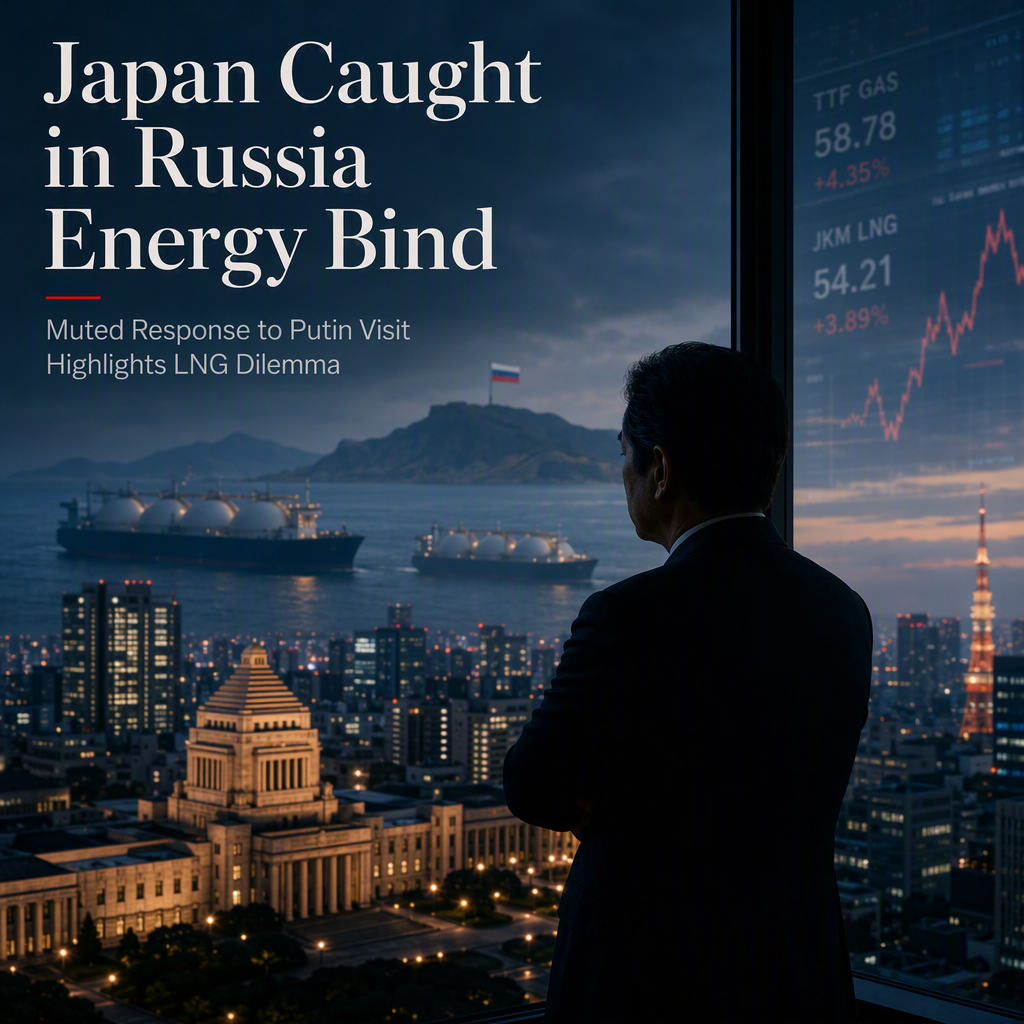
In the month following Russian President Vladimir Putin's visit to a disputed northwestern Pacific island, Japan has refrained from taking any concrete countermeasures, highlighting the country's complex relationship with Russia as a key energy supplier [1]. Japanese Prime Minister Sanae Takaichi formally objected to Putin's visit but has not escalated the response, reflecting Tokyo's reluctance to adopt a hard-line stance against Moscow during a period of heightened global energy market volatility due to the ongoing Iran war [1].
Japan's heavy reliance on liquefied natural gas (LNG) imports, with Russia as a significant supplier, has placed the government in a difficult position. Policymakers are concerned that any strong action against Russia could disrupt LNG supplies, threatening Japan's energy security and market stability [1]. Financial and market analysts attribute Japan's muted response to fears of rising energy costs and potential supply shortages, especially as the conflict in the Middle East continues to affect LNG and oil markets globally [1].
A senior analyst at a Japanese trading house stated, "Japan cannot afford to jeopardize its LNG contracts with Russia at this time," emphasizing that energy diversification options are currently limited and expensive due to the Iran war's impact on the market [1]. This situation has forced Japanese policymakers to balance national security, diplomatic principles, and economic interests, with no clear indication of when or if a more assertive stance toward Russia will be taken [1].
CONCLUSION
Japan's cautious approach following Putin's disputed-island visit underscores the country's dependence on Russian LNG and the broader volatility in global energy markets. The lack of concrete countermeasures reflects concerns over energy security and economic stability, leaving future diplomatic actions uncertain.