
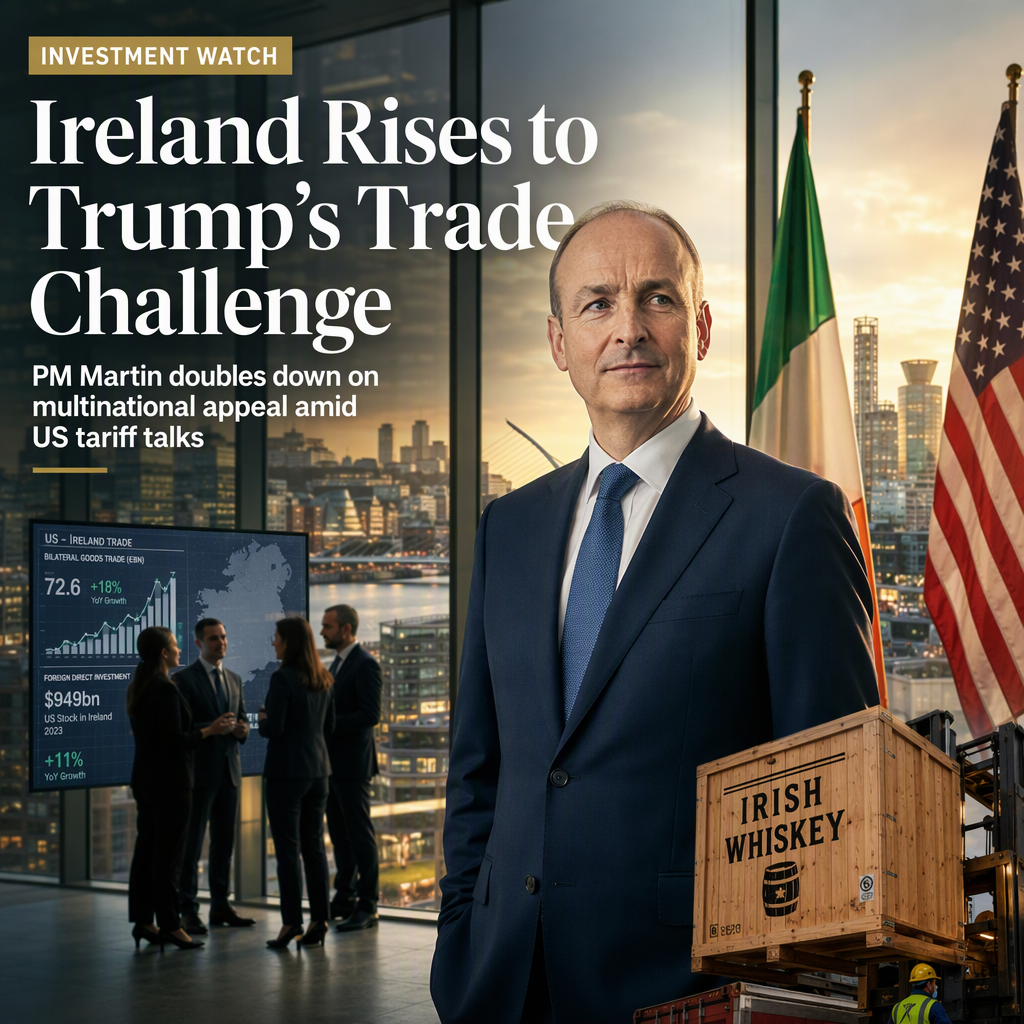
President Donald Trump has intensified efforts to encourage U.S. multinationals to expand investment domestically, making this a central pillar of his America First economic agenda through tariffs and other trade measures aimed at promoting domestic manufacturing and investment [1]. Irish Prime Minister Micheál Martin, who has met Trump several times this year, acknowledged that Trump's investment agenda is already having an impact, stating, "He's certainly had success... in terms of the investments that those companies are now making in the U.S." [1].
Despite the challenge posed by Trump's policies, Martin views them as a catalyst for Ireland to strengthen its appeal to multinational companies. He emphasized that Ireland is responding by becoming more competitive, noting, "Competition is a good thing, and he puts down challenges, and we respond and make ourselves fitter and more nimble and agile and that's the agenda" [1]. Martin also highlighted ongoing trade negotiations, including Trump's commitment to lift tariffs on Irish whiskey, and indicated that Ireland is already eyeing another iconic Irish export for potential tariff relief [1].
Martin argued that Ireland's attractiveness for investment extends beyond its corporate tax policy, citing strengths in pharmaceuticals, medical devices, technology, a highly educated workforce, and a pro-enterprise government approach. He described Ireland as "less bureaucratic" and focused on solving challenges for incoming companies, with agencies such as IDA Ireland and Enterprise Ireland playing key roles in attracting overseas investment [1].
The market implications center on Ireland's efforts to maintain and grow inward investment from U.S. multinationals despite Trump's push for domestic expansion. The ongoing trade negotiations, particularly regarding Irish whiskey tariffs, could further impact Ireland's export sector and multinational investment climate [1].
CONCLUSION
Ireland is adapting to President Trump's investment agenda by enhancing its competitiveness and pro-enterprise environment, aiming to remain a leading European hub for U.S. multinationals. Ongoing trade negotiations, including potential tariff relief for Irish exports, may influence future investment flows and market dynamics. The overall sentiment is cautiously optimistic as Ireland positions itself to respond to new challenges.