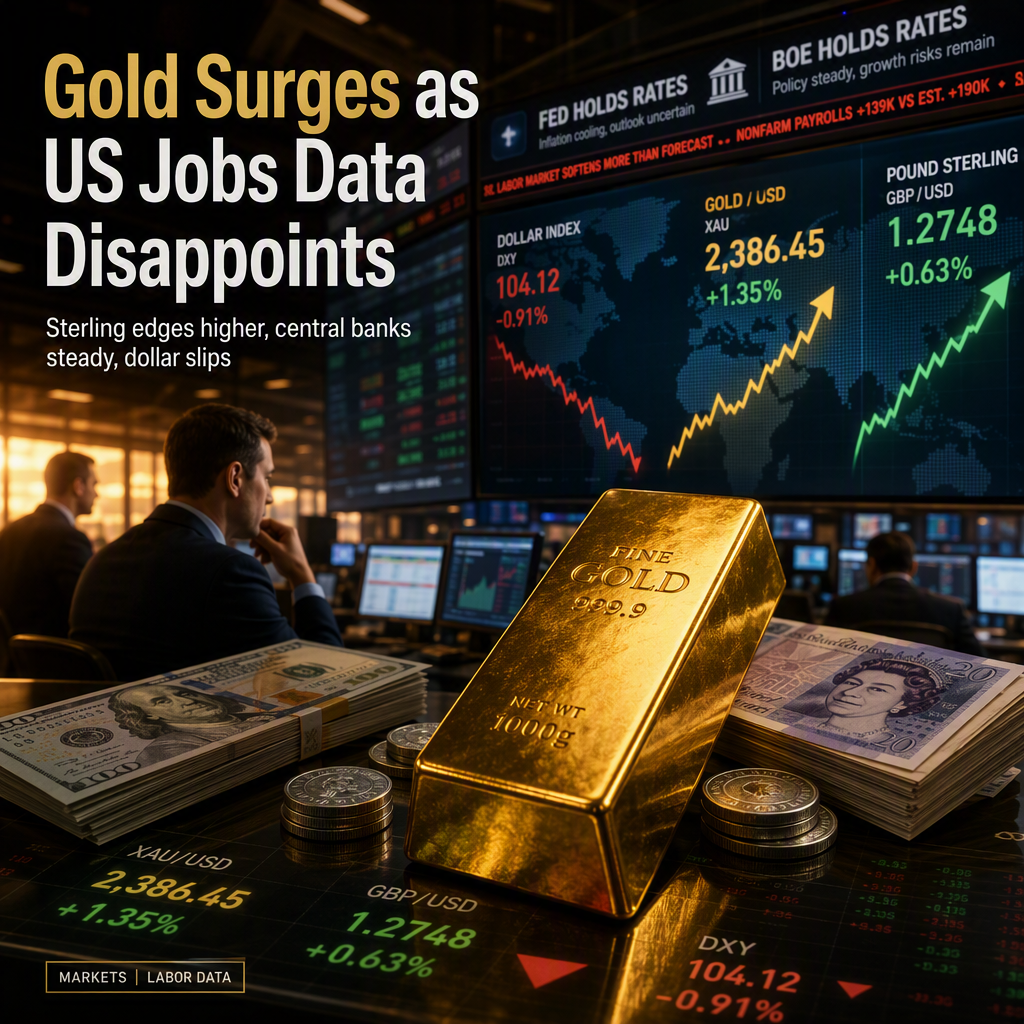
The core event across both articles is the release of softer-than-expected US labor market data, which triggered notable moves in currency and commodity markets. ADP private payrolls for July printed at 44K, significantly below the 70K consensus and a sharp drop from June's 98K, while the ISM Services PMI headline index came in at 54.1 versus expectations of 54.5. The employment sub-index fell to 47.4 from 51.2, indicating outright contraction and confirming a broad hiring slowdown in the US economy [1][2].
This labor miss led to a decline in the US Dollar Index (DXY), which eased by around 0.16% and traded near 99.70, remaining in a narrow range for the past four days [2]. The Pound Sterling benefited modestly, rising a tenth of a percent and trading near 1.3450, with forty-eight hours of trading adding little beyond Monday's gains. The Sterling's movement was largely attributed to US Dollar weakness rather than domestic UK factors, as Britain is on recess and no British data was responsible for the price action [1].
Gold surged more than 4% to trade near $4,247 per troy ounce, and Silver rallied almost 5% toward $62.20, making metals the biggest earners of the day. The rally was driven by the disappointing US labor data and a general risk-off sentiment [2]. Currency heat maps show the US Dollar was weakest against the New Zealand Dollar and lost 0.08% against the Pound Sterling [2].
On the central bank front, both the Federal Reserve and Bank of England held rates steady within twenty-four hours of each other. The Fed maintained its target at 3.50%-3.75% with three policymakers dissenting for a quarter-point increase, while the Bank of England held at 3.75% with three members voting for 4.00%, up from two in June. The British Monetary Policy Committee appeared more hawkish on paper, but Sterling did not react meaningfully, as rate differentials were not the primary driver of the exchange rate [1].
Forward-looking statements from the UK suggest that the case for further tightening depends on energy prices, with June headline CPI at 2.6% versus a 2.7% consensus and services inflation down to 3.6%. Market pricing for 2026 has shifted from expecting two British rate cuts to debating potential increases, reflecting uncertainty about future policy moves [1].
CONCLUSION
Disappointing US labor data triggered a sharp rally in gold and modest gains for the Pound Sterling, with the US Dollar weakening across most major currencies. Despite hawkish signals from the Bank of England, Sterling's movement was driven by US factors rather than domestic developments. The market remains focused on US economic releases and central bank policy signals, with metals outperforming amid risk-off sentiment.