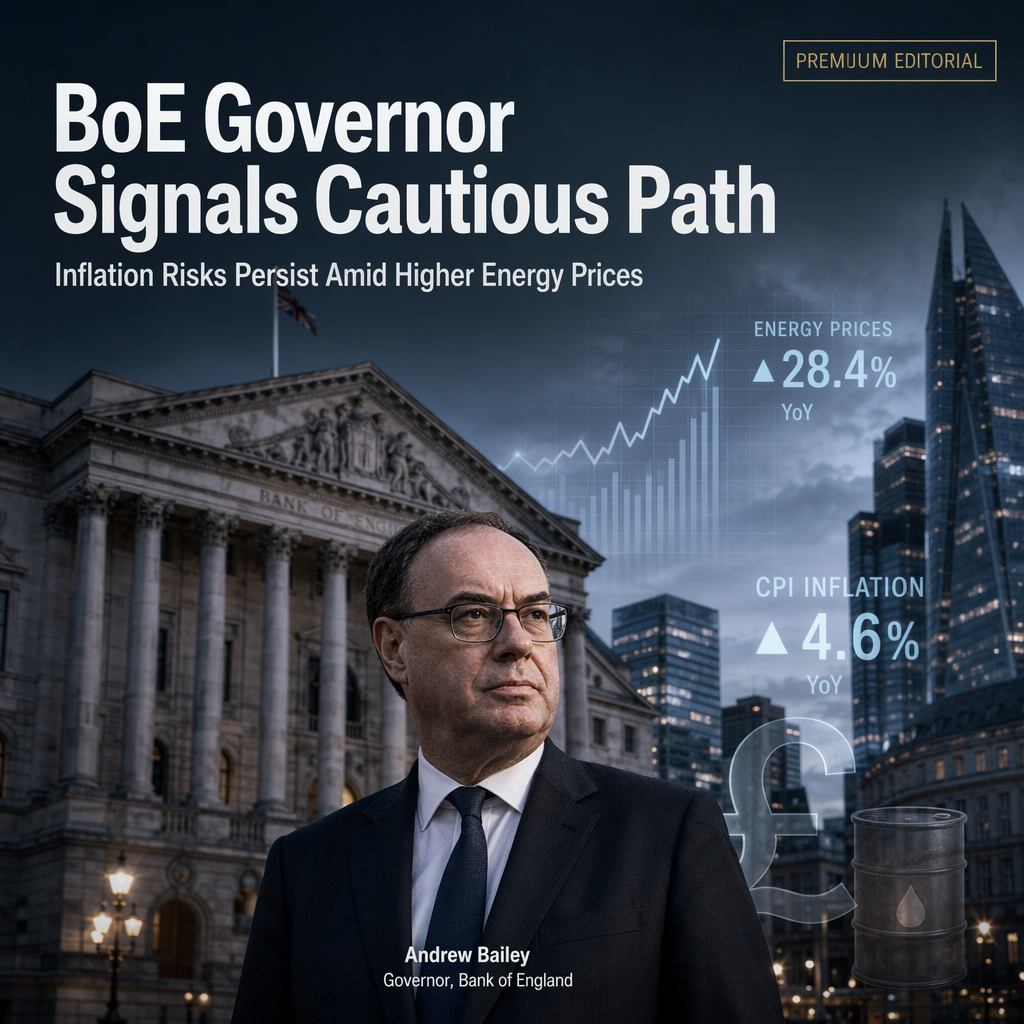
Bank of England (BoE) Governor Andrew Bailey, in comments to CNBC, stated that policymakers have time to assess how higher energy prices may impact the United Kingdom (UK) economy, emphasizing a measured approach to potential future interest rate decisions [1]. Bailey highlighted that UK inflation could still rise to 3.2% later this year, attributing some of the inflationary pressures to the effects of the Iran war, which he said delayed the UK reaching its inflation target from April or May 2026 [1].
Bailey noted that financial conditions have already tightened, which provides the BoE with the flexibility to evaluate the pass-through of higher energy prices before deciding on any further adjustments to the Bank Rate [1]. He also pointed out that energy prices are currently not much higher than before the Iran war, suggesting that while inflation risks persist, the immediate pressure for additional rate hikes may be limited [1].
The BoE Governor’s remarks received a 7.2/10 FXS Speechtracker score, above the historic 4.7/10 baseline, indicating a more hawkish tone than usual, though tempered by his emphasis on patience and data dependency [1]. Bailey’s comments imply that the central bank is likely to remain cautious, monitoring inflation and energy market developments closely before making any policy moves [1].
No specific market reactions or analyst opinions were cited in the article, but Bailey’s statements suggest that the British pound (GBP) could remain sensitive to incoming inflation and energy price data [1].
CONCLUSION
BoE Governor Bailey’s comments reflect a cautious but vigilant stance, balancing inflation risks from higher energy prices with the need for patience in monetary policy. The central bank appears in no rush to raise rates, preferring to assess further data before acting. Markets are likely to remain attentive to UK inflation and energy price developments in the coming months.